

INSIDE NEWTON
If you’ve taken a stroll through Newton’s Webster Woods or Houghton Garden over the past few years, you might have noticed subtle signs of technology encroaching on the landscape: strange equipment attached to tree trunks, wires and tubing snaking through the underbrush.
This high-tech gear is part of the staging for cutting-edge forest ecology research conducted by Boston University scientists. Armed with a $634,000 grant from the U.S. Department of Agriculture, a team of BU professors, graduate students, undergraduates, and technicians has turned our local woods into a living laboratory.
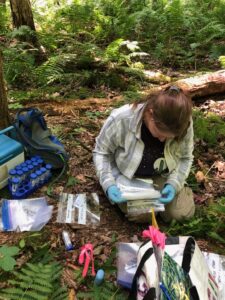
Collecting soil samples for analysis back in the lab. Photo by Corinne Vietorisz.
What’s the aim of this elaborate research undertaking? The answer lies in the air we breathe and the water we drink.
The university’s eight-year-long “Urban New England” project is monitoring air pollution, air temperature, soil temperature and moisture, and several measures of forest health at a time of ongoing development and environmental challenges.
By studying a strip of land stretching from the busy Hammond Pond Parkway to the forest interior, researchers are uncovering how roads and human activities influence the health of trees and soils and their ability to clean our air and water. Webster Woods serves as a crucial puzzle piece in a much larger network of study sites, stretching from Boston to central Massachusetts.
“Our goal is to understand how trees can provide a cleaner and healthier urban environment,” explains BU Professor Pamela Templer.
What they are finding right here in Newton might surprise you.
City trees: Fast-growing pollution fighters
Counterintuitively, this project has shown that trees grow faster in cities and suburbs like Newton—especially at forest edges along busy roads—than in rural areas, despite heavier air pollution in cities from burning fossil fuels.
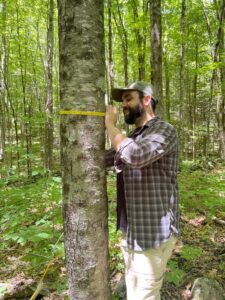
Measuring the circumference of a tree to determine growth rates. Photo by Corinne Vietorisz.
Much of the air pollution comes from higher vehicle traffic along city roads, such as Hammond Pond Parkway. The higher growth rate of trees is due to the extra nitrogen contained in air pollution and the higher light levels on forest edges.
These fast-growing trees act as environmental filters. Their roots and leaves scrub pollutants from the air and soil, absorb climate-warming carbon dioxide, and prevent some contaminated runoff from reaching our water supplies.
BU graduate student Emma Daily is documenting this in Webster Woods by examining living leaves.
“There are often so many air-pollution particles on leaves that we think the leaves might have a reduced ability to photosynthesize,” she reports. Yet, despite this heavy coating of pollution, these trees in Webster Woods still have high growth rates.
The hidden workforce beneath our feet
Meanwhile, BU graduate student Corinne Vietorisz is extracting DNA from soil samples, revealing a staggeringly diverse and productive microscopic world: roughly 8,000 species of fungi and 20,000 species of bacteria at the study sites.
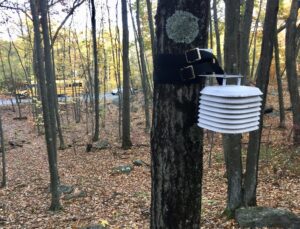
Air temperature monitor on a tree. Photo by Richard Primack.
These microbes break down dead leaves and recycle essential nutrients back into the soil. Certain fungi are surprisingly good predictors of soil nutrient availability—even better predictors than the plant community or soil structure.
“Microbes are the unseen workforce maintaining soil fertility and supporting forest growth,” explains Vietorisz. “Identifying these microbial groups helps us predict how forests will respond to environmental changes like climate warming and urbanization.”
Near the forest edge, there is a noticeable decline in beneficial, root-dwelling fungi, likely due to the drier conditions and human disturbance. In the same forest edge zones, there is also an increase in parasitic and disease-causing fungi and bacteria that can harm trees, animals, and people.
This federally funded BU project underscores the essential need to preserve forests, like Webster Woods. They are complex ecosystems filtering our air pollution, protecting our water supply, and providing other vital services we are still learning about.
Richard B. Primack is a lifelong resident of Newton and plant ecology professor at Boston University. He can be reached at: primack@bu.edu.
Share This Story On:
DONATE TO SUPPORT LOCAL NEWS
Your tax-deductible gift to the Newton Beacon keeps our community connected and its residents informed.
Get story alerts twice a week:
Related Posts









Upcoming Events