
MOVING AROUND
Efforts are underway to reimagine Newton Corner and replace its dreaded “Circle of Death” rotary.
If done right, these efforts will look back at the attributes of the village of the past to build a vibrant Newton Corner of the future. Just as the redesign of Boston’s Central Artery led to the Rose Kennedy Greenway, we can envision a Newton Corner that becomes an attractive destination rather than a frustrating and unsafe pass-through on a highway interchange ramp.
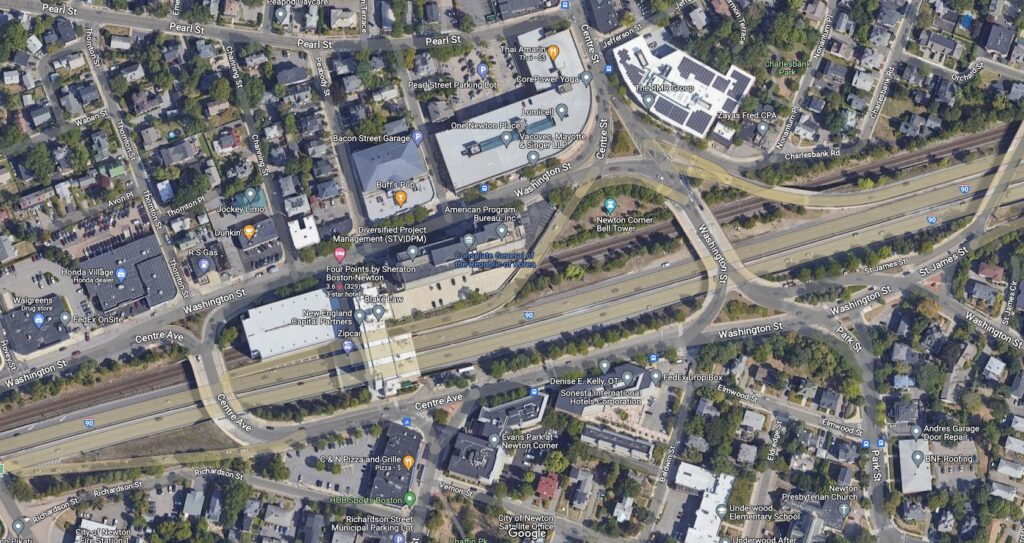
Aerial view of Newton Corner today.
Everybody knows the story. By the mid-1900s, Boston and its surrounding area had fallen into economic decline. The mills and industries and harbor had stagnated, and people were moving out of the city and into the more distant suburbs. To reverse these trends, planners initiated major highway projects.
The Mass Pike opened for traffic in 1957, extending 123 miles from the New York state border to the recently completed Route 128 in Weston. People soon realized the local routes from there into Boston were becoming choked with traffic. Plans were drawn up to extend the turnpike another 12 miles into Boston.
Citizens of Newton were furious. The new turnpike extension was to follow the route of the Boston & Albany railroad. The railroad, which had led to the growth of the villages of Newton Corner, Newtonville, West Newton and Auburndale, was about to become the source of their destruction.
Perhaps the most severely affected village was Newton Corner, where a highway interchange was built. The village was split in two, losing more than a third of its businesses. The railroad station was closed and demolished, and the railroad was reduced from four tracks to two.

A map of Newton Corner, pre-turnpike.
The street pattern was severely disrupted, as the main north-south route of Centre Street was severed, a rotary with multiple weaving traffic patterns was built, and local streets became one-way to funnel traffic into highway off and on-ramps. By 1969, electric streetcar service through Newton Corner to Boston was also terminated and the “auto age” was fully in place.
As the decades passed, increased amounts of traffic used the turnpike interchange. Newton Corner’s rotary gained the moniker “Circle of Death” not so much for the actual number of collisions leading to fatalities but for the perception many people held about the dangers of merging, weaving, turning, accelerating and decelerating vehicles.
The interchange became a pedestrian and bicycle wasteland, as many avoided it. The economy and vitality once enjoyed by the village withered. Perhaps the only saving grace was the “express bus” service that took people in and out of downtown Boston.
Months turned to years, years to decades, and decades to generations. Fast forward 60 years and now finally, state highway officials have a new set of priorities for this interchange.
Rather than just moving increasing numbers of cars and continuing to expand the highways, community-centered goals have emerged: improve access, safety and mobility; reconnect Newton’s neighborhoods; enhance quality of life; promote sustainable transportation solutions; and, develop actionable recommendations.
Finally, there is hope for change in Newton Corner that is more aligned with the quality of life of its residents and the economic vitality of the village center.
Under a capable and forward-thinking project leadership team, Mass DOT has assembled a task force of highway officials, transportation consultants, MBTA representation, municipal personnel from Newton and Watertown, and community stakeholders to make positive changes at Newton Corner that many have anticipated for years. From this process, there are currently six options for redesign that have emerged.
Many of these options propose reconnecting Centre Street, making it safer and easier for everyone to travel north and south. All the options propose improved safety for pedestrians and bicyclists, creating fewer friction points with auto drivers and improving the quality of experience on foot or on a bike.
Most of the options propose recreating a Newton Corner railroad station on the Worcester to South Station line. Each of the options propose new bidirectional traffic patterns on local roadways, eliminating the need to travel in a rotary to get from one place to another.
And some of the proposals call for moving the westbound ramp to the turnpike out of the Centre Street intersection to a point further west, reducing the potential for conflicting movements between local traffic and highway-bound traffic. Additional turnpike decking with expanded green space is now being considered. So is better access to the nearby Charles River.
What will likely emerge from this process?
Hopefully the best design features from each of the alternatives will be merged together to create the most favorable possible scenario. Alternative #3 includes many positive changes: a new Centre Street bridge, a restored MBTA station, improved access to the Charles River, a relocated westbound on-ramp to the Turnpike, bidirectional traffic on Washington Street, and improved pedestrian, bicycle and bus transit.
https://www.mass.gov/doc/newton-corner-draft-alternatives-for-discussion/download
Options for further decking of the turnpike to implement green space and new modest-scale development can be added to help restore the connections in Newton Corner.
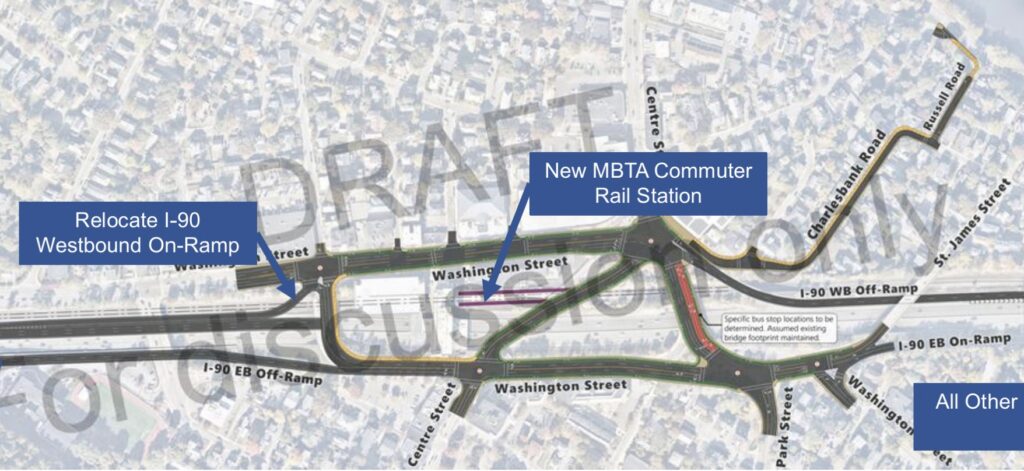
A view of “Alternative #3” for Newton Corner redesign.
There are still challenges in getting to the best solution. One of the alternatives doesn’t do enough and maintains the “Circle of Death.” Some alternatives call for widened and longer highway ramps that would only serve to dump more traffic onto local streets. There is a concern that stakeholders will be asked to support an alternative that has a couple of good features but also several bad features, rather than merging the good features into an even better option.
Hopefully, the task force will stick to its primary goals: reconnecting the village, boosting mobility for everyone, and not just cars, along with improved safety, sustainable transportation, and quality of life. That will provide the best opportunity for a positive outcome.
Dr. Srdjan S. Nedeljkovic, a resident of Newton Highlands, serves on the Newton Transportation Advisory Group.
Share This Story On:
DONATE TO SUPPORT LOCAL NEWS
Your tax-deductible gift to the Newton Beacon keeps our community connected and its residents informed.
Get story alerts twice a week:
Related Posts




Upcoming Events