

INSIDE NEWTON
Newton has been bursting into color the past few weeks as plants come into flower. Cherry and magnolia trees are covered in pink flowers, and forsythia shrubs have turned bright yellow. Pear trees are coming alive with masses of white flowers.
How do these plants know it’s spring? It may seem mysterious, but plants rely on three key cues to flower and leaf out.
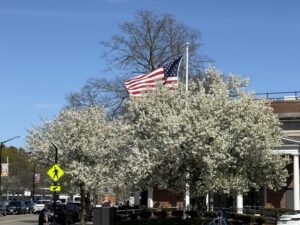
Flowering pear trees in Newton Centre. Photo by Richard Primack.
The first is winter chilling. New England plants have to go through several cold months before they are ready to respond to warmer weather. This prevents them from flowering and leafing out too early, which would risk having new buds, leaves and flowers killed by frost. Historically, the region’s long winters have provided plenty of cold weather to ready plants for spring.
The second and most important cue in New England is warm spring weather. Different plants need different amounts of warming, which is why Norway maple trees flower and leaf early, while oak and black locust trees flower and leaf later.
The third cue is day length or, more accurately, night length. Shorter nights and longer days can allow plants to double check the signals they get from winter chilling and spring warming. Beech trees and a few others rely on changes in the length of nights and days, but for most New England plants it’s only a minor factor.
Climate change
Climate change—that is, warming temperatures and changing patterns of precipitation—is disrupting the predictable patterns of spring. These effects are particularly evident here, as southern New England is warming about twice as rapidly as the rest of the country.
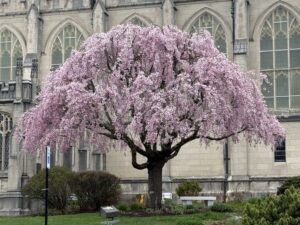
Weeping cherry tree near church. Photo by Richard Primack.
Research studies at the Arnold Arboretum in Boston and in nearby Concord have demonstrated that our region’s plants are now flowering and leafing out about 10 days to two weeks earlier than they did 170 years ago.
We know this because we can compare the current flowering and leafing of common wildflowers, such as marsh marigolds and violets, and trees, such as red maples and black birch, with museum specimens held at the Arnold Arboretum and with observations from Concord made in the 1850s by the environmental philosopher Henry David Thoreau. For example, Thoreau recorded the pink lady’s slipper orchid as first flowering in late May in Concord, while in recent years this species now starts to flower two weeks earlier in mid-May.
It’s clear that temperature is driving this earlier arrival of spring in New England. Flowering and leafing out happens earlier during warmer springs and later during colder springs, and springs are now much warmer than they used to be.
Consequences of a warmer climate
Warmer springs may sound appealing to Newton residents at the end of long cold winters. But earlier springs bring risks for plants.
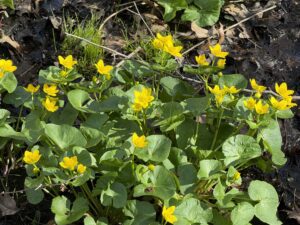
Marsh marigold plants along a stream in the Webster Woods. Photo by Richard Primack.
After a period of warmer weather in March or early April, plants might respond by taking in water and swelling buds. Young flowers and leaves might emerge. But with a late frost, which is still common, young moist tissues can freeze and die.
For fruit trees, such as apples, peaches and plums, frozen flowers can reduce the fruit that we would otherwise enjoy later in the summer. For ornamental plants, like cherries and crabapples, there may be fewer brilliant displays of flowers.
Adapting to change
A warming climate also means that many plant species sensitive to cold—among them, camellias, fig trees and southern magnolias—may now grow here more reliably or for the first time.
We may have to experiment with these species, as warming and the arrival of new insects and diseases reduce the health of local species, like hemlocks, ash trees and beeches.
Like it or not, Newton’s climate is changing and our plants are changing with it.
Richard B. Primack is a lifelong resident of Newton and plant ecology professor at Boston University. He can be reached at: primack@bu.edu.
Share This Story On:

DONATE TO SUPPORT LOCAL NEWS
Your tax-deductible gift to the Newton Beacon keeps our community connected and its residents informed.
Get story alerts twice a week:
Related Posts









Upcoming Events