

THE JOURNEY
There are few places on earth so remote that time has little meaning. Tufi, in Papua New Guinea, is one of them.
In 2006, from our Newton home, my wife Becky and I planned a five-week trip to New Zealand and Australia. Amazing as they both were, I yearned to tack a little more excitement onto the itinerary. Looking at a map, Papua New Guinea certainly qualified and seemed reasonably close.
Searching the “world-wide web,” then still relatively new, I came across Tufi Dive Resort, on the opposite side of the country from Port Moresby, the capital. Its remoteness, and its mission of sustainable ecotourism, were intriguing. With no roads, the only practical way to get there was by small plane. The thought terrified Becky. But she was game for a new cultural adventure. Looking back, it was one of our most unforgettable ones.

The view from Tufi Dive Resort. Photo: Andris Vizulis
Fast forward to January 2026, last month. It was 10 months after Becky’s passing and 20 years since our last visit. I had brought my daughter Arjana and husband Ivan to Papua New Guinea to experience the place we’d always talked about.
As the sun came up over the Owen Stanley Range, we boarded a vintage de Havilland Twin Otter prop plane at the TropicAir shed next to Port Moresby Airport. It could easily have been the same plane Becky and I boarded back in 2006.
So far it was all the same. Port Moresby still rated as one of the most dangerous places on earth. Our hotel had been locked down with walls and barbed wired, and guards controlled entry from the connected mall and food court. Foreigners like us were still dissuaded from going into the city because of rampant crime, poverty and unemployment.
In my memory, the peacefulness of Tufi had stood in stark contrast. Hopefully that hadn’t changed.
The Aussie pilot, with his laid-back ’60s vibe, launched us into the air. Arjana’s forced smile made me feel like Becky was still with us. Minutes later, the Twin Otter banked to the right to avoid 13,000-foot mountain peaks and their unpredictable weather.
Within an hour, in the rain, we touched down gently onto Tufi’s grass landing strip. Nothing much seemed to have changed here either, except for more subdued villagers who stayed well back from the runway this time.
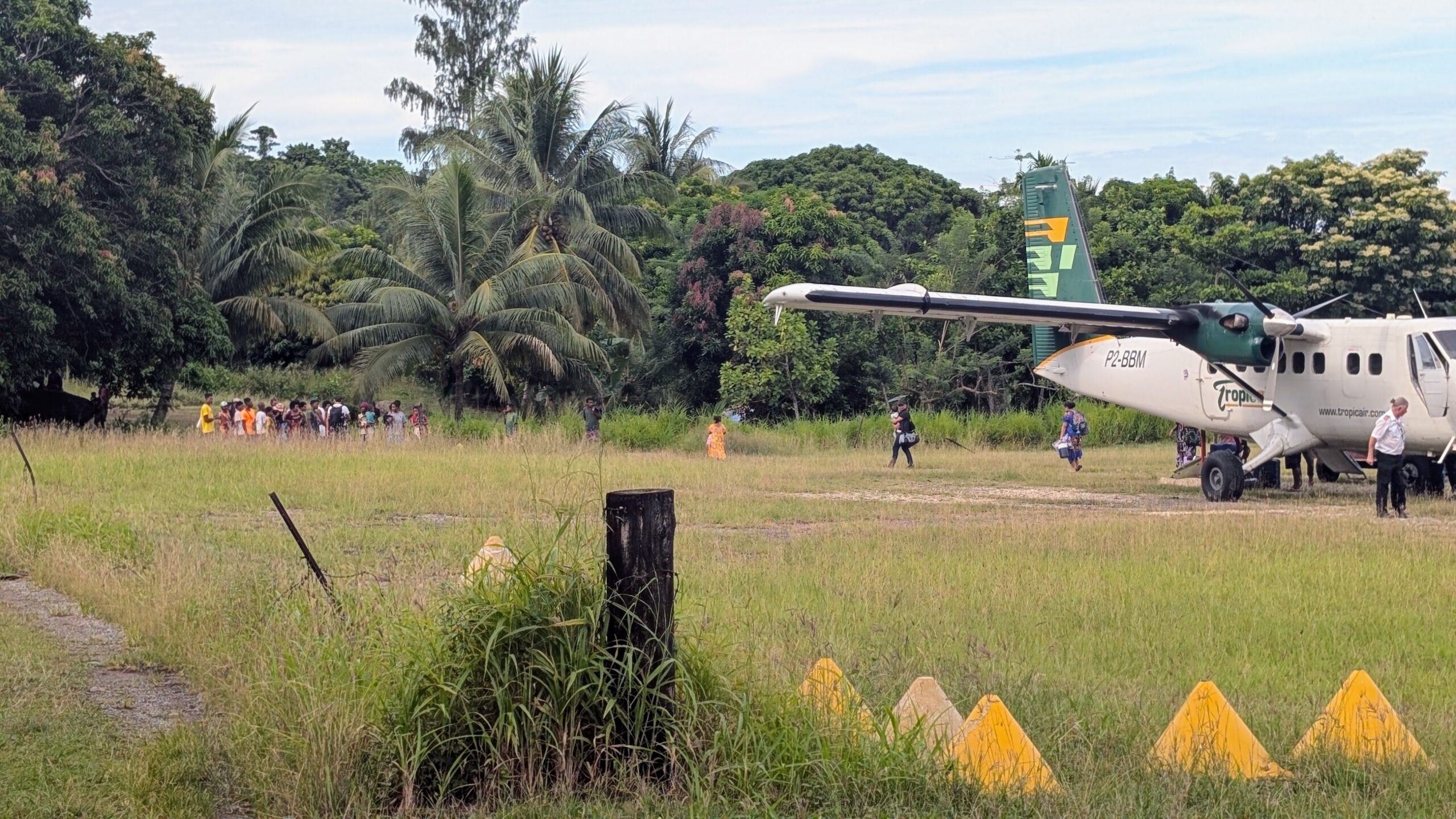
Arriving in Tufi, Papua New Guinea. Photo: Andris Vizulis
Becky and I had walked a few minutes to the resort. This time, Arjana, Ivan and I were bundled into an old Land Cruiser. Our luggage followed on a cart hauled by an equally old front-end loader.
The main center of the resort felt like I’d never left. The wide, exposed outer porch with its rattan furniture was ready for the daily swapping of stories, over gin and tonics, with divers from all over the world. The small viewing deck had been converted to a spacious breakfast area. But it still revealed a breathtaking panorama, from the open sea to the tiny harbor a few hundred feet down the cliff below. Straight ahead, a majestic jungle-lined fjord showcased ancient 4,000-foot volcanoes.
Time was brought to an emotional standstill when I saw Evie. A dive instructor back then, she was now managing the dining room. We had stayed in contact for many years because of Becky. On hearing of her death, Evie tearfully shared that the 2007 calendar and deck of cards Becky had sent her were prized possessions. I again felt Becky’s presence.
Our rooms were just above the one Becky and I had stayed in, bringing a flood of memories. Besides a view of the open sea, the back porch overlooked the dirt road coming up from the harbor and its flow of villagers bringing goods to market. I remembered Becky talking and laughing with kids coming to school by sailau (hand-hewn canoes with outriggers), carrying coconuts instead of flasks for their lunch drinks. The villagers sold handicrafts to tourists then, and they still do.
I wondered how much village life had changed in these last two decades. Had technology had a huge effect, like it had on us? After a cultural tour and an overnight stay, it was clear to me that it had not.
Because of its extreme remoteness, life in Tufi is still all about self-sufficiency and sustainability.

Kids paddle a dugout canoe in Papua New Guinea. Photo: Andris Vizulis
Rubbing wood together to start fires is still a foolproof method and a necessary skill. Palm leaves folded over long sticks make durable roofing shingles. The inner bark of the paper mulberry tree is pounded into tapa cloth for myriad uses, including purses and bags for tourists. Pigs and chickens are raised for local consumption. Modern technology offers few advantages. And without the technology, volleyball becomes the evening’s entertainment rather than doom scrolling on social media.
Although our phones had reasonable service at the resort, we saw no phones in use at the local market, in the villages or by roadside souvenir vendors.
Tufi’s dense jungles, hills and valleys, and the area’s non-monetary subsistence economy make cell towers impractical. Starlink satellites may change that some day, but at what cost to the sustainability and social fabric of its tightly knit villages?
Until that time comes, Tufi’s time machine is sure to remain on perennial pause.
Andris Vizulis is a Newton neighbor, indefatigable traveler and technology futurist. He can be reached at avizulis@gmail.com. For a deeper dive into Tufi Dive Resort, including an interview with its manager, visit Andris’ Substack at mumblingoldman.substack.com.
Share This Story On:
BEACON SPONSOR

DONATE TO SUPPORT LOCAL NEWS
Your tax-deductible gift to the Newton Beacon keeps our community connected and its residents informed.
Get story alerts twice a week:
Related Posts










Upcoming Events