

TASTE OF NEWTON
Before the ground thaws at Newton Community Farm, the growing season begins in a heated greenhouse.
There the staff sprinkles seeds into dirt-lined slot trays that can start 600 plants at once. Handwritten labels on popsicle sticks identify each type of plant: Jedi hot peppers, Brandywine tomatoes, Zephyr summer squash and scores of other varieties.
“Opening day for us is when we’re putting in the seeds in the greenhouse,” said farm director Greg Maslowe, who is starting his 20th season at the farm.
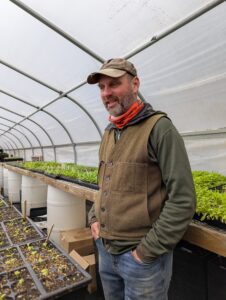
Farm director Greg Maslowe. Photo by Clara Silverstein.
About 30,000 plants were ready for the annual seedling sale, this year held May 16 and 17. The farm keeps the rest of the vegetables, herbs and flowers to grow in its fields and to distribute around Newton.
Maslowe, who often goes by the name “Farmer Greg,” surveyed the fields on a cold, rainy spring morning, pointing out the high tunnels—unheated metal structures covered with plastic to protect plants—where arugula and peas are starting. Leeks and onions poke out from straw like green stubble. The next week, he and his crew planned to plant 30 vegetable beds.
“The fields are full by the third week in May,” said Maslowe. “Then it’s a Tetris game of where to put in new crops.”
Squeezed into one and a half acres near the intersection of Nahanton and Winchester streets, Newton Community Farm is the city’s last working farm. Since 2006, the nonprofit farm has operated through a license agreement with the City of Newton, which owns the land but does not pay for maintenance, staffing or farm programs.
Though areas nearby are being developed, the farm is a holdout, linking modern life to a time when small-scale farming was commonplace in Newton. The English settlers who came to Newton in the 1600s began cultivating this area. The Angino family ran a farm on this spot for much of the 20th century.
The work that now takes place at Newton Community Farm—planting, weeding, harvesting, and gathering eggs from a flock of about 25 hens—may seem self-contained, but the farm makes connecting with the community part of its mission. Visitors of all ages are invited to attend educational programs, some of which take place in a historic barn renovated in 2010.
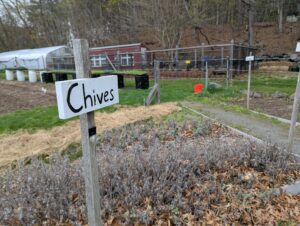
Chives planted at Newton Community Farm. Photo by Clara Silverstein.
The farm sells its produce through CSA (community-supported agriculture) shares, the onsite farm stand, and the Saturday Farmers’ Market at Newton North High School. About 10 percent of the farm’s estimated 50,000 pounds of produce harvested in a typical season is donated to local food pantries.
Newton Highlands resident Susan Tornheim has been a CSA member and volunteer at the farm since it opened.
“My husband and I helped strip wallpaper in the farmhouse,” she remembered.
For many years, Tornheim edited the farm’s newsletter and is now its proofreader. From her perspective, the farm adds to the Newton landscape. “I love going by and seeing what’s growing,” she said. “It’s a mood booster just to look at the farm. And the amount of produce that Greg is able to grow and make available to the community is amazing.”
Maslowe has seen traffic steadily increase over the 20 years that he and his family have occupied the onsite farmhouse. He said he is glad that the farm still offers “a small, visible oasis” to residents of the metropolitan area.
Plants from the farm grown using organic practices add greenery to other parts of Newton.
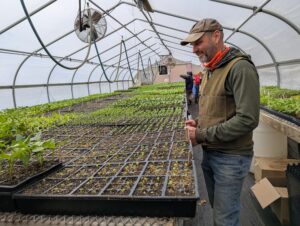
Maslowe in the farm’s greenhouse. Photo by Clara Silverstein.
“When you look at a community like Newton, the largest amount of available land for growing is in people’s yards,” said Maslowe. “The (seedling) sale is one of the most hopeful days. You see people with smiles on their faces, ready to go home and grow things. We have 30,000 plants going to the community that have not been sprayed with poisons.”
A summer high school internship program gives young people a chance to participate in farming. Maslowe said many of today’s teens spend time outdoors for sports but not much else.
“A soccer field can be very antiseptic,” he said. “Here they have a chance to experience getting dirty. It’s immersion in nature with prickly plants and bugs walking on you. There aren’t that many opportunities to do that anymore.”
Former interns often come back to visit and even volunteer. A few have gone on to careers in land management or environmental studies.
The farm celebrates its 20th anniversary June 11 with a Farm to Table Dinner to give supporters a taste of the food that grows there.
Maslowe, the founding farm manager, is being honored as he prepares to leave at the end of this season. Andrea Egan has already been named as his successor, and he is busy training her.
“The systems are in place for the farm to continue,” Maslowe said. “We’ve had an incredible 20-year run. We want it to go for another 20 plus years.”
Clara Silverstein is a cookbook author with extensive knowledge of Newton history. She can be reached at clara@clarasilverstein.com.
Share This Story On:
BEACON SPONSOR

DONATE TO SUPPORT LOCAL NEWS
Your tax-deductible gift to the Newton Beacon keeps our community connected and its residents informed.
Get story alerts twice a week:
Related Posts









Upcoming Events