
MOVING AROUND
A year after Washington Street was reconfigured in a $2.8 million “pilot” program, the changes have lowered roadway speeds, reduced collisions, boosted bicycle and pedestrian traffic, and created a more human-scale corridor.
But for some Newton residents, there’s a perception gap. Nearly half of those who responded to a survey said the old configuration should be restored. Many thought traffic safety and parking had worsened despite data to the contrary. More data will be needed to convince a skeptical public of the pilot’s benefits.
Here’s some background and history to bring folks up to date as they navigate the crosstown traffic:
Washington Street is an important regional roadway spanning Wellesley, Newton and Boston. Locally, it connects Newton Lower Falls, West Newton, Newtonville and Newton Corner, passing Newton-Wellesley Hospital, the West Newton Courthouse and Police Station, and the Jackson Homestead. It crosses the Charles River, Route 128, and the Massachusetts Turnpike twice. On its eastern end, it is currently the subject of a long-term effort to re-imagine the Newton Corner rotary.
For most of its length, Washington Street has had a four-lane auto lane cross-section. A study commissioned by the Boston Region Metropolitan Planning Organization in 2013 evaluated safety and mobility issues between Chestnut Street in West Newton and Church Street in Newton Corner.
Traffic volumes were highest toward Newton Corner. Surprisingly, the section between West Newton and Newtonville witnessed traffic volumes of only around 14,000 vehicles per day, no higher than those found on other principal roads, such as Beacon Street, Walnut Street and Centre Street. By contrast, each of these streets has only a two-travel lane auto cross-section.
In 2019, the City of Newton adopted the Washington Street Vision Plan. One of its goals was to promote multimodal transportation by reconfiguring segments of Washington Street to be safer and better functioning for all roadway users. How? By reducing auto lanes, introducing bicycle lanes, and shortening pedestrian crossing distances while adding green landscape.
In January 2024, several roadway redesign concepts were presented. The preferred option consisted of a roadway cross-section of two auto lanes, a center turning lane where needed, the preservation of most on-street parking, and a new two-way shared use path on the south side of the street, alongside the Mass Turnpike. Last summer, construction of the pilot was substantially completed at a cost of $2.8 million.
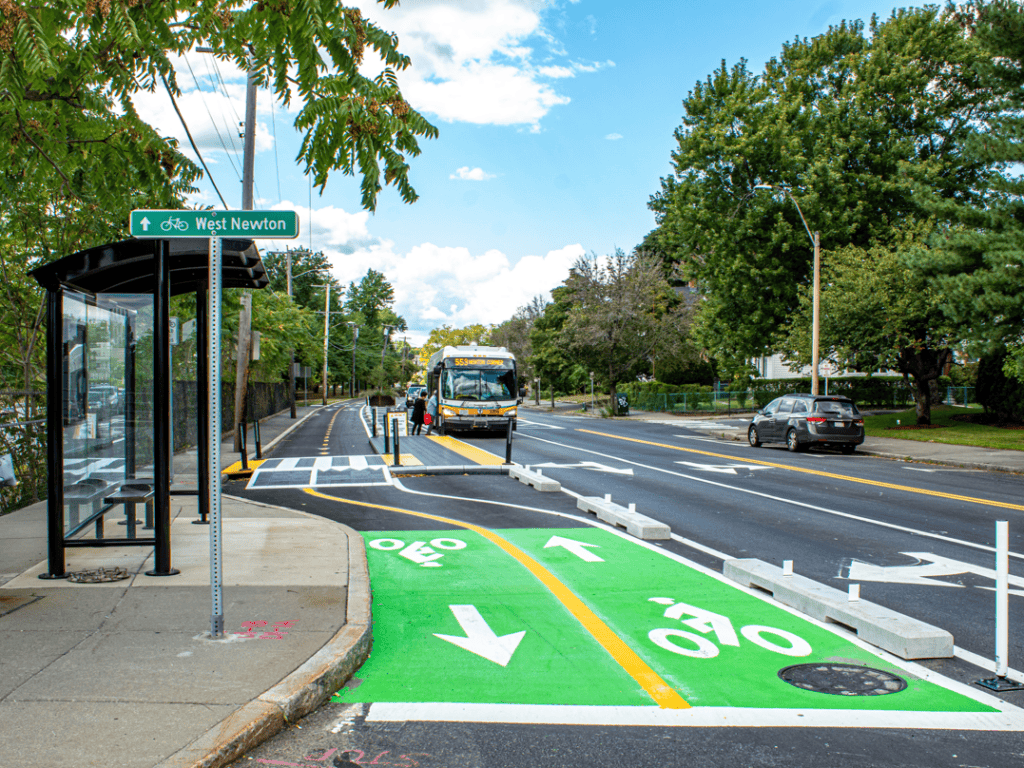
Washington Street pilot just west of Lowell Avenue.
So how would the success of the pilot be evaluated? The metrics included safety improvement from lowered roadway speeds, reduction in collisions, and lack of traffic diversion to adjacent streets. In addition, project success was to be judged by showing that a higher number of pedestrians and bicyclists were using the roadway. Issues such as parking utilization, travel time for motorists, and snow removal were also to be evaluated.
The first evaluation study was completed last fall. During that time, several major construction projects in the corridor were occurring, potentially affecting the predetermined metrics for project success. Despite the potentially negative effects of construction, the study showed improvement in all outcomes.
- Roadway speeds shifted from 30-35 mph to 25-30 mph.
- Collisions were reduced by half and were of lower severity.
- No substantial diversion occurred on adjacent roads.
- There was an increase in pedestrian and bicycle volumes.
- Parking utilization was at 61 percent, indicating many available spaces.
- Travel time did not increase by more than one minute over the 0.9-mile segment.
The technical aspects of the study were published in a 363-page memorandum. Traffic volumes on Washington Street decreased from around 14,874 to 12,039 trips per day, while traffic volumes on adjacent streets generally remained the same or decreased.
After the study was completed, Newton was subjected to two significant snowstorms last January and February. Snow clearance was well conducted in the corridor, including the shared use path.
By these objective metrics, the Washington Street pilot has been a success. In addition, many residents have observed that the corridor seems more pleasant, greener, more comfortable, and more human-scale.
However, in listening sessions held by newly elected Mayor Marc Laredo after taking office in January, community feedback has been mixed regarding landscape design elements, such as planters along parts of the corridor. Some constituents have stated they preferred the “old” roadway design, while others have advocated extending the new design toward Newton Corner.
A survey conducted by the Newtonville Area Council early this year had mixed results. The survey reported that of 861 respondents, with 58 percent coming from West Newton or Newtonville, 45 percent were in favor of restoring the old roadway, 31 percent were in favor of making the pilot permanent, and 24 percent were interested in modifying the pilot.
Some respondents believed that the pilot has worsened driving safety and had an adverse effect on parking. Some believed that bike safety and quality is worse, despite a dedicated path for bicyclists that provides separation from auto traffic.
The survey’s executive summary questions why there is such a perception gap. It also notes that the survey is not a scientific sampling and that results may be influenced by organized advocacy groups.
What does the future hold?
Most roadway projects in today’s world involve roadway expansion, new auto and turning lanes, and a focus on providing more space for cars. Yet even with more asphalt and bigger roads, traffic congestion seems to be worsening in many communities.
In Newton, we now have an opportunity to see what happens when a roadway is designed to be more human scaled, with a greater focus on pedestrians, bicyclists and greenery.
Similar projects done elsewhere suggest that increased safety, greater community vitality, and improved quality of life are likely outcomes. The traffic doesn’t seem to get worse in these situations. Often, it gets better or even “evaporates” as people become more accustomed to the new paradigm.
For the Washington Street pilot, additional data needs to be collected to evaluate the project in its second year and to see if the successes seen initially are being maintained.
Dr. Srdjan S. Nedeljkovic, a resident of Newton Highlands, serves on the Newton Transportation Advisory Group.
Share This Story On:
DONATE TO SUPPORT LOCAL NEWS
Your tax-deductible gift to the Newton Beacon keeps our community connected and its residents informed.
Get story alerts twice a week:
Related Posts



Upcoming Events