
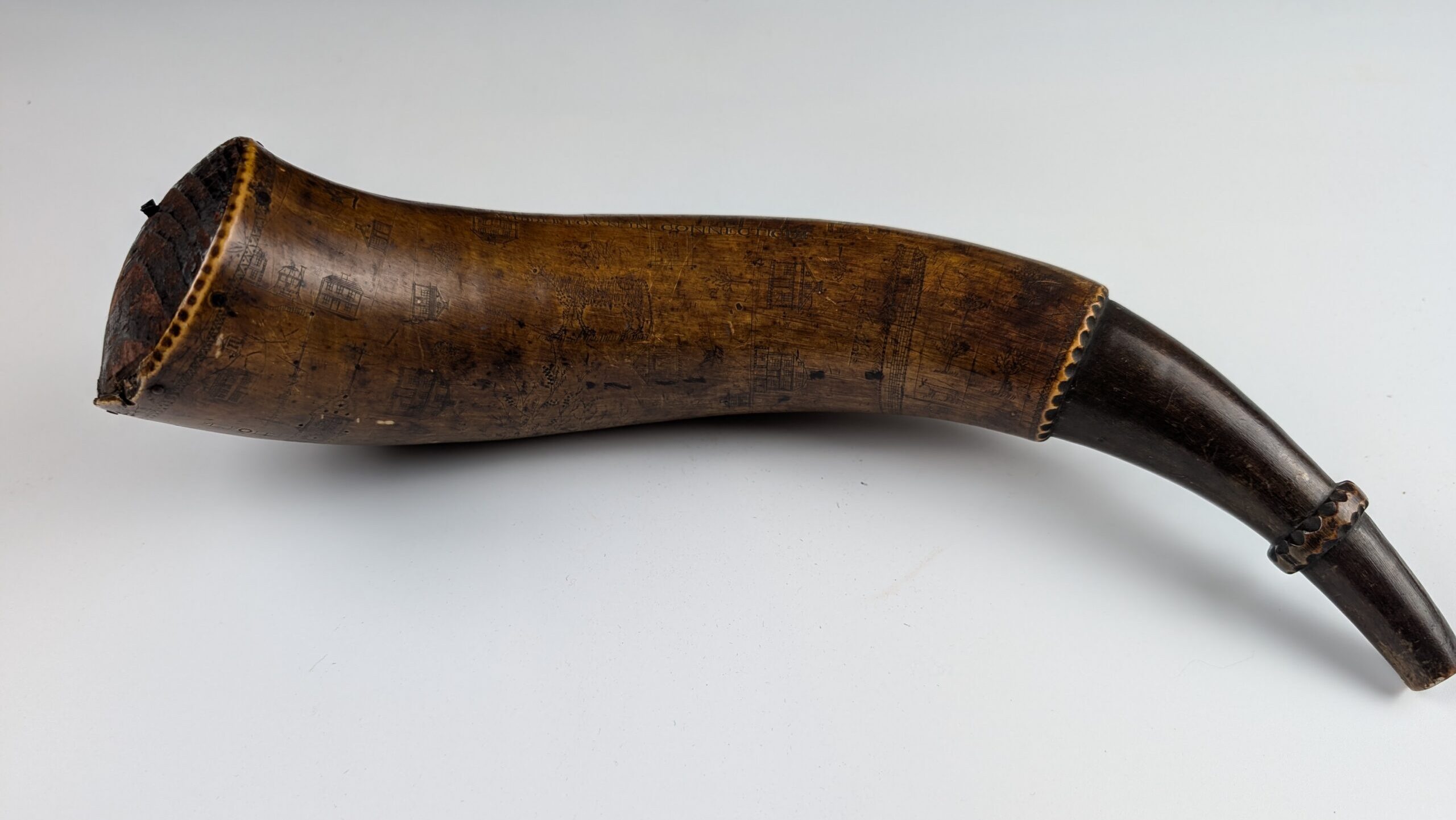
horn
Historic Newton's new exhibit contains documents and artifacts from Newton's storied history, including some from Revolutionary times. Courtesy photo
After being closed for several months, the Jackson Homestead has reopened with new exhibitions titled Newton: The City We Make. It has several subsections, such as how Newton became industrialized and then suburbanized, how generations of immigrants have made Newton home, and how Newtonians have worked toward creating change. The museum also continues to host a display about slavery, relevant to the Jackson Homestead’s history as a site on the Underground Railroad.
Right now, there is a display of material related to the American Revolution and previous commemorations of American history, which will be on display until the fall. But there’s also a display about nuclear disarmament protests in the 1980s. “It’s not a static exhibit,” said Lisa Dady, executive director of Historic Newton. She hopes people will come see what’s currently on display—and then come back when it rotates to new material.
One item in their Revolution display is Michael Jackson’s powder horn, from 1782, that he would have used to carry gunpowder as a soldier during the war. Like many powder horns, it is decorated with carvings. It was one of the initial items donated to the museum, given by a Jackson descendant in the 1950s. But the display also contains artifacts relating to a commemoration of Bunker Hill in 1812, the 100th anniversary of Lexington and Concord in 1875, and the bicentennial in 1976. Dady wants visitors to think not only about objects, but how we think about and frame our history, and how that can change. “They were a lot more patriotic in 1976,” she said.
America changed a lot in its first 200 years, and one of the ways it changed was going from men with powder horns to men dropping nuclear missiles. In the 1980s, people all over the United States protested the ironically named ‘LGM-118 Peacekeeper,’ an intercontinental ballistic missile designed as part of the Cold War. “We have a large prop of an MX missile that somebody artistically painted with a fierce looking face,” said Sara Lundberg, the curator of Historic Newton. In Newton, a lot of the protestors were young mothers, and much of the protest imagery on display features women with children.
There is also a panel from a nuclear disarmament peace ribbon that was composed of 27,000 panels, and on August 4, 1985, the panels were assembled to stretch the 18 miles from the Pentagon to the White House. People from all over the world made panels and sent them in. The one on display at Historic Newton features a mother bird and a baby bird, and is on loan from the United Parish of Auburndale.
A current display called ‘suitcase stories’ shows artifacts that different immigrants brought to Newton from their home countries. One of those items is a cardboard box: the only thing a poor man had to bring his possessions in. Dady said that while a cardboard box isn’t what people generally think would be in a museum, having it on display is part of Historic Newton’s mission to be about every era of Newton history. And she hopes that people will see it and the other objects and feel a connection with their own life, or with the lives of their ancestors.
She said that they are actively collecting objects from ordinary people related to Newton history. They are happy to have items on loan, like the peace panel, as opposed to being donated.
One area of interest right now is Judaica. “We don’t have as many artifacts related to Jewish history as you’d think we would,” she said. This is particularly true when it comes to textiles.
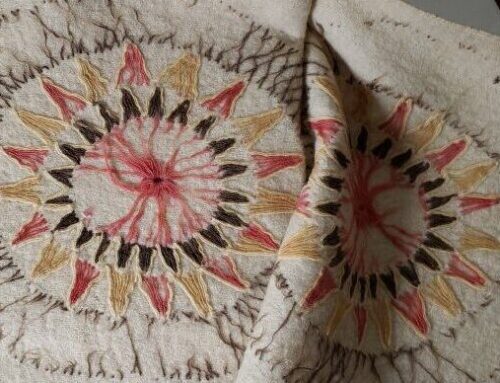
Historic Newton received a large federal grant to better understand their its textile collection. Textile management and conservation is more complex than paper items, and Historic Newton has textiles left over from the museum’s previous iteration as a period house museum that might not be from Newton at all. While federal funding cuts made them afraid that they would lose their grant, grant restoration means that they believe they will be able to proceed with their initial project.
Dady and Lundberg are pleased with the positive response from visitors, not only Newtonians but people from other communities. The average visitor stay is 45 minutes, which is a long time for a museum of this size. It was a large amount of time and financial investment to improve the museum, and they’re happy it’s paying off. “We felt that Newton deserved a current, well-designed exhibit,” said Dady.
Stay tuned to learn more about discoveries in the textile collection this summer, as well as papers from a prominent Newtonian that recently headed off to the Smithsonian.
Share This Story On:
DONATE TO SUPPORT LOCAL NEWS
Your tax-deductible gift to the Newton Beacon keeps our community connected and its residents informed.
Get story alerts twice a week:
Related Posts





Upcoming Events