

sophiapic1
Sophia D’Alleva has published a book while battling Hodgkin’s Lymphoma. Courtesy photo
Sophia D’Alleva pointed to the faint scar on the left side of her chest where her port-a-cath had been before doctors removed it.
“It being ripped out of my chest was a tangible form of heartbreak,” she said.
For six months, the device under her skin had delivered a series of four chemotherapy drugs to D’Alleva’s bloodstream, in an effort to fight stage 2 Hodgkin’s Lymphoma, a highly treatable albeit serious cancer affecting white blood cells.
That ordeal inspired the 25-year-old Newton author’s upcoming memoir, “Beauty of Mountains & Valleys,” which she has scheduled for publication next Feb. 14. Her 2022 book, the self-published novel-in-verse “A Letter I Never Sent: & Note to Self,” documented the emotional rollercoaster she overcame after breaking up with her boyfriend.
“I took all the pain, all the crying, all the agony, and turned it into a collection of stories that are purposeful and meaningful.” she said. “Turning pain into purpose was exactly what I did.”
On Feb. 14, 2025, D’Alleva got an unwelcome Valentine’s Day surprise – a tender lump on the right side of her neck.
“At first, I didn’t give it much thought,” she said. To be safe, though, she went to her primary care physician. “I had a cold before I developed the lump, so they expected it was mono or an autoimmune disease.” A fine needle biopsy was scheduled.
By April, D’Alleva began experiencing full-body itching that could not be satiated with oatmeal baths or antihistamines. “It felt like spiders were crawling beneath my skin,” she said.
Working full-time at the real estate broker Coldwell Banker, she grew increasingly fatigued. Additionally, D’Alleva’s parents noticed the lump was becoming slightly discolored. “That’s when I had a suspicion something was wrong,” she said.
Before her biopsy, D’Alleva approached her mom downstairs in her family’s kitchen saying, “This lump and my symptoms are all so weird. Google said it might be cancer.” Her mom, Sheila, paused midway through slicing sweet potatoes and said, “Sophia, that’s ridiculous. You’re too young. It’s not cancer.”
She was not too young. Sophia’s oncologist, Dr. Patrick Connor Johnson of Massachusetts General Hospital, who specializes in B-cell lymphoma, said the typical stage 2 Hodgkin’s Lymphoma patient is diagnosed in their 20s or 30s.
In mid-July, D’Alleva underwent a surgical biopsy and received a phone call one afternoon from a doctor telling her she had stage 2 Hodgkin’s Lymphoma. “My heart felt like it was in my throat,” she said. Fighting this feeling, D’Alleva told herself, “‘I need to get through this,’ so I finished my day at work, planned to tell my parents, and took it one step at a time.”
When she got home, her dad, David, embraced her in a tight hug, where D’Alleva became inconsolable. “It all just came flowing out.” she said.
The next person D’Alleva told was her closest friend, Hannah Picchioni: “I remember her being upset, as she rightfully should have been — we were all shocked and devastated,” Picchioni said.
After speaking with Picchioni, D’Alleva, who had previously shared her writing on social media, decided to write detailed Instagram captions about her cancer journey. “It was my way of documenting my fight to survive,” D’Alleva said.
In response to D’Alleva’s posts documenting her journey with cancer, Picchioni said D’Alleva’s “writing has always been intensely personal and unafraid of vulnerability … and I am so proud that she is taking this horrible experience and turning it into something that can comfort others in their time of need.”
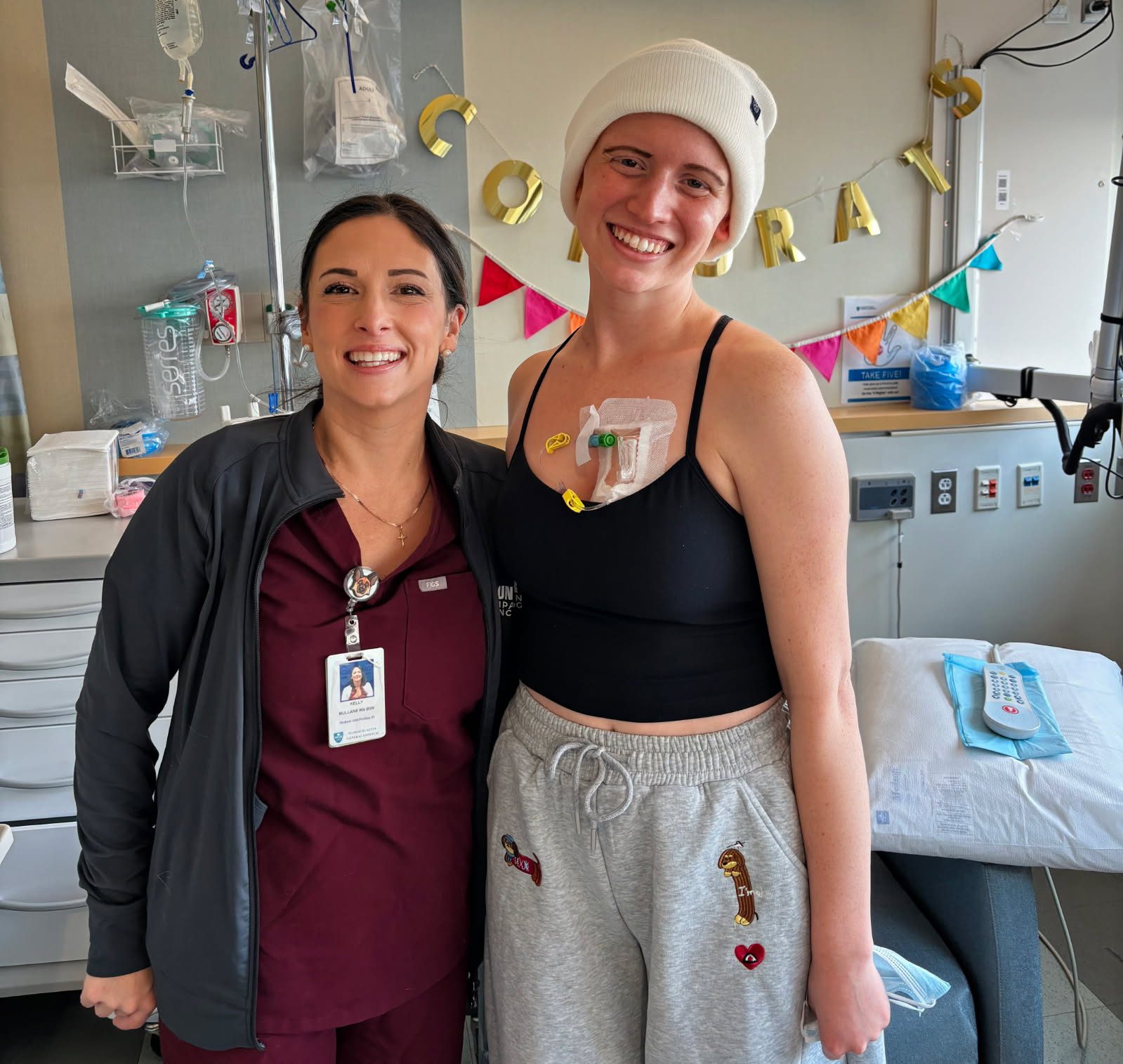
Sophia D’Alleva, shown here with nurse Kelly Mullane, has published a book while battling Hodgkin’s Lymphoma. Courtesy photo
Her most vulnerable post was the documentation of her hair loss from chemo. “I felt like I was being stripped of my feminine identity,” D’Alleva said. She held the first clump of hair for over five minutes, sobbing.
The turmoil her body endured was not limited to the loss of her hair: D’Alleva’s first round of chemo was administered before her port placement. “It felt like someone was taking a cast-iron pan to my veins for an entire hour,” she said.
D’Alleva’s cytotoxic chemo, coupled with Hodgkin’s being intrinsically immune-suppressing, left her hospitalized with COVID-19 and influenza-A from late December 2025 to early January 2026. Her mouth, already filled with sores, throbbed more than ever. “I felt like I was swallowing shards of glass,” D’Alleva said.
However, it was this low moment that sparked an epiphany for D’Alleva. “I need to write at least six more books before I die, so I was going to fight no matter what—no question,” she said.
A month after her hospitalization, D’Alleva’s PET scans revealed she was in remission. At that moment, she thought, “You don’t know the beauty of a mountain until you sit in a valley,” inspiring the name of her upcoming memoir, “Beauty of Mountains & Valleys” about the highs and lows of her cancer journey.
Despite the horrific physical consequences of chemo, such as mouth sores and temporary changes in taste, D’Alleva was able to appreciate positive changes, such as the immediate relief from her itching after the first round of chemo.
“I’ve been drinking coffee since I was 2, and having the taste not change maintained a sense of normalcy for me,” D’Alleva said, as coffee was the only food whose taste wasn’t changed from chemo.
D’Alleva’s last chemo occurred 11 months after she found the lump on her neck, and it was also her grandmother’s birthday. “My grandmother was very emotional throughout the entire process” and said D’Alleva’s last chemo was “the best birthday gift she ever could’ve received.”
While looking at recent photos taken in front of MGH, D’Alleva said her body, which had once betrayed her, “is finally working with me and building that trust again, which is something I referenced in my book.”
“If someone at the beginning of 2025 told me I would have survived cancer, I would have truthfully laughed,” D’Alleva said. “I wouldn’t have thought I had that strength in me.”
****
This story is part of a partnership between The Newton Beacon and the Boston University Department of Journalism’s Newsroom program.
Share This Story On:

DONATE TO SUPPORT LOCAL NEWS
Your tax-deductible gift to the Newton Beacon keeps our community connected and its residents informed.
Get story alerts twice a week:
Related Posts





Upcoming Events