
INSIDE NEWTON
Even though Jews make up only 2 percent of the country’s population, they are the target of more than half of all religious hate crimes in the United States.
So it’s not surprising that the issue of security and safety resonates in Newton, a city with a large Jewish population. Its many congregations, schools, recreational facilities, senior centers and other Jewish institutions have had to become more alert in recent years.
Threats against the American Jewish community have risen since the Hamas attack on Oct. 7, 2023, which killed about 1,200 Israelis, and the subsequent conflict in which Israel killed tens of thousands of Palestinians.
To address pressing concerns in a post-10/7 world, the Connie Spear Birnbaum Foundation recently organized a community event titled “Security through strength: Ensuring the safety of the Jewish community” at Congregation Kehillath Israel in Brookline.
The reality of rising threats
The threats to the Jewish community are very real and escalating, said Michael Masters, director of the Secure Community Network, a national group that coordinates security for Jewish organizations.
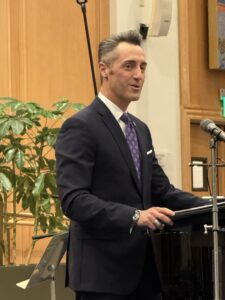
Michael Masters, director of the Secure Community Network. Photo by Richard Primack
Masters noted that incidents of antisemitism in the United States have increased by 130 percent over the past five years. Last year alone, his group documented 4,400 threats.
Locally, the impact of this threat climate is palpable.
Rabbi Marc Baker, president of the Combined Jewish Philanthropies of Boston, reported that some people are now asking, “Is it safe to be living as a Jew in Boston?”
A recent survey showed that 37 percent of Jews in the Boston area have changed their behavior in the past year due to personal security concerns. This includes not wearing a kippah, the Jewish skullcap, or jewelry with the Star of David, and avoiding public mentions of being Jewish.
From open doors to active defense
“We learn from history that we do not survive by being silent,” Masters stated. “We need to come together to protect ourselves.”
Baker pointed out that just 15 years ago, Jewish synagogues did not lock their doors, had no guards, and were not concerned with security. Today, millions of dollars are spent each year to secure these facilities.
Jewish organizations in Newton and across the Boston area are actively increasing their security measures, often starting with security assessments. These assessments lead to upgraded physical infrastructure such as fencing, reinforced windows, and better door locks. They also prompt many institutions to hire guards.
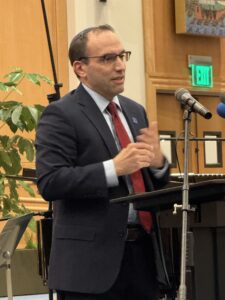
Rabbi Marc Baker, president of the Combined Jewish Philanthropies of Boston. Photo by Richard Primack
The defense strategy goes beyond physical barriers. Combined Jewish Philanthropies provides cybersecurity support and extensive safety training for about 5,500 people in the region each year, teaching temples’ staff and volunteers situational awareness, de-escalation tactics and first aid.
To support these efforts, the organization disburses about $1.8 million in annual security grants to nearly 390 Jewish organizations and assists them in securing an additional $3 million to $7 million in government funding.
“At CJP, we have a responsibility to the institutions and people inside to keep them safe,” Baker said. “Security is not just about protecting, it is about a community where people can show up and thrive.”
A community-wide responsibility
Newton resident Alan Teperow, director of the Birnbaum Foundation, emphasized that these threats should concern all residents of Newton.
Freedom of religion is a cherished American value, and threats that start with one community rarely end there, he said. They inevitably expand to harm others, including Asians, Blacks, Muslims and refugees.
Rabbi Daniel Berman of Temple Reyim in Newton described how his congregation puts this concern into practice: “We formed a strong relationship with the leaders and community members of a local church and mosque and developed multi-faith programming focused on education on the many forms of bias and acts of discrimination, racism and antisemitism we all face.”
Clergy and government officials in Newton have an especially important role to play in working together to convey messages of tolerance and condemnations of hate. We must actively support one another to ensure a safe, thriving community for everyone.
Richard B. Primack is a lifelong resident of Newton and plant ecology professor at Boston University. He can be reached at: primack@bu.edu.
Share This Story On:
DONATE TO SUPPORT LOCAL NEWS
Your tax-deductible gift to the Newton Beacon keeps our community connected and its residents informed.
Get story alerts twice a week:
Related Posts


Upcoming Events