
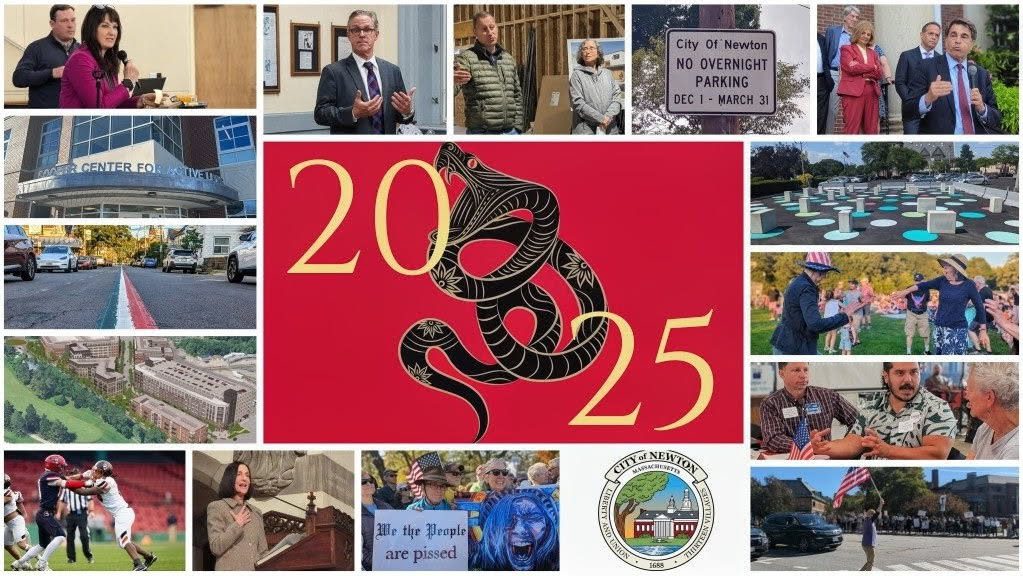
2025cover
In early January, an article in the Newton Beacon laid out a forecast for the year ahead, as 2025 was the Chinese Zodiac’s Year of the Snake—thought to be a time of transformation and the shedding of skin for new growth—and that Newton would be going through some changes.
It did.
A quarter of the City Council opted not to run for reelection, and 75 percent of the School Committee was turning over as well. The city’s first woman mayor opted to retire. The new-yet-not-new president of the United States targeted Newton in a culture war. The city stopped trying to push office space where there was no demand for it. And there was a strange summer skirmish over street lines.
Indeed, while many in the city have shown opposition to change, it’s been for naught: Newton’s growing pains have been met with an excited resolve to shed what was in favor of what can be. The frustrating lack of consensus on what that last part means has vibrated from the core of every debate, every permit discussion, every campaign speech, every idea of what makes Newton home.
Here are the stories that shaped Newton’s 2025.

Protesters displayed signs expressing anger toward the Trump administration during the “No Kings” protest on Oct. 18, 2025. Photo by Bryan McGonigle
The federal fray
The year started with an incoming presidential administration, a second term for Donald Trump and a heaping pile of worry for Democratic-run states and progressive communities like Newton.
Mayor Ruthanne Fuller let it be known from the start that she had no plans to play nice with the Trump administration’s policies regarding immigration (Newton is a sanctuary city), transgender rights and diversity, equity and inclusion initiatives (Newton has DEI programs for both the city and school department).
In February, Fuller warned the City Council about a memo written by new U.S. Attorney General Pam Bondi pledging to keep federal funding from sanctuary cities as well as a memo written by new Transportation Secretary Sean Duffy reporting that federal transportation funding would prioritize communities with no COVID-19 mask mandates and the highest birth rates.
While Newton doesn’t a have mask mandate, it also doesn’t have a young population ready to spark a baby boom. And a report from last year shows Newton’s population is getting older.
Fuller cautioned that the city could lose about $12 million in federal funds for schools, firefighter training, Medicaid reimbursement and more.
Later that month, the Trump administration cut a special education program that helps kids with autism transition to adulthood that Newton had just joined.
Within weeks of Trump taking office, crowds of Newtonians were taking to the streets in protest and holding rallies in front of City Hall to express opposition to the Trump administration’s policies.
Anger at the Trump administration has been evergreen. Every week, the group Newton Indivisible has held rallies (with U.S. Sen. Ed Markey occasionally stopping by) near the Newton Centre Green and on the bridges above the Massachusetts Turnpike. Those protests were ramped up even more after multiple Immigration & Customs Enforcement raids in and around Newton in the spring.
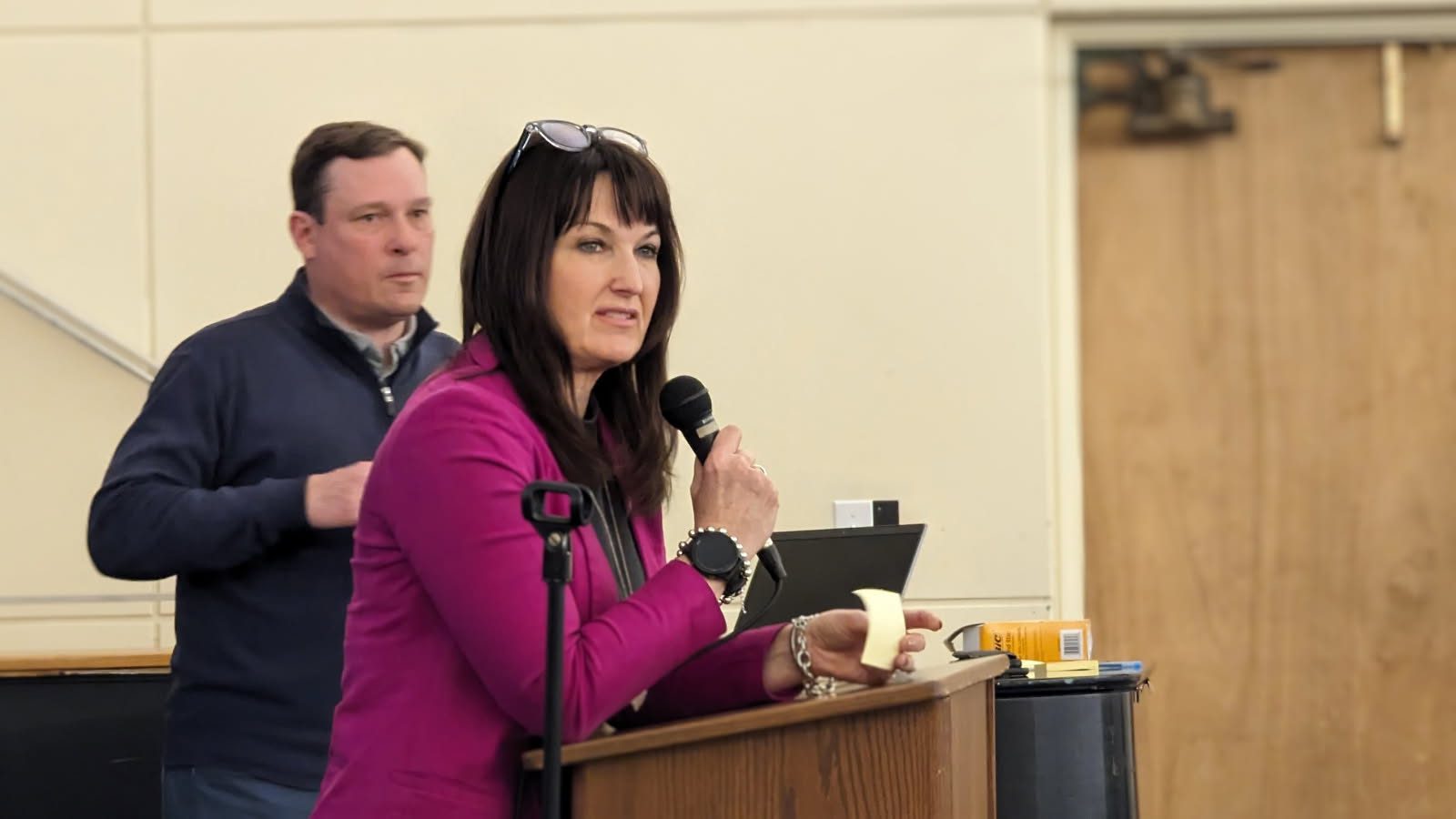
Superintendent Anna Nolin and School Committee Chair Chris Brezski speak to about 100 community members at Brown Middle School on March 27, 2025. Photo by Bryan McGonigle
The budget crisis
There was a crisis brewing locally last winter, too—a chasm between the amount of money Superintendent Anna Nolin said the schools needed to maintain current services and the amount Mayor Fuller planned to allocate for the schools for Fiscal Year 2026—that turned the spring into an impassioned campaign season of sorts.
Week-by-week, Nolin gave NPS families updates, via email and in community information sessions she and School Committee Chair Chris Brezski held around the city, and rallied the community to push for more money. Parents and teachers, meanwhile, spoke out to put pressure on the city to get the schools fully funded.
Members of the City Council wrung their hands and called for this solution or that remedy, and some started talking about changing the City Charter to wrestle some budgetary authority from the mayor’s office in the future.
The School Committee even took the rare step of approving Nolin’s unfunded budget over Fuller’s allocated budget.
Fuller and Nolin worked the numbers and, by May, a budget was hashed out that would fund the schools with some free cash and other sources with the understanding that Newton’s school budgeting needs a dramatic overhaul in the future.
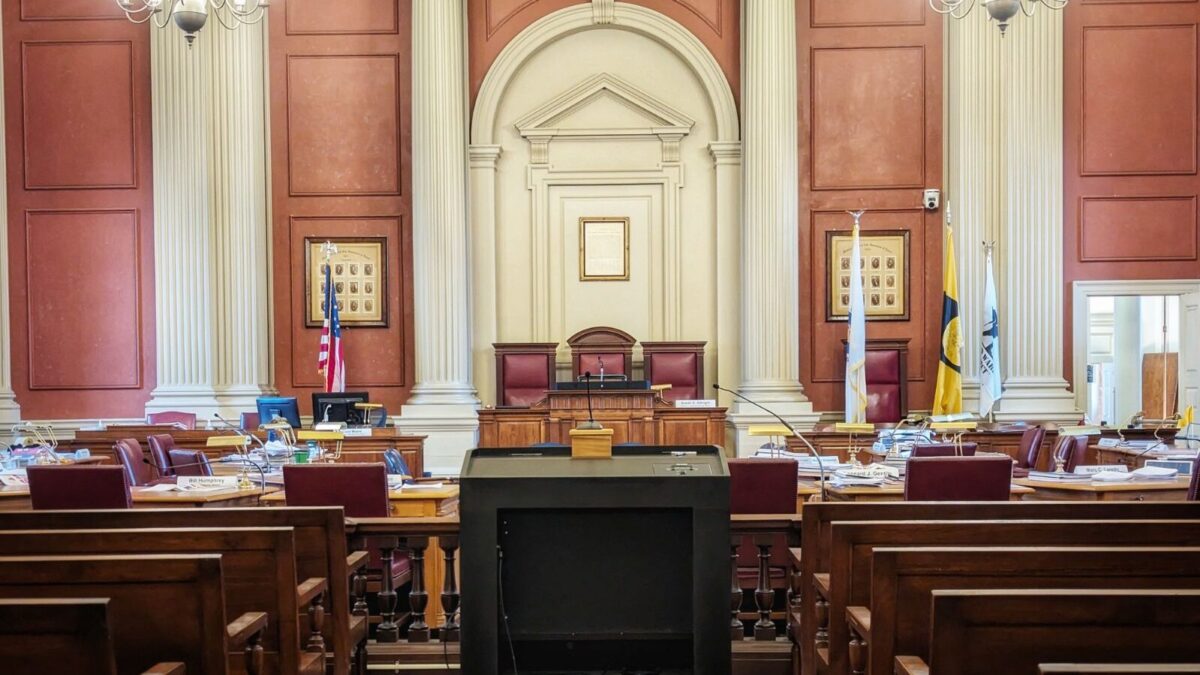
Newton City Council Chambers. Photo by Bryan McGonigle
The exodus of electeds
The 2024-2025 School Committee term was rough. It started with a two-week teacher strike that had the committee chair breaking down in tears on live TV and ended with another budget crisis and that same chair opting not to seek reelection.
Brezski was not alone in that choice. Several other committee members chose not to run again, in addition to two who had reached their term limits, and in the end only Ward 4’s Tamika Olszewski and Ward 7’s Alicia Piedalue would be going for another term. And Piedalue is new herself, joining the committee in April after a special election.
A juxtaposition to ponder: In the 2023 local election, before the strike, there were no contested School Committee seats.
The exodus wasn’t confined to the School Committee. Over the course of the early part of the year, several city councilors announced that they’d be sitting out the 2025 election, and two councilors opted out of the election after the deadline for nomination papers.
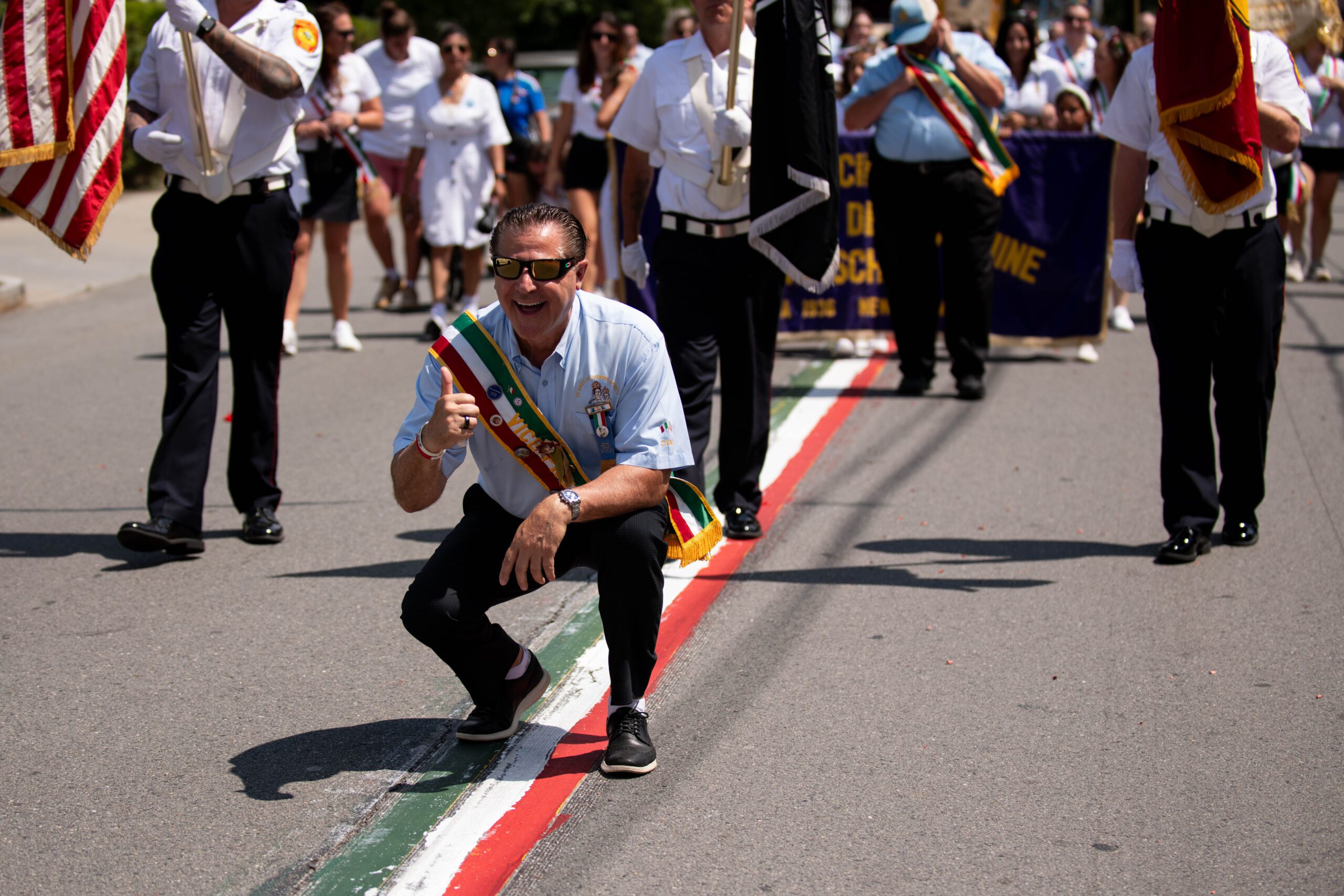
Carl Pasquarosa of the St. Mary of Carmen Society shows off freshly painted street lines at Nonantum’s Italian-American Festival on July 20, 2025. Photo by Tami Nguyen.
The street lines
One night in late June, residents on Adams Street in Nonantum noticed something strange. A city work crew was removing the red, white and green Italian flag-colored lines from Adams Street; lines that had been repainted there every year since the 1930s as an expression of that neighborhood’s Italian heritage.
Neighbors in Nonantum erupted in outrage as the line-erasing was done just a couple of weeks before the St. Mary of Carmen Society’s Italian-American Festival, which was celebrating its 90th year.
The mayor said the removal was necessary because of traffic volume on that street and state law requirements for streets with such traffic volume, while Nonantum residents accused her of cherry-picking traffic data from exceptionally busy weekends to justify wounding Nonantum’s Italian pride.
The Adams Street Shul joined with Italian-American neighbors to put pressure on the mayor, highlighting the strong bond forged by Italian and Jewish immigrant families generations ago. At one point, a crowd of Nonantum residents rallied at City Hall demanding the mayor have the Italian flag lines put back onto the street.
The mayor did not do that, but eventually the neighbors did. And then the city removed them again.
That story was a wild ride nobody asked for, but it definitely made the summer of 2025 memorable. And the Italian-American Festival arrived with a side of gloria del villaggio (village glory).

Northland Vice President of Construction Mike Medeiros gives a site tour to Max Woolf of the Charles River Regional Chamber and resident Garry Miller on Aug. 22, 2025. Photo by Bryan McGonigle
The demise of Big Office
The COVID-19 pandemic changed a lot of things in our economy, including how we work. With so many Americans working remotely and inflation driving up costs everywhere, companies started evaluating how much space they really need.
So, gone are the days of high demand for large office and lab space complexes, like those commonly seen along the I-95 corridor from MetroWest to the North Shore.
Last year, Northland Development asked the City Council to issue a new special permit after it changed plans for its large Upper Falls complex to include more housing and no office space. A few months later, Mark Development did the same for the much-delayed Riverside development, signaling a trend that wasn’t reversing any time soon.
This summer, the Zoning and Planning Committee met with Economic Development Director John Sisson to talk about the challenges facing the office space market in this post-pandemic reality.
The City Council approved the Northland changes in May and the new Riverside plan in December.

Mayor-elect Marc Laredo takes congratulatory phone calls after results come in on Nov. 4, 2025. Photo by Bryan McGonigle
The election
The above-mentioned budget crisis and the above-mentioned exodus from the School Committee brought Newton an active local election season, which was made even more interesting with six city councilors—Bill Humphrey, Andreae Downs, Vicki Danberg, Rick Lipof, Alan Lobovits and Leonard Gentile not seeking reelection. A seventh seat held by Marc Laredo, who was running for mayor, was up for grabs as well.
Mayor Fuller wasn’t seeking reelection, either, so Laredo and Al Cecchinelli competed for that job.
It ended up being Laredo’s year, in multiple ways. With Cecchinelli—a staunch conservative Trump supporter running in a progressive, decidedly non-MAGA community—being a long shot candidate, Laredo was free to focus on shaping other races.
Latredo published a list of School Committee endorsements followed by a list of City Council endorsements, setting off waves of backlash from people who thought such endorsements were unfair and divisive. But the voters clearly agreed with Laredo, as he won overwhelmingly and most of his picks won, too.
There was a controversy in the fall when past Facebook comments made by Ward 4 at-large candidate John Chaimanis came to light, comments that questioned whether transgender athletes should be allowed in the locker rooms associated with their gender identity. Chaimanis ended up being the only Laredo-endorsed candidate to lose.
The voters also chose, very narrowly, to keep the winter overnight parking ban, after a campaign season full of discussion about the ban and its impact on the city. The City Council is expected to start discussing a replacement ban system, however, which would only cover certain parts of the city.
After the election, Ward 1 at-large Councilor John Oliver was picked to be City Council president for the 2026-2027 term.
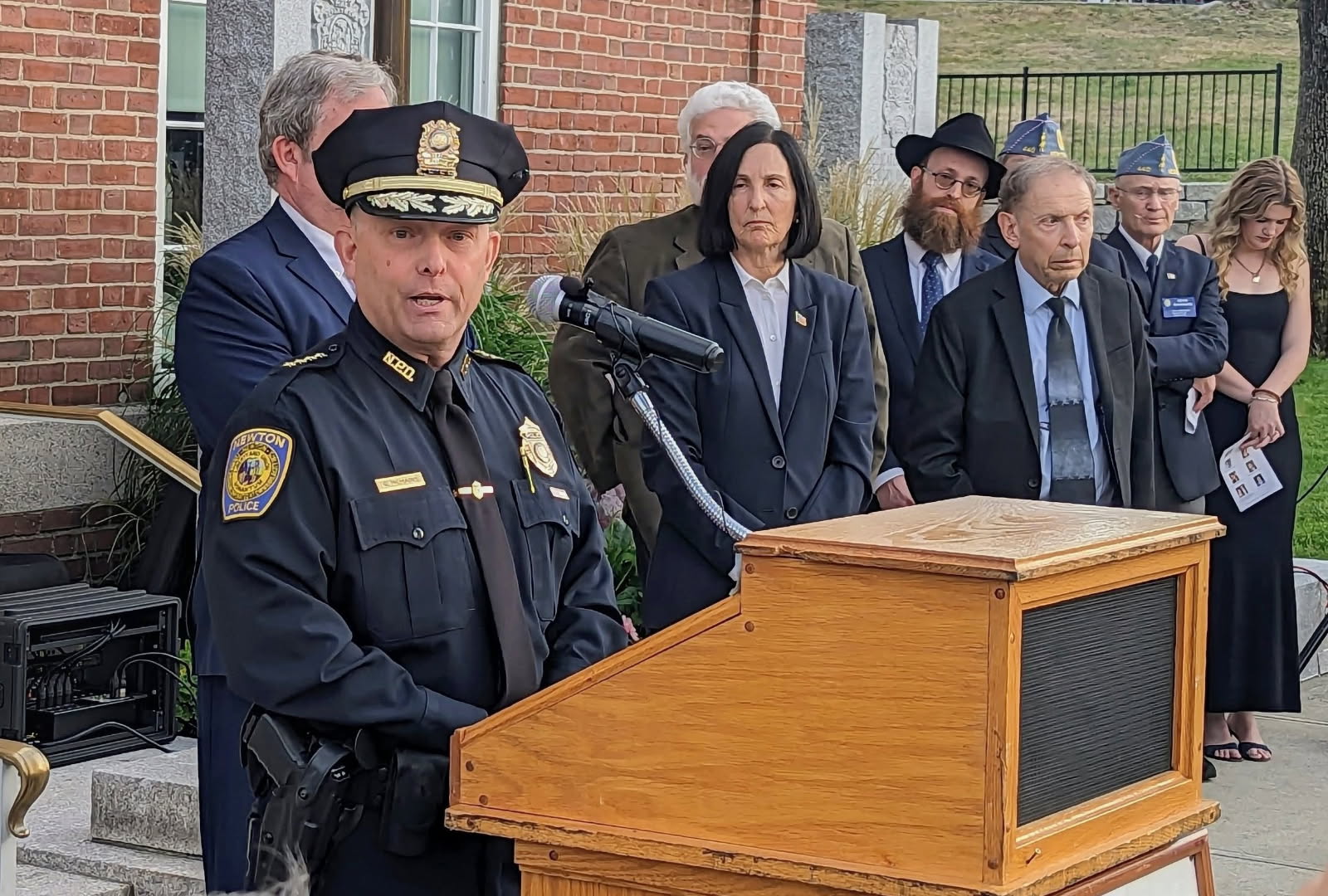
Newton Police Chief George McMains speaks at at Newton’s annual Sept. 11 ceremony. Photo by Bryan McGonigle
The departures
As mentioned above, Mayor Fuller chose not to run in this year’s election, putting an end to her time leading City Hall. And a quarter of the City Council and three-quarters of the School Committee joined her.
They’re not the only ones heading for the exit doors, as a new administration typically brings a lot of leadership turnover.
Chief Operations Officer Jonathan Yeo is also leaving at the end of the year, with current Public Buildings Commissioner Josh Morse taking his place.
Economic Development Director John Sisson is leaving, and All Over Newton’s Lauren Berman will step into that role in January.
Planning Director Barney Heath is leaving for a job overseeing the Metro West Collaborative Development, and Deputy Planning Director Jen Caira is heading to Cambridge.
Newton Free Library Director Jill Mercurio was hired in Brookline, and ADA Coordinator Jini Fairley retired.
And Newton Police Chief George McMains announced his retirement in September after serving on the Newton Police Department for almost 30 years and as chief for the past year-and-a-half.

Newton City Clerk Drew Willison gives remarks at the start of Newton’s City Council leadership election on Dec. 4, 2025. Photo by Bryan McGonigle
The arrivals
2025 wasn’t all exits.
Early in the year, Shawna Sullivan became the first woman to lead the Newton Department of Public Works.
Newton also got a new city clerk, Drew Willison. Willison previously served as United States Senate at Arms and as chief of staff for former Senate Majority Leader Harry Reid. In Newton, he started his job in the thick of the local election, getting a trial-by-fire start to his City Hall career.
The city also got a new City Seal, after a commission was formed to replace the old one, which depicted Rev. John Eliot preaching to Native Americans and has been seen as problematic for years.
The new Lincoln-Eliot Elementary School was completed, too.
In January, Mayor Fuller announced that a new plaza would be built on part of the Langley Parking Lot in Newton Centre to give people a place to gather outside in that village center.
The plaza plan was met with excitement but also concern, as it took away parking spaces from the Langley lot in one of the busiest parts of the city.
So, the Planning Department cut the size of the proposed plaza to free up some parking from the original plan. And by the end of the summer, the plaza was pretty popular. The Traffic Council recently voted to keep it up through 2026.
But it’s not popular enough for some, as there’s a plan to try to have the Traffic Council vote repealed in 2026.
And earlier this month, the Cooper Center for Active Living opened, bringing the city into a new era that focuses on aging with joy.
Now, Newton embarks on a new year–with a new mayor, a new School Committee, a new City Council–to start an unwritten chapter in Newton’s rich, albeit strange, history.
And the Newton Beacon will help sort it all out.
Share This Story On:
DONATE TO SUPPORT LOCAL NEWS
Your tax-deductible gift to the Newton Beacon keeps our community connected and its residents informed.
Get story alerts
twice a week:
Related Posts





Upcoming Events