
Office2
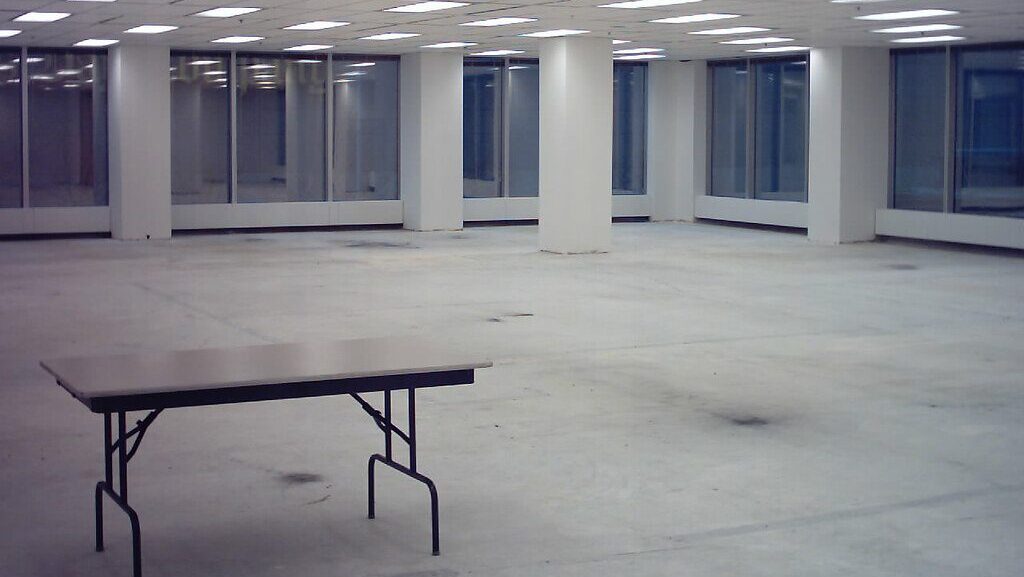
Vacant office. Public domain photo
Two big real estate developments—Northland and Riverside—are changing plans to scrap office space for more housing. The world has changed in the past few years, and it’s taken the commercial real estate market for a wild ride.
So several city councilors have been calling for an examination of Newton’s office space market and ways to help strengthen it in the wake of normalized remote work and rising rents.
The City Council’s Zoning and Planning Committee recently sat down with Economic Development Director John Sisson to talk about the commercial real estate market.
The meeting was preceded by a bit of drama after Charles River Chamber President Greg Reibman had requested a chance for his organization to speak, but Lisle Baker, chair of the committee, said no because he wanted to keep it to the core speakers and wasn’t letting anyone else address the meeting.
“I want to be clear, this is summer. This is July,” Baker said. “We don’t make decisions, generally, in the summer. I think that’s part of the process at the Council, and we’ll have plenty of opportunity for further conversation on all of these items.”
The discussion was docketed by City Councilor Tarik Lucas, who said he’s received a lot of emails about Baker not allowing outside speakers.
Lucas emphasized that the meeting was to “just have an open and honest conversation with city staff who are here in the room and the EDC, and that’s it. It’s just a discussion. I’m not talking about development. I’m not talking about changing zones.”
With that out of the way, here are some highlights from the talk.
Newton doesn’t have much office space
Newton is a “bedroom community,” meaning a lot more people come home to the city as their place of residence than come to the city as their place of work.
So while Newton is the 11th largest city in the state, commercial real estate only makes up 6 percent of Newton’s taxable property value. To put that into dollars, the combined value of commercial property is about $2.6 billion and the combined value for residential property is $38.6 billion.
“It’s roughly $33 of commercial for every $500 of residential,” Sisson said.
And just over a third of that commercial real estate is office space.
“We’re talking about 37 percent of 6 percent, which is somewhere in the neighborhood of 2 percent of the city’s tax base,” Sisson added.
Newton has its unique challenges
Despite office space being scarce for the city’s size, Sisson said the city’s commercial sector has its strengths, and the city’s location near Boston benefits its business community while Newton itself offers businesses variety.
“The geography of Newton is really cool, in that it provides people with office space in a variety of settings,” Sisson said. “You can be in a village center. You can be in a quiet office park. You can be in a gateway center right next to a major interstate.”
But that opportunity is met with challenges.
In recent years, and especially since the COVID-19 pandemic normalized remote working, the demand for office space has dropped. Newton’s commercial vacancy rate is almost 15 percent. And that’s lower than nearby communities like Watertown with a lot more office space to fill and a lot less demand.
Economic uncertainty isn’t helping. In addition to the high cost of doing business in Greater Boston, recent actions by the federal government (tariffs, funding cuts, etc.) have impacted the health care, education and research industries that have historically dominated the regional economy.
Newton’s commercial vacancy rate could rise due to those government actions, Sisson cautioned.
“Most of our jobs are professional jobs, and there may be some vulnerability,” Sisson said. “If those sectors are affected by current events, that may affect some of the offices, that may affect some of our businesses in town, and that may affect our residents, so it’s good to be aware of those things.”
And then there’s the local red tape. At a recent meeting between mayoral candidate Marc Laredo and Newton nonprofit leaders, attendees said a major hurdle for them was the permitting process for events, fundraisers and other activities.
With business, a major point of contention is often the city’s permitting process and the complexity of local regulations.
Newton has options
It’s not all bad. Sisson went over some of the ways in which he feels the city has strengthened its business community (specifically the rezoning of the village centers in 2023).
Sisson laid out some options Newton could pursue to make the city more attractive to businesses. The city could streamline its application process for things like commercial signage, for example.
And there’s more that could be done with zoning.
“Updating the zoning of certain areas—and some of that is just helping align the zoning with current uses,” Sisson said “Right now we have uses in place that are perfectly fine, although they’re nonconforming with the zoning. And that means to do something different there, you’re going to have to go back and get a special permit.
“If we just decide that it’s alright to have office space at the Stop and Shop parcel, which is right now zoned for manufacturing, if we could make that a different zone for that property, it would save everyone a great deal of time,” he explained.
Economic Development Chair Chuck Tanowitz urged for more focus on strategy than marketing.
“I want to make sure we’re asking the right questions here,” Tanowitz said. “We’re asking what we’re doing to attract businesses to Newton. It’s a very tactical question, right? It’s a marketing question. How are you driving leads? I feel like the question we should be asking instead, probably more of a strategic question, is: How do we make ourselves more attractive to business? What changes do we need to make to the city of Newton to be a more attractive place to open a business, to be a faster place to open a business, to be a cheaper place to open a business?”
That will help the city determine what specific industries to try to attract.
“Right now we know the lab market has flatlined, the office market has flatlined, there’s not much activity happening in big corporate offices opening up,” Sisson continued. “So, what business are available? What businesses are happening in the region? How do we then change ourselves… to really bring those businesses in?”
This, as Baker and Lucas noted, was the first of many discussions on Newton’s commercial real estate and business community. And decisions or policy changes will likely take a while to hash out and put before public hearings.
You can watch the entire presentation on NewTV’s YouTube channel.
Share This Story On:
DONATE TO SUPPORT LOCAL NEWS
Your tax-deductible gift to the Newton Beacon keeps our community connected and its residents informed.
Get story alerts twice a week:
Related Posts




Upcoming Events