

riverside3
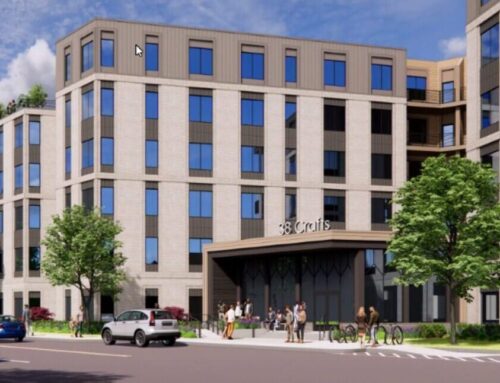
Design for proposed mixed-use development at the Riverside MBTA station in Auburndale. Mark Development
The City Council voted Monday night to approve the special permit requested by Mark Development for its Riverside project—now in its fourth version and approaching its seventh year of the approval process—clearing the way for the site to finally see new life.
The vote was split into three items: two zoning changes and a special permit.
The first zoning change was approved 23-1, and the second passed with the same 23-1 vote. And the special permit got a 22-2 vote.
The road from idea to approval has been so long that it started with a Board of Aldermen (which became the City Council in January 2016). The project was changed in 2020 to include 10 buildings comprised of office space, apartments, retail and a hotel. And the next year, the City Council approved a change to the 2020 special permit to incorporate about 370,0000 square feet of lab space.
But that long metaphorical road has been full of metaphorical potholes. A global pandemic gave way to a massive inflation crisis that threw construction projects off budget, and then the office space market collapsed.
And so, Riverside 4.0 was born, with more changes—an overall size decrease of more than 100,000 square feet, an increase in housing units from 550 to 750 and the elimination of the hotel and almost 370,000 square feet of office and lab science space—and that scaled-down version was approved by the Land Use Committee in September.
Ward 4 Councilor Randy Block, who has been involved in the process as a member of the Lower Falls Improvement Association, said he’s able to support this latest version of the Riverside project.
“It’s not a perfect plan, but then there probably is no such thing,” Block said.
At-large Councilor Joshua Krintzman, first became involved with the Riverside planning in 2007, also as a former member of the Lower Falls Improvement Association, when the MBTA put out a call for bids to redevelop the property around the Riverside MBTA station. And while he would like to see more office space, he said he’s ready to see the new plan go forward.
“I thought that office space was good, both for the site and for the city,” he said. “I had hoped that there would be more retail.”
Krintzman also wanted less parking, not more, at the site, because he believes more parking brings more traffic. But he added that he’s still happy to support the project.
The vibe of the vote Monday mirrored the tone of the approval process leading up to it: an underlying agreement that Riverside 4.0 wasn’t ideal but after 20 years of talking, shovels need to hit the ground.
“It provides more housing than any of the other iterations that we have seen, and we hear daily about the need that we have for housing, and affordable housing, of which there will be a significant number of units,” Councilor Leonard Gentile said.
Gentile also noted that the Riverside project has lower building heights and less anticipated traffic than other big developments coming to Newton.
One of the two “no” votes on the special permit was cast by At-Large Councilor John Oliver, who—although he voted in favor of the mixed-use zoning changes—said he wanted his opposition to the special permit and the Riverside project in general to send a message to the rest of the Council that Newton needs to shore up its commercial tax base.
“At some point, properties like this are no longer going to exist in this city,” Oliver said. “And Newton doesn’t just need housing. We have to protect all of the interests of the city. It’s the only reason I can’t support this project, just like I couldn’t support the amended version of Northland. We have to find a different way to balance the needs that we all know we have.”
Councilor Julia Malakie, a “no” vote on all three items related to Riverside, echoed Oliver’s points and said she’d rather wait for a proposal that includes more commercial space.
“We can’t keep approving project after project with minimal amounts of commercial and expect to see anything different,” Malakie said. “Once it’s built on, we’re not going to get that space back, and to me it feels like we’re looking at short-term interests when we should be looking at the long-term fiscal sustainability of the city.”
Share This Story On:
DONATE TO SUPPORT LOCAL NEWS
Your tax-deductible gift to the Newton Beacon keeps our community connected and its residents informed.
Get story alerts twice a week:
Related Posts


Upcoming Events