
ElizabethStuartPhelpsWard
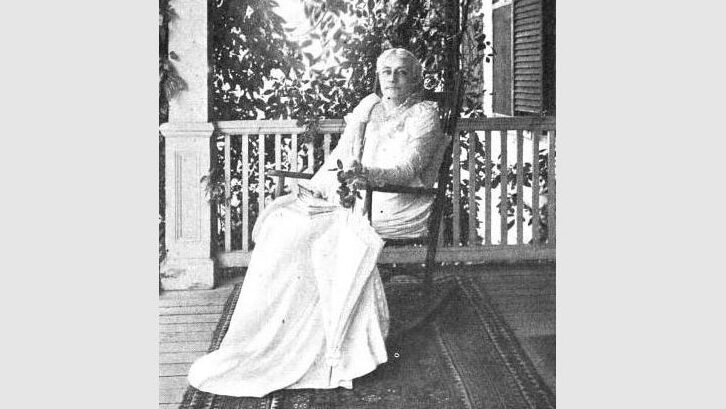
Elizabeth Stuart Phelps of Newton Centre, circa 1910. Public domain photo
Newton has had many literary figures reside within its bounds. One you may not have heard of was Elizabeth (born Mary) Stuart Phelps, who later took the surname Ward, and who spent the last several decades of her life in Newton.
Her 1868 novel The Gates Ajar, which presented a happy view of heaven after America’s bloodiest war, sold over 80,000 copies. She also wrote numerous other books, including The Madonna of the Tubs, which was about the working class in Gloucester. And she was an activist for women’s rights, worker’s rights, and animal rights. But she had been sickly all her life, and she died in 1911 at age 66. After a funeral at First Baptist Church in Newton Centre, her ashes were buried in the Newton Cemetery.
Her book The Gates Ajar follows Mary Cabot, a young woman whose brother died in the Civil War. Their parents were already deceased. She feels despair until her widowed aunt arrives to reassure her that she and her brother will be reunited in heaven, and that her brother was enjoying a world that was similar to their own. It was a deeply personal book, for Phelps’ beau, 19 years old and only a few months after graduating from Phillips Andover, had been killed at Antietam.
But her losses had started before that. Her father was a minister in Boston, and she was just eight years old when her mother, Elizabeth, who wrote children’s books, died. It was then that the daughter asked to change her name from Mary to Elizabeth in her mother’s honor.
In addition to children’s books, her mother had written a book about the drudgery of household labor and how difficult it made women’s lives. The daughter Elizabeth would follow in her mother’s footsteps as a writer, but one thing she would not do was become a minister’s wife. Phelps would remain unmarried until 1888, when she was 44 years old. She married Herbert Dickinson Ward, who was 17 years younger and also a writer. They would move to Newton Centre in 1893, building a home on 6 ½ acres; he would live in Newton until his death in 1932.
Being free of the rigid obligations of a 19th century wife and mother freed Phelps to write widely. While she would later tell potential freelancers not to start by pitching stories to Harper’s Magazine, her own first story was in Harper’s when she was only 19. Entitled “A Sacrifice Consumed,” it is about a young woman whose fiancé is killed at Antietam. While she initially does not think the Union is worth his death and her grief, she comes to accept it as a necessary sacrifice. She would also write about laborers, including a story based on the death of dozens of workers, mostly young girls, in Lawrence in 1860. Her 1877 book The Story of Avis follows a woman trying to retain her artistic independence but still ending up trapped by the expectations of life as a wife and mother, despite her professor husband claiming to be progressive about gender roles.
Throughout her life, she was a proponent of the cause for women’s rights. She would write: “We read of the Pilgrim Fathers. Who tells us of the Pilgrim Mothers?” She wanted women to have career aspirations beyond teaching. One of the careers she suggested was physician. This was in 1867. In 1864, of America’s 54,500 physicians, only 300 were women.
“Be sure that you could be few things more womanly or more notable,” she wrote. “The brave pioneers—God bless them for it!—have broken the way for you,” she added. She even published an article defending women as ministers when that was still an extreme rarity.
Her activism included women’s dress reform, a 19th-century movement that aimed to free women from the expenses and restrictions of fashionable women’s attire. “Make a bonfire of the cruel steel that has lorded it over the contents of the abdomen and thorax so many thoughtless years,” she wrote in 1873 about corsets. She also said not to give one’s old corsets to ‘Biddy,’ the nickname given to Irish serving girls. “Never fasten about another woman, in the sacred name of charity, the chains from which you have yourself escaped,” she said.
But this was also about the exploitation of the world’s poor in the production of luxury goods. “Are we sending to the tenders of the silk-worms, do you think, their fair profits on the brocade we buy tomorrow? Or to the miners their honest share of the great golden ciphers which represent the diamonds on our dressing-tables? Has the world’s younger son ever yet received the portion of goods which falleth to him? Has his elder brother ever yet meant in good faith that he should?” she wrote.
This was the era of the temperance movement, and alcohol manufacturers were attacked for the harm their product did to society. But for her, that meant the harms of other industries were being ignored. “You may ruin a human soul just as thoroughly with a piece of point-lace as with a glass of cognac,” she wrote. She commented on everything there was to comment on, from the Lizzie Borden trial to the Spanish-American War, but what really drew her attention at the end of her life was vivisection. This was the medical practice of animal experimentation, and it attracted immense opposition in the 19th century. Her writings on this topic were so outspoken that they were used as tracts by anti-vivisection groups.
Phelps was successful enough as a writer and Boston University lecturer to be able to afford a home in Gloucester, which is likely where she met Herbert Dickinson Ward. She wrote to his father telling him she liked “his boy” in 1884. They would marry in 1888, when she was 44 and he was 27. They would write several stories together, but she also wrote several stories about unhappy marriages. She did not like that he spent so much of his time on his boat, and later he spent much of his time traveling. He was traveling when she wrote her will on Jan. 2, 1911, and was still away when she died on Jan. 28. He did return to Newton for the funeral.
She quickly faded into obscurity. Even by 1939, when the first biography of Phelps was published, her work was not being read. Her biographer Mary Angela Bennett attributed this to her works being so focused on particular causes that were no longer important. But in recent years there has been more academic attention of her work. If you’re interested in 19th century ghost stories—or learning more about the roles of female writers in the 19th century—you can check out the library catalog.
Share This Story On:

DONATE TO SUPPORT LOCAL NEWS
Your tax-deductible gift to the Newton Beacon keeps our community connected and its residents informed.
Get story alerts twice a week:
Related Posts








Upcoming Events