
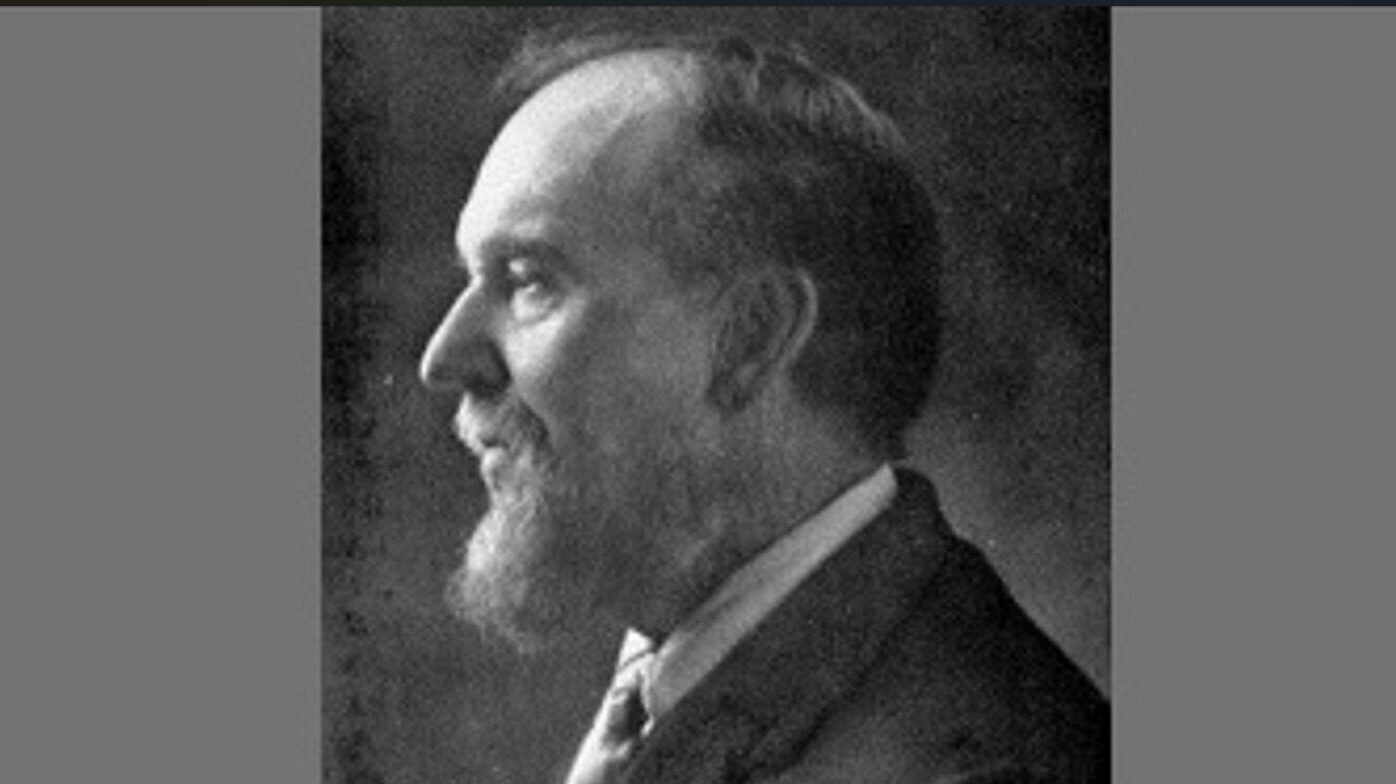
CharlesJohnMaynard2
Charles Johnson Maynard. Public domain image
Charles Johnson Maynard was born in Newton in 1845. Over the next 84 years, he would become a renowned natural historian.
He collected a huge variety of species of animals, particularly birds, and published a popular naturalist’s guide as well as a number of articles about specific animals. But his life also shows the tensions that came with professionalization as 19th century natural history collecting gave way to the establishment of the academic zoological disciplines.
He was raised on a farm in West Newton, and had always been interested in the natural world. After his father and eldest brother died, he left school at 16 to help on the farm. But his heart yearned for something else.
“My innate desire to investigate the mysteries of nature was too strong to allow me to settle down to farming,” he wrote.
But he needed a career to support himself. A year at the Waltham Watch Factory proved disappointing. Then he discovered a profession that would perfectly suit him: taxidermy. His shop in Newtonville would become renowned up and down the East Coast.
The 19th century was an age of collecting. In a century marked by rapid industrialization, Americans set out to retrieve rocks, plants, butterflies, birds and other evidence of the landscape that was being gobbled up by the new edifices of machinery. Many men had begun collecting eggs as boys and moved onto birds as adults. While some men learned how to mount birds at home, it was also common to bring dead birds to a taxidermist. Taxidermists also bought birds to resell them to customers eager to display a wide variety of birds in their homes.
There was plenty of work for Maynard, particularly as he was located near the Harvard Museum of Comparative Zoology. Many specimens owned by Maynard, whether he had shot them or someone else had, would find their way to the MCZ.
The MCZ, founded by Swiss-born naturalist Louis Agassiz, was like other natural history museums and focused on the collection and display of animals. There could be a very fine line between collector and scientist, and men who had not finished high school like Maynard travelled in the same circles as men with degrees. But this was beginning to change.
Maynard became a member of the Nuttall Ornithological Club, founded by Harvard students in 1873. It had both Harvard undergraduates as well as local residents interested in ornithology. Maynard was supposed to be an editor for their new journal, but he was removed and replaced by J.A. Allen, a Harvard alumnus.
The stated reason he had been removed was because he had ignored his duties to the publication schedule to go on a collecting trip instead. Maynard was passionate about collecting to an almost absurd degree: even his honeymoon with his second wife had been more of a collecting trip. But this was not just his hobby, as it was for Harvard students, but his profession, and he had to collect birds to have something to sell. He also liked to have control over publications, more than what an editor of a club’s journal would have. He had his own publishing house in his Newton shop, where he not only wrote articles, but also set the type, engraved the figures, and bound the books. He published numerous books during his lifetime.
His first book, which he did not print himself, was his 1870 naturalist’s guide, which was very popular among the reading public eager to learn about birds and how to prepare their skins for display. His knowledge in the preparation of skins was sought out by young college and college-bound men, like Bowdoin student Nathan Clifford Brown, or Newton High student Glover Merrill Allen. Both men would become prominent ornithologists.
Maynard also taught about natural history more broadly, both in Newton and at the summer school of the Massachusetts Agricultural College. He revitalized the Newton Natural History Society, making it more education focused, and lent specimens to local teachers to display for their students. He led bird walks in Newton and surrounding towns, as well as in Ipswich and on Plum Island.
Yet despite this respected status as a taxidermist and teacher, Maynard would continue to have issues with the burgeoning ornithological establishment. When he was not invited to join the American Ornithologists’ Union, another non-college-educated ornithologist grumbled that science, unlike other areas of society, was not reserved for men with Yale keys. Other ornithologists would later comment that Maynard’s contributions to the ornithological world might have been more respected if he had published more of his works in the primary scientific journals. While this would have been easier than it would be today, it was still not a world wholly open to a man without a degree.
There was one area where Maynard was aligned with the college-educated, proto-scientific ornithological establishment, which was the naming of subspecies. At the beginning of the 19th century, ornithologists rushed to discover new American birds. By the end of the 19th century, there were few birds left to discover—although Maynard was lucky in being able to discover the dusky seaside sparrow in Florida. But men could still pour over minute differences in specimens to see if a bird might belong to a subspecies, that is, a new regional variant of an already known bird. Maynard named several subspecies, some of which bear his name. This practice was derided by critics as ‘feather-splitting.’ Many hobbyist collectors found this practice of pronouncing a new subspecies, and the practice of referring to birds by Latin names, to be evidence of the elite takeover of ornithology. But Maynard existed in the shrinking gray area between natural history dealer and scientist.
Maynard was also interested in other animals, which provided more opportunities to discover new species. In 1888, Maynard got a ride on a schooner that was sailing from Kingston, Jamaica, to Grand Cayman, and convinced the captain to let him off on Cayman Brac, the middle island. He somehow got to Little Cayman, perhaps on a small fishing boat, where he became the first person to describe the Cerion nanus snail. He also described the Bahaman raccoon, which was initially thought to be a subspecies native to the Bahamas, although it is now recognized as an invasive descendant of the Florida raccoon.
While he made multiple trips to tropical locations to collect and describe, he continued to live in Newton. He was not enthusiastic about the changes to Newton’s landscape during his lifetime. “The beautiful brook has been straightened into a ditch, and most of the willows have been cut down. The cedar hill is now an unsightly gravel pit. The golfer rolls his ball where once the meadow lark and bobolink sang,” he wrote in 1907. He wanted public parks to have native shrubbery and wild sections left for birds.
Maynard died in 1929, in a Newton that was vastly different from the one into which he had been born in 1845.
“The late Charles J. Maynard was a gentleman and a gentle man,” wrote the Newton Graphic. In 1951, Charles Foster Batchelder, who had been one of the people to deny Maynard entrance to the American Ornithological Union, compiled a lengthy bibliography of Maynard’s work.
Maynard’s house was put on the National Register of Historic Places in 1996, and in 2003, Newton Conservators began offering a Charles Johnson Maynard award to those in Newton dedicated to conservation. He is still referenced in scientific articles published recently, such as a 2008 article about raccoons, a 2021 article about snails, and a 2022 article about sparrows. While many of his books are available at the Newton Free Library, they are all in-library use only; but with a more recent field guide, you can honor his legacy by going out and seeing the birds, butterflies and snails (and other creatures) that inhabit our community.
Share This Story On:

DONATE TO SUPPORT LOCAL NEWS
Your tax-deductible gift to the Newton Beacon keeps our community connected and its residents informed.
Get story alerts twice a week:
Related Posts






Upcoming Events