

MOVING AROUND
A new mobility phenomenon is quietly spreading throughout cities and neighborhoods in Massachusetts and beyond.
It’s the concept of fare free transit.
Providing fare free transit can be considered a matter of equity. Transportation costs are a major burden for low-income households and there are many people of all income levels who can’t drive or would prefer not to.
Using transit can allow people to leave their cars at home, leading to less traffic and less use of fossil fuels. Transit improves mobility and access to jobs, health care and social activities. Less congestion on the roads can lead to faster trips for everyone.
People who use transit tend to walk more, and as a result have better health. Transit accessibility enables higher density of housing, potentially unlocking a key to providing more plentiful and affordable living options for people.
At the MBTA, ridership remains about 30 percent below pre-pandemic levels, with about 500,000 riders using the subway in October 2025 compared to around 750,000 at the same time in 2019. The amount of revenue generated from fares at the MBTA has dropped from nearly 43 percent in 2019 to about 15 percent in 2025.
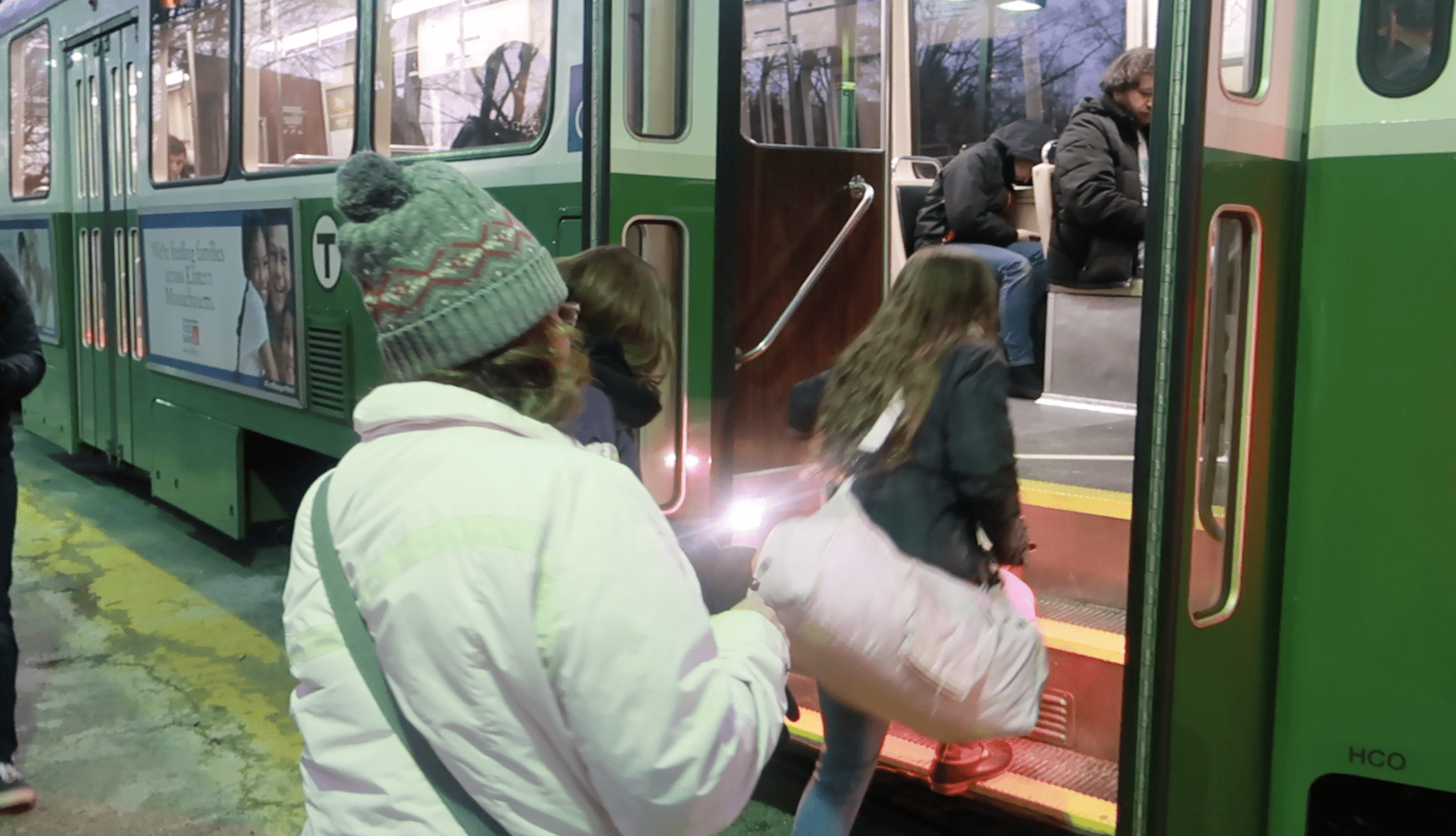
Passengers boarding an MBTA car at Eliot Station in Newton. Photo: Srdjan Nedeljkovic
With 85 percent of the cost of the MBTA subsidized from other sources, such as a portion of the Massachusetts sales tax, local government assessments, and money from the Commonwealth Transportation fund, fares play a shrinking role in paying for the system. Meanwhile, the cost of collecting fares on the MBTA is substantial. There are credit card processing fees of 8 cents per charge. New technology to collect fares has cost nearly $1 billion to implement and more than $30 million a year to operate. Fare evasion personnel are budgeted at $2 million per year.
The revenue lost to fare evasion on MBTA subway and bus routes is estimated to be $6 million annually. Collecting fares slows down the system, likely keeps some people from using buses and trains, and potentially targets socioeconomically disadvantaged people.
Enter fare free transit. It’s already being used in places as far away as Luxembourg and as close as Lawrence, Worcester, Southeast Massachusetts, and even several bus routes in Boston.
In Luxembourg, a nationwide fare-free public transport program was started in 2020. Prior to that, only 8 percent of the cost of transit was covered by fares. Since the fare-free program started, it has led to a 38 percent increase in transit usage among residents, resulting in a 8.3 percent reduction in CO2 emissions.
Massachusetts has also seen a ridership boost in regions of the state that have stopped charging for transit.
In the Fall River and New Bedford area, the Southeastern Regional Transit Authority, known as SRTA, went fare free in January 2024. There has been a 55.5 percent increase in bus ridership in the first five months of fiscal 2025 compared to before fares were free. Eliminating fares improved the on-time performance of buses since each stop took less time to load passengers.
In Lawrence, meanwhile, ridership increased 49 percent in 2023 compared to the year before transit became fare free. And in Worcester, ridership on its fare-free service increased 16 percent in 2024, giving its Worcester Regional Transit Authority, or WRTA, the largest ridership it has seen this century. Ridership on the Merrimack Valley Transit system quadrupled since fares were eliminated in March 2022.
These successes prompted Governor Maura Healey’s administration in 2024 to announce $30 million in grants to 13 regional transit authorities in Massachusetts to provide fare-free public transportation.
Fare-free transit was a key component of Mayor-elect Zorhan Mamdani’s successful political campaign in New York City. The $800 million cost of the New York program is proposed to be funded by an increase in the corporate tax rate and an additional income tax on those who earn more than $1 million.
In Boston, ridership on fare-free bus Routes 23, 28, and 29 has doubled compared to when fares were collected, although the city’s traffic congestion still slows trips.
As momentum for fare-free transit builds, U.S. Representative Ayanna Pressley, who represents Boston, joined with other legislators in November 2025 to call for federal funding to support fare-free programs nationwide.
What does this mean for Newton? Is there a fare-free transit future for the Garden City?
An MBTA commuter bus in West Newton. Photo: Robert Weisman
In a 2022 analysis, the eight MBTA bus lines that traverse Newton had a daily ridership of just over 2,000 inbound passengers, with the highest ridership on the Route 57 bus. Based on full fare collection, at $1.70 per boarding, the MBTA was generating about $7,000 per day from these riders, or around $2 million per year. If the city of Newton could find funding (federal, state, local, corporate) to compensate the MBTA in return for making these routes fare free, could we see fare-free transit here?
It may be a concept whose time has come.
Dr. Srdjan S. Nedeljkovic, a resident of Newton Highlands, serves on the Newton Transportation Advisory Group.
Share This Story On:

DONATE TO SUPPORT LOCAL NEWS
Your tax-deductible gift to the Newton Beacon keeps our community connected and its residents informed.
Get story alerts twice a week:
Related Posts








Upcoming Events