

INSIDE NEWTON
The most striking feature of the Webster Woods is its abundance of rocks, from sheer cliff faces and rocky slopes to isolated boulders and ancient stone walls.
These are mostly puddingstone, a gray conglomerate rock in which rounded pebble to cobble-sized stones are embedded in a sandy-muddy mix, but there are also layers of brownish sandstone. This prevalence of rocky features is found nowhere else in Newton and is likely why the area remained undeveloped.

Elephant Head Rock. Photo by Richard Primack
The woods can be a wonderful place to see leaves change into dazzling displays of colors in autumn, marvel at winter’s snow-covered branches, and observe wildflowers and the arrival of migratory birds in spring.
I would argue, however, that what makes the Webster Woods special are the unique areas formed by its many rock formations left behind when the glaciers melted 15,000 years ago.
Webster Woods South
Bare Pond is a vernal pool occupied by tadpoles and spotted salamander larvae in the spring. Pyramid Rock, a six-foot tall rock, emerges from the middle of the pond and shows distinctive horizontal high-water marks when the pond is dry in summer.
On the northern edge is the Bare Pond Overlook, a perfect place to sit and enjoy the view. A rock wall, constructed 200 years ago, cuts through the pond. To the south is an impressive rocky slope to explore, though at this site and elsewhere caution must be used to avoid falls.
In late winter and early spring, a thin sheet of ice covers one of the rock faces, called Movie Rock. Water droplets seeping between the ice and rock create a unique display of descending bubbles, winking off and on.
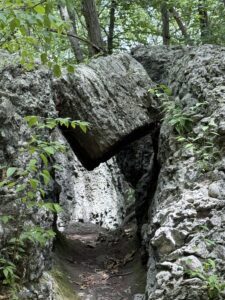
Hanging rock. Photo by Richard Primack
Further south is Quarry Rock, which shows the vertical marking of a two-man hand drill used to break out a block of rock. The rock was then hauled away, perhaps to make a threshold. Nearby in the vale is Salamander Rock, an inconspicuous flat rock about two feet across, which can be tilted up by a strong adult and usually has salamanders underneath. Great for kids!
Webster Woods North
North of Temple Road is a rock-climbing location called Cake Rock, named for its straight sides and vertical faces. Nearby is Gooch’s Caves, supposedly named for a past local character. This rocky slope has chambers and hideouts that are fun to explore, including a deep cave that is difficult to find. On the west slope is a massive 8-foot-tall boulder, which amazingly has not rolled off since it was left by the glaciers.
Hammond Pond Woods
Paralleling the shore of Hammond Pond is an elongated ridge, including a tall cliff face that I call the Hammond Pond Cliffs.

Hammond Pond Cliff. Photo by Richard Primack
Perhaps 50 feet high and 100 feet long, it’s one of the premier climbing locations in the Boston area due to its size and numerous vertical cracks and handholds. On top of the ridge is a lovely rock wall covered with light gray lichens.
Just north from the Cliffs along the ridge is a hanging rock, 2 feet on a side and 6 feet long, caught at eye level between two rock faces.
At the southern edge of the ridge near the Parkway, a passageway leads to a magical courtyard enclosed on three sides with 15-foot walls, known to climbers as the Alcove.
Hemlock Grove
On the back of the ridge is an enormous rocky slope and valley filled with towering hemlock trees, many now dead and dying because of the woolly adelgid infestation. Recently a massive sheet broke off from the rock face, tumbled downslope, and broke into four large pieces and many smaller fragments. The newly exposed rock surface is distinctly lighter in color, and the area should not be approached closely as it’s still unstable.
At the base of the slope is a round moss-covered rock about 4 feet across with an uncanny resemblance to the Incredible Hulk.

Mountain Lion Rock. Photo by Richard Primack
On the Parkway side is The Elephant’s Head, probably the largest surface rock in the woods at 100 feet across and weighing tens of millions of pounds.
Above the Hemlock Grove is Mountain Lion Rock, a huge boulder with a cat-like face. Nearby is a cluster of four large, block-like boulders, with two of them holding up a third one in the air.
The Ledges
The Ledges occur in the northwest section of the woods between Beacon Street and the T tracks, accessed on the west side of the Parkway. With a combination of cliffs and rocky slopes, including alternating sandstone and puddingstone layers, the Ledges have a fantastic mixture of rock forms. The most striking rock is the Pinnacle, a 15-foot free standing column. At one place, the cliff face is broken up into an exposed matrix of right-angled sandstone fragments.
At the top of the cliff, a gap leads to a private alcove overlooking the valley below.
Continuing westward along the trail and turning left at the old fence, an isolated cluster of a dozen massive boulders suggests the toys of a long-vanished giant.
These are some of the most interesting features of the woods, some named by others and some by me. There are far more waiting to be discovered and appreciated by you.
Richard Primack is a life-long Newton native and a Professor of Plant Ecology at Boston University. He can be reached at primack@bu.edu.
Share This Story On:

DONATE TO SUPPORT LOCAL NEWS
Your tax-deductible gift to the Newton Beacon keeps our community connected and its residents informed.
Get story alerts twice a week:
Related Posts









Upcoming Events