
Garden City
Nothing makes a gardener smile more than seeing signs of new growth. After all the snow, and now amid the mud, the cold wind, and the gray skies, I walked my suburban yard and looked for signs of spring awakenings.
Spring bulbs have started to poke through the slowly warming soil. Crocuses, snowdrops, and the sturdy leaves of daffodils have emerged. They should be in full bloom by the time of the Boston Marathon on April 20, and possibly sooner. My tulips have also peeped out, but they need to be protected, either with a screen, such as a wire wastebasket flipped over and the bottom cut off, or a few sprays of Rabbit Scram to keep the critters from devouring them.
Among the first plants to flower are the hardy hellebores, a treat in the early spring garden. Their drooping, cup-shaped flowers in white, ivory, pink, purple and yellow appear in late winter and bring much-longed-for color to the shade garden.
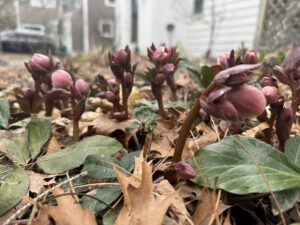
Hellebores about to bloom. Photo by Marian Prokop.
Also known as Lenten roses, hellebores are no relation to traditional roses, but their bloom time coincides with the Christian season of Lent. These perennials, with their dark green leaves, are native to Europe and Asia. They aren’t a good food source for early spring insects, although an occasional bee or insect might stop on one as it searches for food.
Among the early-blooming native plants in New England are the spring ephemerals. These are woodland plants that take advantage of the sunshine before trees leaf out and cover them in shade. The cool-tolerant plants are an important food source for early-emerging native insects. They bloom in April and May, but by June their leaves turn brown and they fade back into the ground until next spring.
Some popular ephemerals in New England are the bloodroot, a pretty white-petaled flower that blooms in April and is 6 to 9 inches in height; blue cohosh, with yellow-green flowers and bluish green foliage; and, violets, which bloom all over my lawn. (My husband has to wait until the violets finish blooming before he is allowed to mow.) Another wonderful spring ephemeral is the trillium, a gorgeous three-petaled flower. The Native Plant Trust in Framingham has a wonderful selection of trilliums, which are worth a visit in late April and early May.
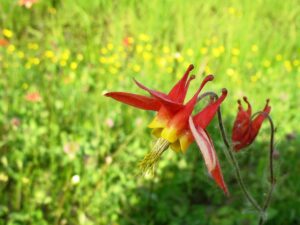
Wild columbine, with its showy flowers, blooms in late spring. Photo by JJefeerydev via Pixabay.
Other popular early bloomers are the mayapple, whose wide maple-shaped leaves remind me of beach umbrellas. They have a yellowish round fruit, which can be found under its leaves, but the leaves can last well into June, so it’s not exactly an ephemeral. So too is one of my favorites, the wild columbine, whose delicate flowers, like hanging crimson bells punctuated with yellow crowns, are a spring favorite of hummingbirds and long-tongued butterflies. While its flowers look delicate, these plants are tough, and once their unusual flowers fade, they tend to reseed all over the garden.
Starting Seeds Indoors
Mid-March to mid-April is the best time to start vegetable seeds indoors in the Bay State. I use a potting medium that is one-half seed-starter mix and one-half coconut coir. Using coconut coir helps reduce the need for peat moss, which is a nonrenewable product, and important for absorbing carbon and as a wildlife habitat. My vegetable garden is small—two 4-by-8-foot raised beds, so I’m sowing several varieties of tomatoes, lettuce, some herbs, and some flowers, including native coreopsis and gaillardia and non-native zinnias. Other vegetables, including cucumbers, zucchini, spinach, swiss chard, arugula and bush beans, will be sown directly into the garden bed. I’d add kale, but my family doesn’t like it so it’s not worth the trouble. A wise gardener once told me, don’t plant vegetables you won’t eat.
Inspired by my colleague Lisa’s column on winter sowing, I am waiting to see if the columbine seed that was sown in a milk jug outdoors in early February will germinate.
There’s lots to do and lots more not to do in the spring garden. It’s too early to clean up the yard and too cold and wet to start planting. If you’re inclined to start seeds indoors, go for it but hold off on planting outdoors until late April at the earliest. The last frost dates in this region range from late April to early May.
Marian Prokop and Lisa Gianelly, who alternate columns, are Newton residents and certified master gardeners. They welcome your suggestions for column ideas and news to share of gardening-related events throughout the city. They can be reached at beacongardeners@gmail.com.
Share This Story On:
DONATE TO SUPPORT LOCAL NEWS
Your tax-deductible gift to the Newton Beacon keeps our community connected and its residents informed.
Get story alerts
twice a week:
Related Posts








Upcoming Events