

TEACHER THOUGHTS
Sometimes it’s hard for students to see themselves as more than their test scores.
It’s the job of teachers to show them that they are, that competence is a thing they grow, not a fixed calculation of how much they fail to understand. But in an education system built on metrics, that’s not an easy task.
A Newton school committee member addressed a group of high school teachers earlier this year and asked a reasonable school committee member’s question: “What’s your metric for success?”
Spring is the season of metrics in schools, and over the next few months we’ll produce plenty. Parents recently received progress reports and data generated by something called a STAR assessment. That upbeat label refers to a comprehension test for students through grade nine. Students click away for 20 minutes on a screen to determine in part how good a reader they are.
Grade 10 students will spend hours on their devices in just a few weeks taking English MCAS to determine mostly the same thing. Their parents are perhaps beginning to wonder how much they should worry about the PSAT, too. The juniors I teach are already prepping and panicking for the ACT and SAT, and students in AP classes will soon be making their final push toward the College Board exams that rate them 1, 2, 3, 4 or 5.
All through April and May, MCAS testing will take up some portion of almost every student’s day.
The tests can tell us something, but far from everything. There will always be a tension in them. While providing some metric of skill level, they mostly serve to sort students and send a distorted message about who belongs where. They can stand in the way of kids setting expectations for themselves.
Voters rejected the idea that MCAS should stand in the way of graduation. But now high school students will take an end-of-course test (EOC, in the argot of the Department of Education, or what we’ve always just called a final exam), that the state will use as a metric to make for each student, in its words, a “competency determination.”
Students ascertain early on to be plenty impatient with their imperfection, so maybe instead schools should teach them how to live with a little incompetence.
Error nags at them. They struggle to see how they learn from it. I often tell students, “If you already knew this, we wouldn’t all get to be here together.” Like the tests they take, students are always on the lookout for errors. It’s a hard habit to break.
I’ve been teaching for three decades and still find it easier to tell students what to fix as opposed to what they’ve done right. Even when I try to explain, young people often insist upon knowing what went awry, why they lost points. They learn to covet those points, which are particularly valuable on the overwrought scoreboard many set up with each other and inside themselves.
Parents’ anxiety is understandable as well. Some metric to measure whether our kids are up to snuff is always reassuring. However, we should try, both as teachers and parents, not to let our children see themselves as a score.
Recently, some high school teachers, myself included, have tried to give assessment more meaning. Some of these changes can be confusing, like when homework isn’t counted or late work isn’t penalized. There’s been some trial and error, but the focus is on escaping the bad math of averages and hundred-point scales.
We try to teach students a standard and show them how to exceed it, or at least let them know how closely they have approached it. The idea is to provide feedback on how far a student has come as opposed to how short they have fallen.
Our students aren’t merely cohorts to be measured but individuals to be appreciated. No one can ever just push a button in an office somewhere, open a spreadsheet, and see all the competency contained within a child.
To his credit, the school committee member who came to talk to my colleagues and me did note that there will inevitably be many metrics for judging our schools’ success. He admitted that the measures shouldn’t all be numbers and that the committee’s role is to identify what lies beyond them.
Tests only tell us what students don’t know (or even care to display) right now, not what they can learn eventually.
Instead of a depiction of talent, they are often a metric of failure and frequently teach our children to believe that anything less than 100 percent makes an attempt unworthy. They belie the breadth of every child’s expanding competence.
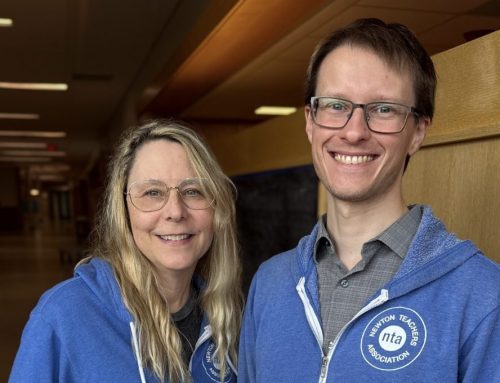
Tom Fabian is an English teacher at Newton North High School and faculty advisor to its student newspaper, the Newtonite. He can be reached at tfabianteaching@gmail.com.
Share This Story On:

DONATE TO SUPPORT LOCAL NEWS
Your tax-deductible gift to the Newton Beacon keeps our community connected and its residents informed.
Get story alerts twice a week:
Related Posts




Upcoming Events