

Garden City
Gardens are singular places. They reflect the style and the interests of the gardener. When I arrived at Margaret Primack’s backyard, it was clear that this was an unusual and special place.
Her garden is the work of someone who respects nature and is committed to making a garden that is productive and self-sustaining. She uses no commercial fertilizers, no herbicides or insecticides. Why bother when you have homemade compost, beneficial insects, and toads doing the work for you?
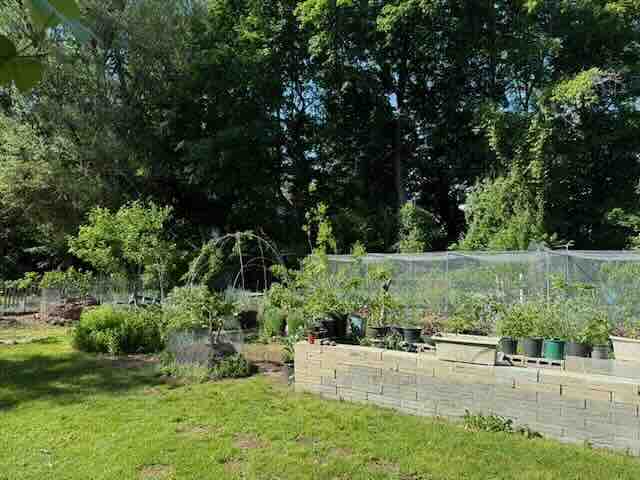
Overall view of Margaret Primack’s garden. Photo by Marian Prokop
Her garden takes several forms in foundational structures she built herself with the eye of an artist: Vegetables and herbs grow in circular raised beds fenced in with chicken wire; berries ripen in a fenced rectangle covered with netting to keep birds away; and, the vines of beans and squash climb over a geodesic dome built out of aluminum poles. Closer to the house a tall vine of kiwi extends from a pole, providing cool shade from the hot afternoon sun.
An arts education teacher for many years, Primack tries to make her garden a visual experience. “This is like a palate,” she says, “It’s changing every year.” Guided by that approach, she allows vegetables to self-seed and sprout where they land. This spring, self-seeded burgundy mustard greens are growing everywhere, as are arugula, lettuce, even tomatoes.
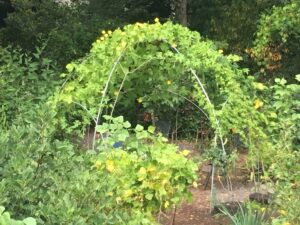
The geodesic dome is covered in squash and bean vines ready to harvest in this photo of the garden in 2024. Photo by Richard Primack
Primack grew up in the state of Sarawak in Malaysia. She remembers hunting and fishing in the jungle with her brothers and sisters, and where her family had a small farm. Growing up on a farm gave her the skills needed to maintain a garden and taught her to use the things that were available to make it thrive.
“That is very deliberate, she says. “I really wanted to see how a garden would grow just using what there is in the garden.”
On the geodesic dome, several varieties of beans and squash climb their way over the structure. In a few weeks it will be completely covered, like a green igloo. In her circle-shaped raised beds, she grows tomatoes, peppers, eggplant, bok choy and herbs including parsley, dill and curry.
Fig trees in Newton
She also has 30 exotic-looking fig trees, about eight varieties. Some of the fig plants, which are sensitive to New England winters, are in pots so they can easily be moved into the garage when the cold weather comes. Cold-tolerant varieties grow in the ground, protected from winter cold with leaf mulch and from rabbits with chicken-wire fencing. (Speaking of those cottontails, Primack finds that her lettuce crop is not a first choice for rabbits. To help solve the rabbit problem, she sows clover seed into a small patch of lawn and says that rabbits prefer the clover over her leafy greens.)
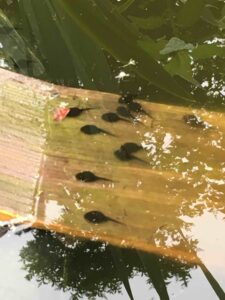
Tadpoles rest on a plank in the pond. Photo by Richard Primack
Her garden requires little in resources. She nourishes the soil with a compost tea derived from a compost of kitchen scraps and leaves topped off with bone meal and natural rock ash. She also adds soldier fly grubs, which help break down plant material, to speed up the composting process.
In the 1980s, she met her Newton-native husband Richard Primack, a botanist who was doing research work in Malaysia. (Richard Primack, a plant ecology professor at Boston University, is also a columnist for The Beacon.) She moved to Newton more than 40 years ago, and the couple raised their three children in the same Newton Centre home where Richard grew up. She retired eight years ago after 46 years as a visual arts teacher and devotes much of her free time to the garden. She shares the bounty with family and friends, who in turn bring her new seeds to try and help pick the vegetables.
A pond and a natural mosquito killer
To conserve water, the garden has an above-ground pond which is used to water plants. The pond generally gets replenished by rain, and when a storm is coming, she connects a roof gutter to direct additional runoff into it. Pondwater is an excellent natural fertilizer, she notes, because of the algae and other decaying organic matter. She gets her exercise by carrying pondwater by the pitcherful to her thirsty plants.
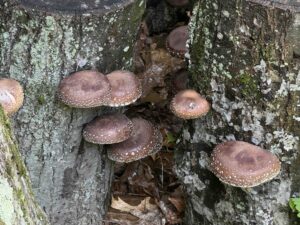
Shiitake mushrooms grow on an oak log. Photo by Richard Primack
The pond is also brimming with life. At the suggestion of her botanist husband, she added spring peeper tadpoles to the pond. The tadpoles are voracious eaters and devour the larvae of mosquitoes, which lay their eggs in the stagnant water. When the tadpoles have nearly completed their metamorphosis into inch-long frogs, she sets a plank in the water that the tiny frogs use as a ramp to climb out.
Near Webster Woods, her low-lying, wet yard is well suited to blueberries, raspberries, blackberries, peaches, plums and strawberries. She protects the fruit-bearing plants from birds and other animals with fencing and netting she installed herself. “It’s easy,” she says. “It just takes time.” She also keeps a few local toads in the berry patch to control slugs and snails. “They are really doing their job,” she says proudly.
Among the more unusual plants she grows are jujubes, or Chinese red dates, which have a sweet flavor, and stinging nettles, which can be quite tasty when sauteed in olive oil. Obtaining them of course is tricky, requiring gloves, “grabbing hold and pulling from the top.” She also grows mushrooms—wine caps and shiitakes on logs she got from a tree company that was taking down an old oak, and oyster mushrooms growing in a straw pile.
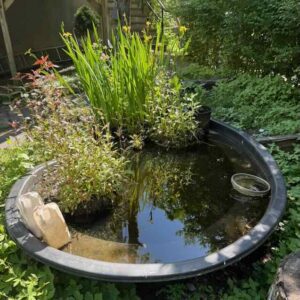
A pond with aquatic plants where tadpoles and dragonfly nymphs are developing. Photo by Marian Prokop
Her unusual garden has drawn university students interested in seeing the insects her garden attracts, while gardening groups want to see what she’s growing and how she’s growing it.
Among the flowers blooming in her garden this month are penstemon, black-eyed susans, marsh mallows, sundrops and borage. The bumblebees are flocking to them. Over the years, Primack has noticed a decline in the number of bees and butterflies in the garden but she does what she can to keep them coming. If she notices bees emerging from a leaf pile, for instance, she will not disturb it.
She views her garden as a blend of art and science. By allowing nature to take its course, she creates a garden that changes from year to year. “It’s a casual way of growing,” she says. “I like to see different things growing, and the arrangement of the garden is different every year.”
Marian Prokop and Lisa Gianelly, who alternate columns, are Newton residents and certified master gardeners. They welcome your suggestions for column ideas and news to share of gardening-related events throughout the city. They can be reached at beacongardeners@gmail.com.
Share This Story On:
DONATE TO SUPPORT LOCAL NEWS
Your tax-deductible gift to the Newton Beacon keeps our community connected and its residents informed.
Get story alerts twice a week:
Related Posts









Upcoming Events