
Tamika
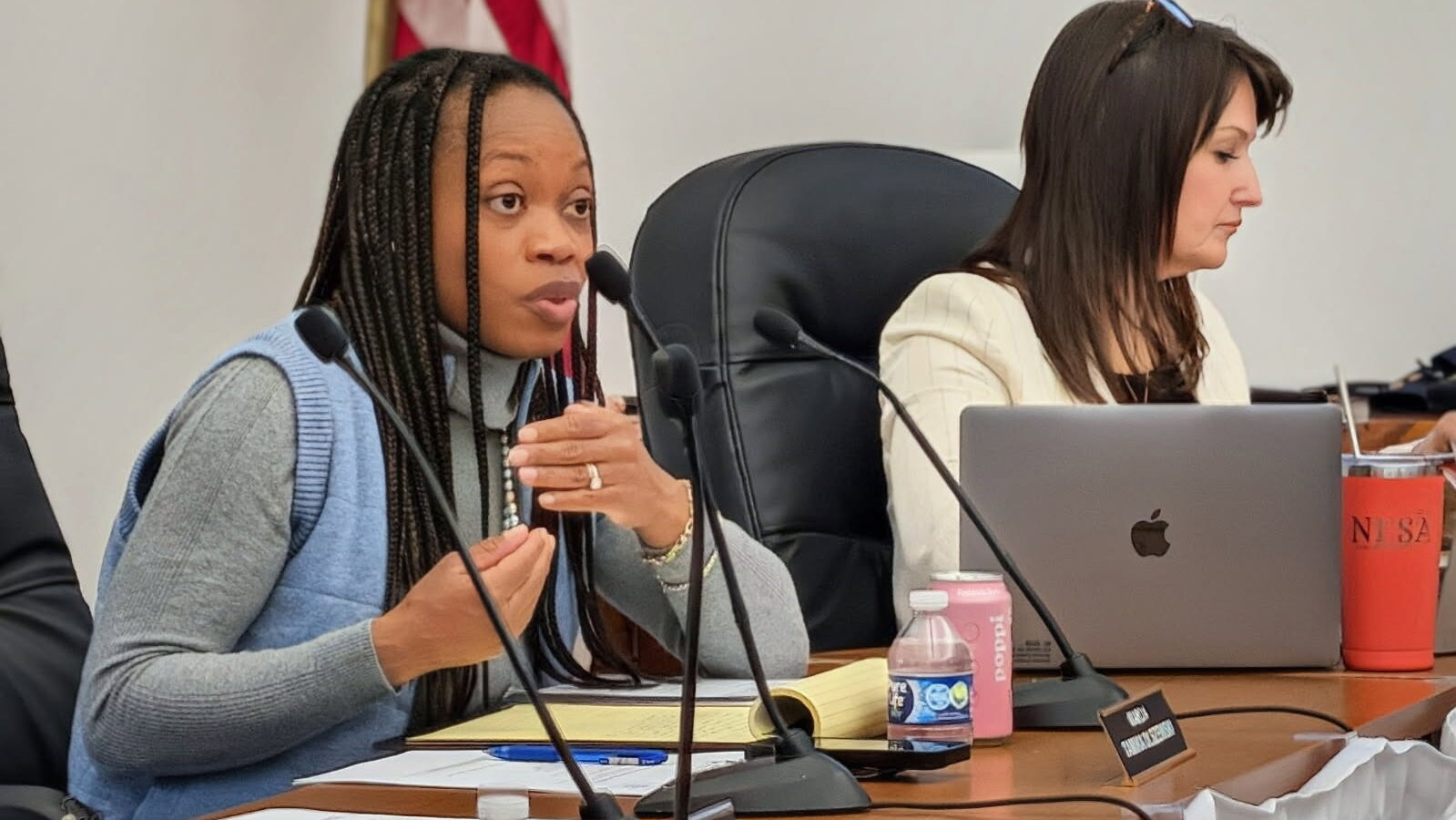
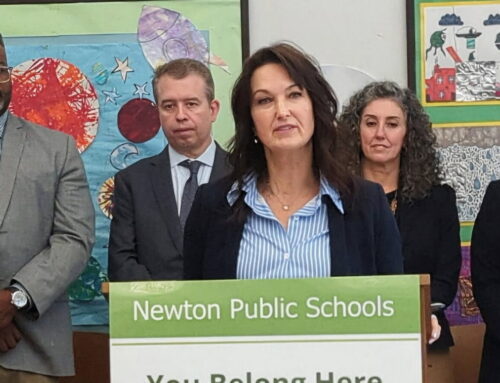
School Committee member Tamika Olszewski, shown here with Superintendent Anna Nolin, speaks after a budget presentation on March 30, 2026. Photo by Bryan McGonigle
“Most of you are new actors in your roles, but the play hasn’t changed in decades,” Newton parent Madeline McNeely said to the School Committee Monday night. “What’s it going to take to write a new script, a new play that inspires us year after year?”
McNeely was one of many there–so many, in fact, that some had to stand in the hallway–to voice their frustration over potential NPS cuts brought on by a more than $2.7 million gap between what Superintendent Anna Nolin says will allow level-services plus a new districtwide math initiative and what Mayor Marc Laredo has allocated for the schools.
The NPS budget crisis–which seems to have become an unfortunate annual tradition–has the School Committee deciding whether to sacrifice diversity and behavioral health positions for a much-demanded districtwide math programming overhaul.
For a refresher: Laredo is allocating a little more than $314 million, and that was enough to keep the district on level services until health care and utility costs soared toward the sky, prompting Nolin to present a budget proposal of more than $317 million to keep services level.
Now, Nolin and the School Committee have to make tough choices, and potential cuts include the district’s Diversity, Equity & Inclusion director, an ABA (applied behavioral analysis) supervisor position, the sustainability director role and more.
People showed up in droves Monday night to urge the mayor and the School Committee to find a way to avoid those cuts.
They spoke out for Diversity, Equity & Inclusion.
“This is a critical role that is already under resourced for a community as large and complex as ours,” Newton parent Laura Towvim said. “This role has been attacked and defended repeatedly in the past few years, and is crucial to ensuring that students feel safe and valued, critical prerequisites for academic success.”
They went to bat for the ABA position.
“The ABA supervisor, Dr James Ellis, oversees services for our most vulnerable students,” Michelle Phanan Steele said. “That’s my kids. His work keeps kids in-district, saving us millions. Cut this role, we pay more in both dollars and harm to children like mine.”
They stood up for math.
“We moved here to start a family,” Keith Bacon, parent to two kids in NPS, said. ”The math is quite simple here. We voted heavily to invest in some of the best teachers in Massachusetts and retain them. That’s fantastic. At the same time, you should be willing to invest to have accelerated math to go along with that.”
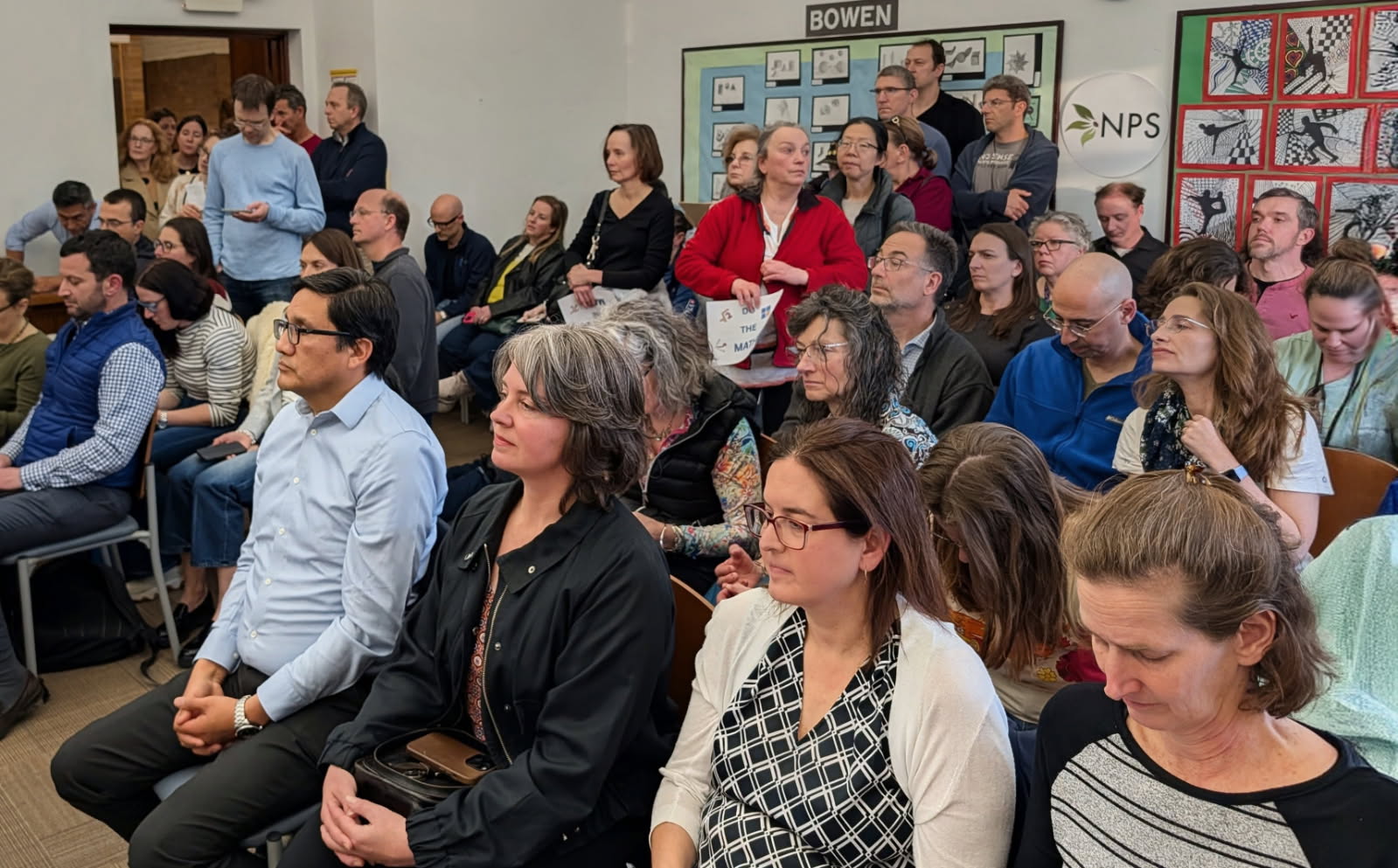
Crowds pack the School Committee meeting room on March 30, 2026, as people line up to speak about the FY2027 budget. Photo by Bryan McGonigle
Working with what’s there
Nolin has emphasized that she wants to keep all of the positions and programs intact–and, in fact, they’re needed as part of her “Thrive by 2030” vision–but the district is forced to work within the reality of limited funds, and these days that means some very difficult choices.
Last year, then-Mayor Ruthanne Fuller’s administration worked some numbers to give NPS more money than initially allocated, and this year, Laredo has used the resulting higher FY2026 amount as a baseline for FY2027 rather than the FY2026 baseline Fuller had started with. That, combined with a 5.75 percent increase, amounts to more than 7 percent increase over last year’s initial budget allocation.
On Monday, Nolin acknowledged that unprecedented increase, despite inflation in health care and utilities devouring much of it.
Put into numbers, Laredo’s NPS budget allocation increase was $17,1 million, which is a 5.75 percent budget increase and actually comes to more than 7 percent increase when adjusted for the lower initial baseline from FY2026.
But with $12 million in mandated salary increases and $4.4 million for health care cost increases, that left only $700,000 from Laredo’s hefty NPS budget increase.
And then there’s $2.8 million in more added costs:
- $800,000 increase in transportation
- $1 million in utility increases
- $1 million in added substitute teacher coverage
The result is a budget gap of more than $2.7 million and headaches for everyone involved. It’s a story similar to those in many other districts in the region, Nolin noted.
Laredo said every city department is going through similar fiscal frustrations.
“There are difficult choices that we make on the city side. We make them every single day,” Laredo said. “We’re going through our own budget process right now, and there are difficult trade-offs. I can assure you that the municipal side of the budget is getting far less of an increase than the school system is. Rightly so. This is where our money is. This is the most important.”
Laredo rejected calls to spend money from reserve accounts to plug the FY2027 NPS budget gap.
“That’s not prudent, and I will not do something that’s not fiscally prudent,” Laredo said. “You don’t go into a rainy day fund because you’re facing some difficult choices in terms of funding. Same thing with the stabilization fund. We need that stabilization fund to go over several years at least. We could take more money this year, but then next year we’d be in a worse situation.”
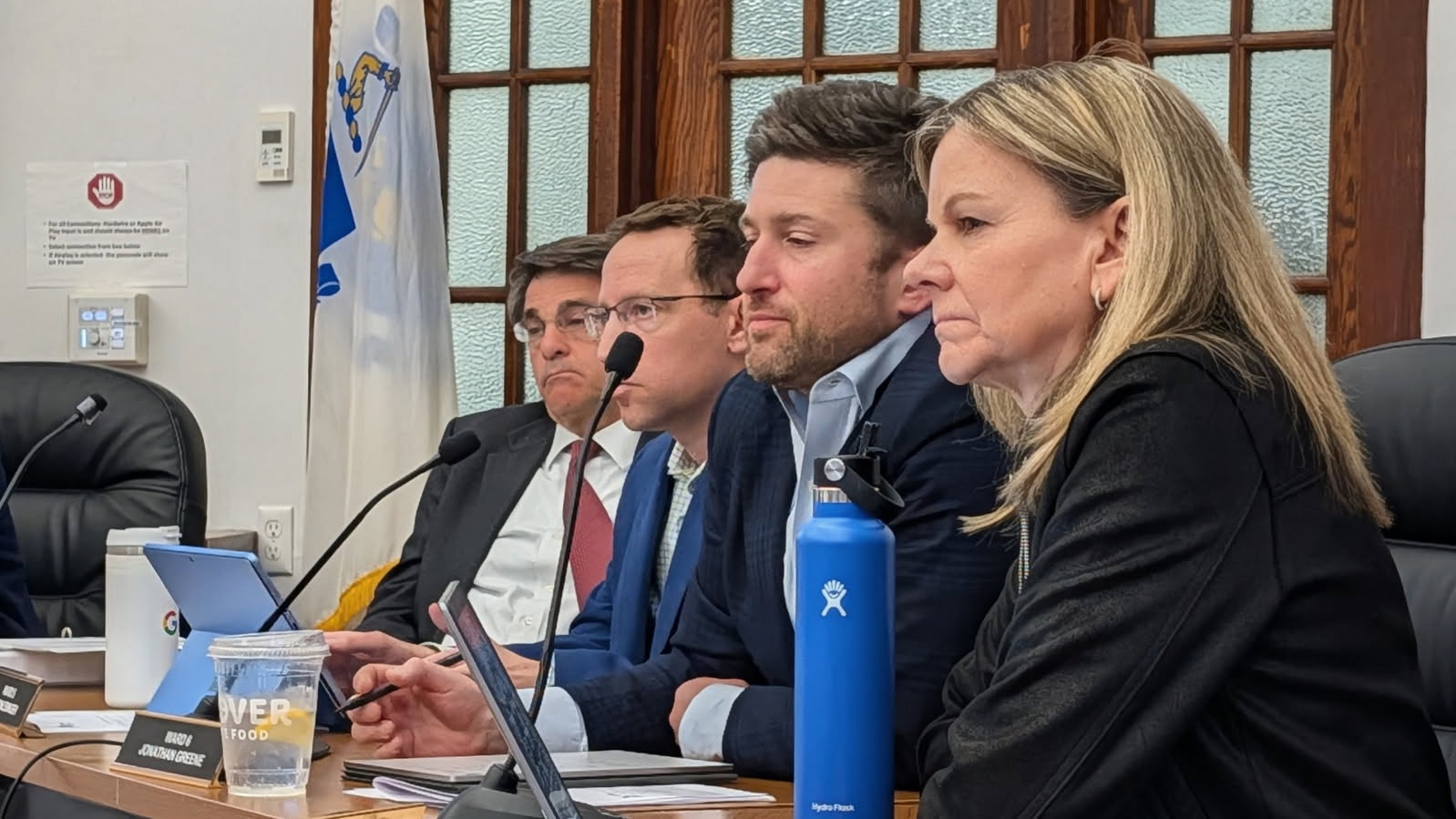
Mayor Marc Laredo and School Committee members Ben Schlesinger, Jonathan Greene and Linda Swain listen to public comment on March 30, 2027. Photo by Bryan McGonigle
The fork in the road
With the allocation what it is, Nolin presented the School Committee with two options to close the gap, using personnel cuts and “non-personnel levers” to get the NPS FY2027 budget down to $314.5 million.
Path A: Approve a $314.5 million budget with no new math program but also with fewer staff cuts.
Path B: Approve a $314.5 million budget advancement with the new math programming but with more staff cuts.
She presented a third option as well, to reject both options and work on a new budget.
Math program overhaul has been a demand of Newton families for years, Nolin said, and her administration has spent a year working with teachers on planning the new programming.
“We have a plan. We’re poised to do it. Is this year to do it,” Nolin said.
Laredo recommended going with Path B, the option that includes the new math programming but comes with cuts to DEI, sustainability and mental health staffing.
“I think many of us heard over and over and over again, as we talked to folks all across the city, that math was lacking, particularly middle school math, and this is an alternative that has the opportunity to affect a very broad group of children,” Laredo said.
Ward 4 School Committee member Tamika Olszewski, however, cautioned against adding eight new employees before the district can figure out how to fund those employees permanently.
She also lamented the potential loss of DEI and sustainability leadership and urged her colleagues to think about creative solutions to “break the cycle whereby every single year, we are cutting–death by a thousand cuts, I heard–cutting positions that are near and dear to the mission and the values of this community, to the delivery of student outcomes.”
“If we’re doing $3 million of cuts year over year, we are not going to be able to get to a place where we can thrive,” Olszewski said. “We are going to be perpetually eroding. We’ll be right back here next year, 3 million more dollars of cuts.”
The School Committee could potentially vote on one of the options on Monday, April 6.
Share This Story On:
DONATE TO SUPPORT LOCAL NEWS
Your tax-deductible gift to the Newton Beacon keeps our community connected and its residents informed.
Get story alerts
twice a week:
Related Posts






Upcoming Events