

SchoolDesks2
Empty school desks
The majority of Newton students in grades 6 through 8 are not seeing learning growth at a pace that meets state standards, and the district’s central administration is looking to fix that.
With what Superintendent Anna Nolin—who made math program overhaul a pillar of her vision for NPS when she started in the district three years ago—calls a “deep urgency,” she and Assistant Superintendent Gina Flanagan presented data and recommendations to the School Committee on Monday night.
“You had asked as a committee for an update, because, like me, you receive a lot of conversation about math, and a lot of people hit you up on the election trail about this, and I need you to know where we are, and I think we can’t talk about it enough in terms of what I’ve heard from Newton residents,” Nolin said.
Distressing data
Nolin’s sense of urgency is highlighted by growth percentiles—a measurement showing a student’s performance relative to their peers over a set amount of time. Over the past two years in Newton, the average growth percentile in middle school has declined.
“The stagnation and the decrease in growth percentile show that Newton is not keeping pace with the nation as a whole and how student growth percentiles are calculated,” Nolin explained. “So for those above benchmark or advanced learners, they’re growing less than anywhere across the nation in terms of the national benchmark and certainly in terms of the state benchmarking.”
Newton students below and above the benchmark of meeting expectations are all seeing lower growth percentiles than students their ages in other districts across Massachusetts and the country as a whole.
The district has 690 students in grades six to eight, and their average growth score in math is 39 percent, compared with the average growth nationally being between 40 percent and 60 percent.
Newton’s middle schools do not have Nolin’s MTSS (Multi-Tiered Systems of Support) framework, which consists of standard curriculum for every student as well as additional support for each student depending on what that student needs to reach both their potential and growth standards. Full district-wide MTSS implementation has been delayed by budget constraints.
Lacking that system would explain in part why middle schools in Newton are struggling more than elementary schools, which have MTSS already.
“So what that means is that the classroom teachers can’t pull a new rabbit out of the same hat without additional resources,” Nolin said. “It’s not due to the practice of our classroom math educators, but it is a combination of our curriculum, lack of alignment, teacher training and differentiation, and these opportunities for intervention. And our fully subscribed teachers, who teach full time at the middle school already, cannot add additional intervention blocks without extending their school day.”
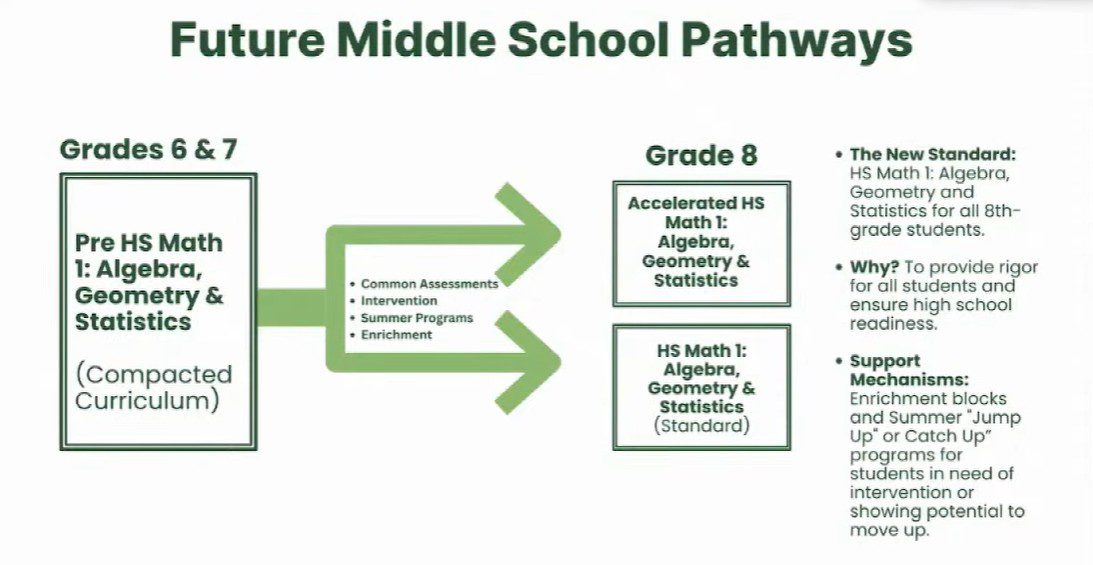
This diagram shows potential math education pathways for students in middle school, Newton Public Schools
Pathways and pilots
Next, Assistant Superintendent Flanagan went over what an overhaul may look like, with a focus on making sure math programming is “very clear, concise and is aligned throughout the district.”
“One thing that we have been discussing over and over again is that we need to move away from rigid tracking and really open up the doors for our students in terms of how they receive math instruction,” Shore said. “The goal has always been to move away from gatekeeping and to create gateways for kids to advance math coursework.”
For starters, algebra will be taught in eighth grade, rather than introduced in ninth grade. And there will be a high school placement test given to eighth graders that will start during the 2026-2027 school.
That test will help determine which of the district’s new pathways to advanced math the student will take.
Those pathways include standard curriculum as well as additional supports for those who need it and an accelerated pathway for those eighth graders who excel beyond the standard. Advanced curriculum will be available to students in the accelerated pathways in eighth grade, while other students will take those courses in high school.
There’s still a lot of evaluation and planning to do to iron out details regarding how many eighth graders will need which supports, how many will fit into accelerated curriculum, and how many teachers there will be to carry out the new programs.
The high schools will transition from one course with several levels to five courses with defined benchmarks for each course.
The new pathways and pilot programs will be phased out over the next three years, with full implementation in the 2028-2029 school year.
You can watch the entire two-hour presentation here.
Editor’s note: An earlier version of this story read that only 42 percent of middle school students met or exceeded expectations, but that number is regarding the percentage of students who met expectations of learning growth, not expectations of performance overall. The actual percentage of students in sixth through eighth gfrade who do not meet performance expectations is 7 percent.
Share This Story On:

DONATE TO SUPPORT LOCAL NEWS
Your tax-deductible gift to the Newton Beacon keeps our community connected and its residents informed.
Get story alerts twice a week:
Related Posts







Upcoming Events