
AmyDain
A few years ago, the state mandated cities and towns with MBTA access rezone for higher density housing, to both combat the state’s housing shortage crisis and inspire more housing development near public transportation stops.
Signed into law by Gov. Charlie Baker in 2021, the MBTA Communities Act has resulted in about 7,000 new housing units in about 100 new developments across eastern Massachusetts.
In Newton, where MBTA Communities Act compliance was met with the Village Center Overlay District passage in December 2023, change has been incremental and not as bold as housing proponents had hoped.
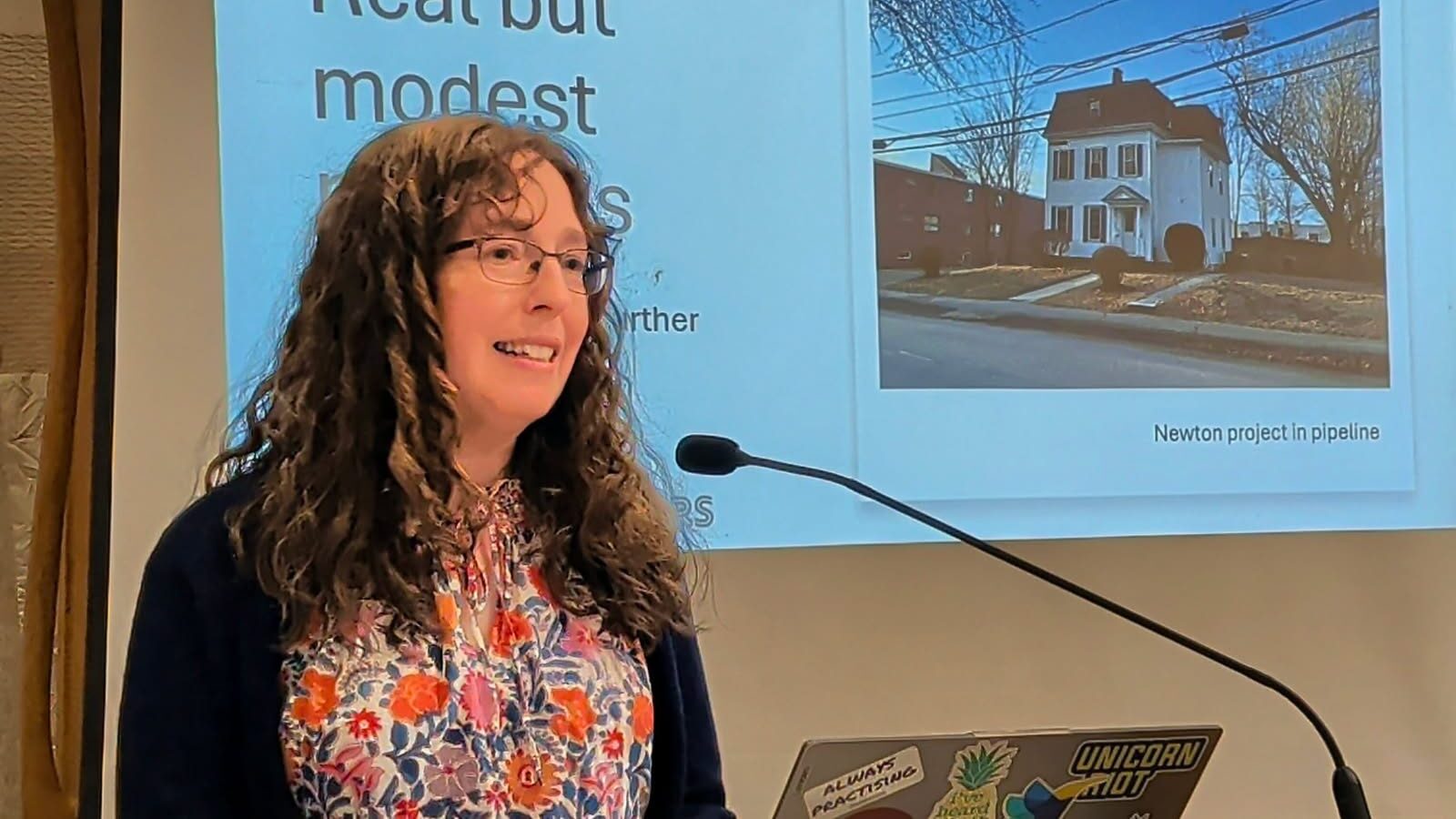
These are just some of the takeaways from a comprehensive report released by Amy Dain of Newton, who works for Boston Indicators, on the impact of the MBTA Communities Act on housing supply. Dain presented her findings last week at Congregation Dorshei Tzedek in West Newton.
“Specifically, I analyze the pipeline of projects under MBTA community zoning, projects that are in the permanent construction or occupancy stages,” Dain said.
The event was organized by Newton for Everyone.
No small feat
All-in-all, Dain said, the MBTA Communities Act has been “a huge accomplishment.”
“We’ve just seen the most significant wave of pro-housing local zoning reform ever in Massachusetts,” Dain said. “Ten years ago, advocates did not think that this level of reform was possible. Political possibilities change.”
Change became possible with a housing shortage that was sending rents and sale prices soaring through the stratosphere, prompting state lawmakers and Gov. Charlie Baker to act.
Since Baker signed the MBTA Communities Act into law in 2021, thousands of new housing units have been built that would not have been allowed by-right before.
So, while in her presentation Dain called the change we’ve seen “modest” because it doesn’t eliminate the housing shortage that has been developing for decades, she emphasizes that it’s real change because there is real housing going up because of the law.
The MBTA Communities Act only requirement covers about 1 percent of the total land area in the affected communities, and more needs to be done by the state to foster even more housing in the future, Dain said.
Dain’s report separates MBTA communities into three compliance categories:
- Communities that went above and beyond
- Communities that went for more incremental change
- Communities that complied on paper only
Newton, which had a near-civil-war over the VCOD, fits into the middle category. About 100 new housing units have either been built or are in the pipeline to be built in Newton’s VCOD.
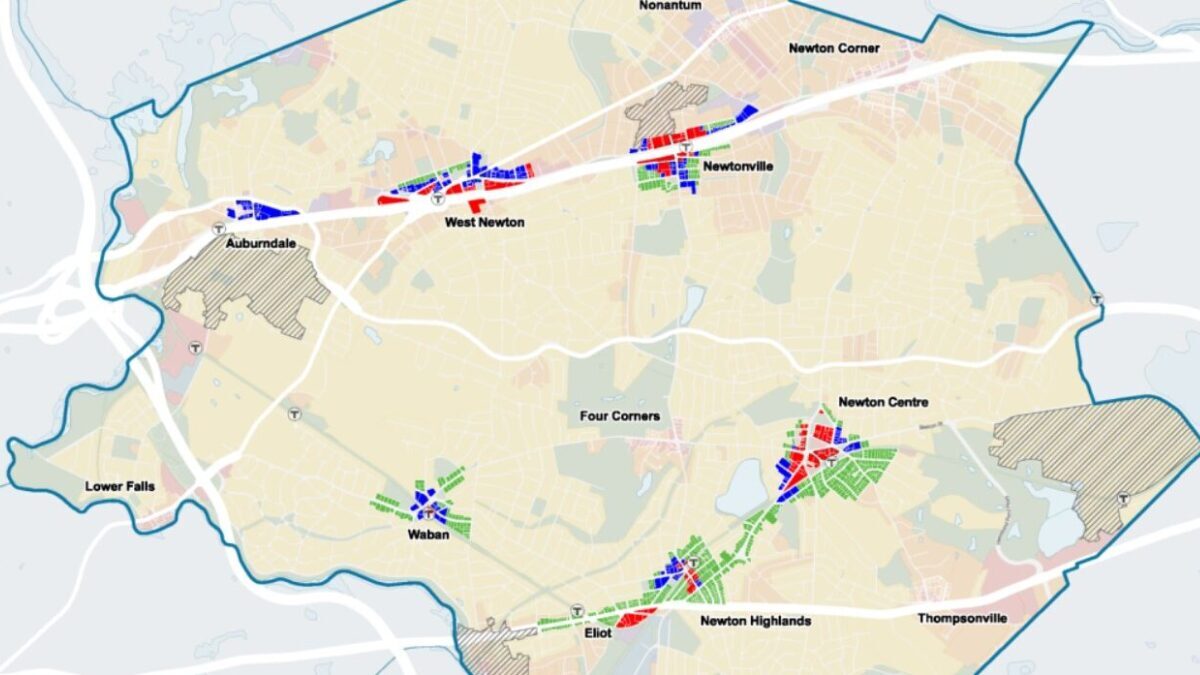
Map of village center zoning ordinance Newton’s City Council passed on Dec. 4, 2023. Red represents Vc3 (highest density zoning), blue represents VC2 (medium density) and green represents MRT (lower density near residential neighborhoods). City of Newton
The Newton numbers
The VCOD—the plans for which were in motion before the MBTA Communities Act was passed—was designed to add more life to the village centers and focus more housing near the city’s 10 MBTA stops. The MBTA Communities Act made that a mandate and came with requirements for each community to up-zone for a certain number of new housing units in MBTA station neighborhoods, and Newton had to allow 8,300 new housing units by-right (without a special permit).
What ensued in Newton was an ever-escalating battle between housing advocates and people who—with more than 2,500 housing units already in approval outside the specific VCOD areas—wanted to pump the brakes on development in the Garden City.
Several city councilors who had promoted the VCOD were ousted in that year’s local election. And that emboldened opposition to pare down the proposed density for the VCOD in areas like West Newton, while Nonantum was left off the VCOD completely.
To Nonantum’s credit, that village has the greatest number of three-family homes in all of Newton already, and those smaller multi-families are what have popped up in Newton’s VCOD, anyway.
But why is that? Newton’s City Council zoned for 8,700 new units of housing across about 3 percent of the city’s land area. But what’s come from it are smaller developments, including adaptive reuse of large houses into multi-family homes.
And adaptive reuse (keeping the bones of a house standing but renovating it into multiple units as opposed to tearing the whole house down and rebuilding) is something the city and state have been promoting.
But larger properties, with many more units and 4.5 stories in height, have not caught on as much.
Newton has about 15 small and medium-sized projects in its pipeline, most involving preservation and adaptation of existing homes.
“These projects were definitely not allowed by-right before before the rezoning. All individual, multi-family projects of any size needed city council approval for special rezoning,” Dain said. “So now they’re allowed by-right, but what we see here, on the one hand, is really profound change from what we did before. On the other hand, 15 projects add up to less than 100 net new units.”
There are 33,000 homes in Newton. So 100 new homes makes for an increase in less than a half of a percentage.
Newton’s VCOD includes tiered zoning, with the MRT zone allowed in residential neighborhoods with lower building heights than the denser VC3 zone in the middle of the village centers. So far, most of the VCOD projects are in MRT. And that accounts for Newton’s modest growth with the VCOD.
Some projects in Newton’s pipeline include:
- 6-10 Floral St., MRT zone, two net new units
- 121-125 Hyde St., MRT zone, three net new units
- 47 Chase St., MRT zone, three net new units
- 49 Chase St., MRT zone, three net new units
- 40 Cypress St., MRT zone, six net new units
- 424 Newtonville Ave., MRT zone, one net new unit
- 19 Highland Ave., VC3 zone, 35 net new units
There are fewer than 40 new units coming in the MRT zone, but the MRT zone is where most of the VCOD participation has been. And that can pose a problem if a community is trying to make real gains in housing supply.
“Small-scale projects have to happen on a lot of parcels to add up,” Dain said. “That’s one of the central lessons of the study.”
Dain noted that Newton does have almost 3,000 new units of housing coming with developments outside the VCOD—Northland, Riverside and Newton Crossing in West Newton are just a few examples—in its pipeline as well.

Small housing developments like this one have become characteristic of Newton’s approach to MBTA Communities Act compliance. Courtesy photo
Elsewhere, results vary
Newton has company. Bedford, Arlington, Belmont, Braintree and Weston also saw moderate incremental results with their MBTA Communities Act compliance.
Bedford, for example, rezoned 55 acres (about 1 percent of the total land area of the town) in the center of town with a new type of district that covers diverse parcels including single-family and multi-family homes, office and retail lots on side streets and main roads. As of now, Bedford has five projects in the pipeline with a total of 75 new housing units.
In Arlington, there are just four projects coming with the MBTA Communities Act, with 14 new units so far.
Watertown has just two projects coming, but they’re large, so they will bring a combined 200 new units of housing.
Communities like Lexington, Melrose, Lowell and Somerville are in Dain’s “above and beyond” category because they went much bigger with their rezoning than the new law requires.
Lexington, long known for an aversion to housing and development, seems to have found religion of sorts.
Before Lexington rezoned for the MBTA Communities Act, all multifamily projects had to be approved at the town’s annual Town Meeting. That means developments sometimes took years to gain approval, usually after projects were scaled down enough to get them the support of Town Meeting voters.
One development, a three-story building with 30 units of housing, was debated across two Town Meetings, over two years, before it got approval, Dain noted.
But with the MBTA Communities Act, Lexington upzoned more land than was required, at greater density than required by the state, and projects on that rezoned land no longer have to go to Town Meeting.
“As of January, Lexington had 12 projects in the pipeline, for a total of 1,286 units, which is actually one-fifth of all the projects on the MBTA Communities regional pipeline,” Dain said. “Just these initial 12 projects will make for a 10 percent growth in Lexington’s housing stock.”
And then there’s the last category, paper compliance only. Some communities aimed for zero growth, though it’s difficult to determine which ones will accomplish that. There would have to be zoning changed for a property that no one would realistically build housing on. Or there would have to already be enough projects under special permit in the works to make the MBTA Communities Act requirements moot.
“For the no-growth strategy to work in a given community, there has to be a certain match between the zoning requirements as benchmarks with the state set and what’s actually on the ground in the community,” Dain said. “So it was kind of like a challenging puzzle for a place that didn’t want to grow at all and wanted to comply with the state. And we’re still figuring out which ones kind of achieved that, and some of them were attempting it, but they might end up with some projects in the pipeline in the future.”
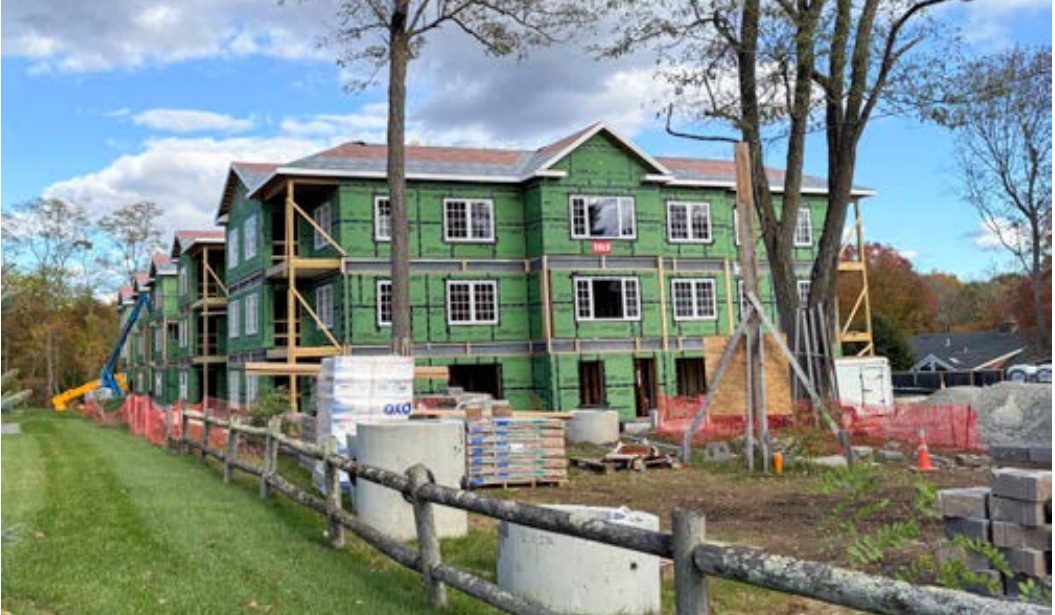
This development in Lexington is being built as a result of MBTA Communities Act compliance. Courtesy photo
What can be done next?
When Brookline passed its MBTA Communities Act compliance, photos came out of their Town Meeting of people smiling, cheering and hugging. That was not the scene in Newton in December 2023 when Newton passed its own compliance.
City councilors lost their seats that year. And in 2025, most of candidates who wanted to slow the roll of housing development won again, as many in the city see their suburb becoming unrecognizable.
At the same time, the panic some opponents spread in the lead up to passage of the VCOD—including claims that there were developers waiting to build up to new 15,000 units almost immediately with “Soviet-style” housing projects—was all for naught. And the actual problem with the VCOD seems to be getting developers to utilize it fully in the middle of the village centers.
That problem, Dain said, likely won’t be solved locally because of the aforementioned melee the VCOD ignited that still burns today. So, while there have been rumbling about expanding the VCOD, any further change in housing and zoning policy may have to come from the state.
For example, Dain sits on the Planning Board and said sometimes processes can take more time than they should. The state could pass a statute setting limits on what can hold up a site plan review of a project.
In the summer of 2024, Gov. Maura Healey signed the largest housing bill in state history, allowing for accessory dwelling units statewide, among other changes to foster more housing and at higher density. The impact of that law is still to be seen.
For now, the state and organizations like Boston Indicators are keeping an eye on the trends and patterns of growth the MBTA Communities Act—and in Newton, the VCOD—may bring in the years to come.
Share This Story On:
DONATE TO SUPPORT LOCAL NEWS
Your tax-deductible gift to the Newton Beacon keeps our community connected and its residents informed.
Get story alerts twice a week:
Related Posts




Upcoming Events