
bricks1
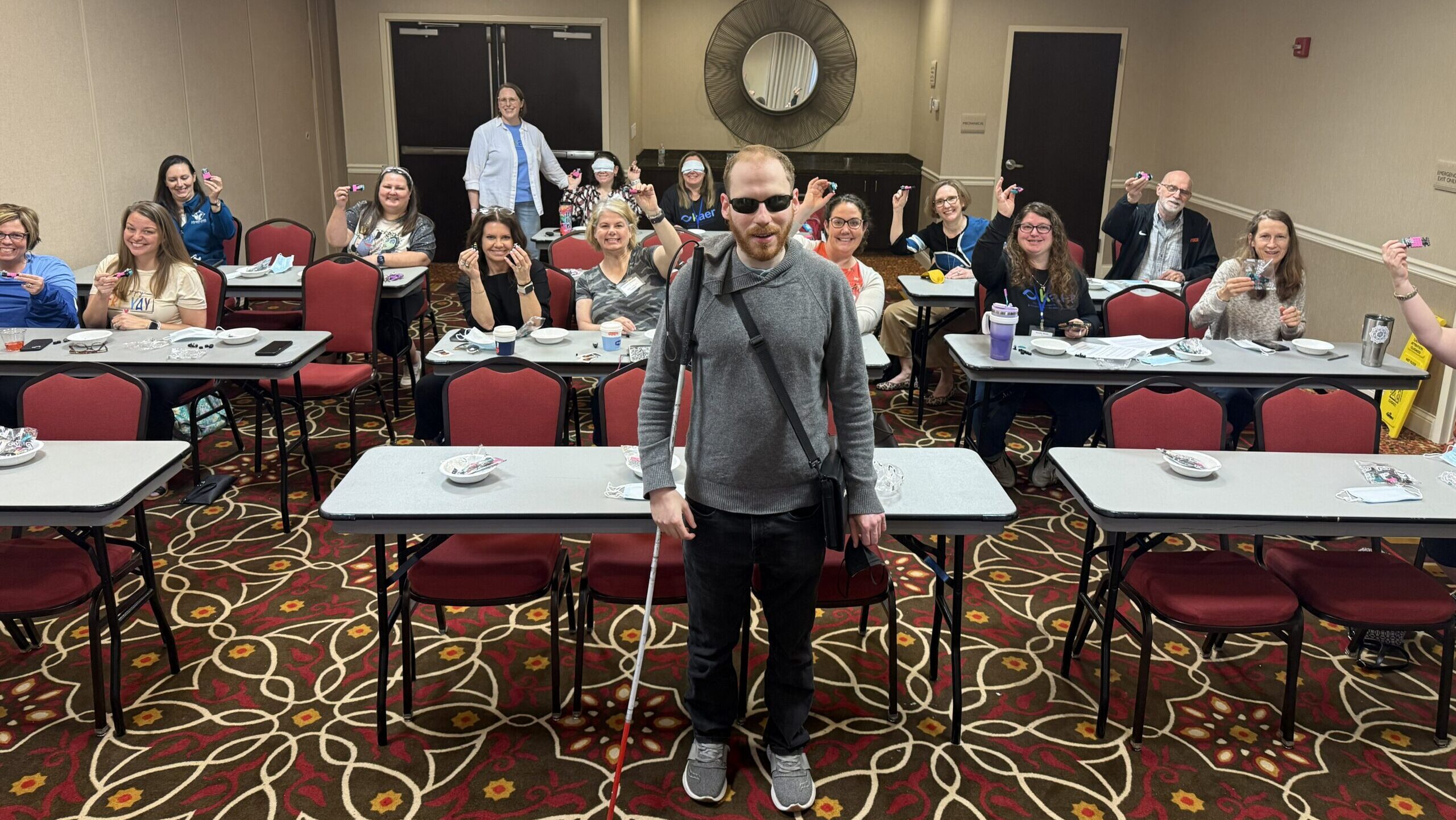
Newton resident Matthew Shifrin leads a nonprofit, Bricks for the Blind, which brings the joy of Legos to the sight-impaired. Courtesy photo
Newton resident Matthew Shifrin leads an initiative to make Legos more accessible through his nonprofit Bricks for the Blind.
“It’s been really wonderful because blind people have been able to explore the world in different ways,” Shifrin said.
Shifrin, 28, who grew up and lives in Newton, was born blind. His love for Legos began when he was 13 and a family friend, Lilya Finkel, translated the picture-based Lego instructions into text so Shifrin could follow along. Since then Shifrin has translated more instructions so other blind people could have access.
“It became this way to learn about the parts of the world that blind people physically cannot access that are too big to engage with,” Shifrin said.
From then, Shirfrin and Finkel started adapting Lego instructions until Finkel’s death in 2017. Shifrin realized he could not keep up this project by himself.
“I said to myself, you can either keep this project going and get it to the people who can make it happen, or you can throw in the towel,” he said.
At first, Shifrin reached out to the Lego Group in 2017 asking for help with his translating initiative. Lego offered to adapt 20 sets a year, which is fewer than 3% of the sets it releases annually.
“I cannot assume that the company is just going to make stuff accessible just because it can,” Shifrin said.
Instead Shifrin pivoted to forming his nonprofit, Bricks for the Blind. The organization has adapted nearly 500 Lego sets, building up a team of 30 writers and testers.
Writers are sighted people who adapted the Lego instructions into text, while the testers are blind people who ensure that the instructions make enough sense that any person could easily build the set. These volunteers come from all over the world.
Natalie Charbonneau, who lost her vision at age 8, was introduced to Legos when her boyfriend at the time had bought a set and audibly guided her through building it herself. That boyfriend is now her husband, Alex Charbonneau, and both are paid volunteers at Bricks for the Blind.
Alex learned about Bricks for the Blind through a Lego subreddit thread in which Shifrin asked for volunteers. After translating a small car set, Alex had Natalie try out his text instructions.
“I gave him some feedback and I was able to do it, and it was just a really cool feeling being able to build that on my own,” Natalie said.
For the past three years, the couple has been volunteering for Bricks for the Blind from the Pacific Northwest.
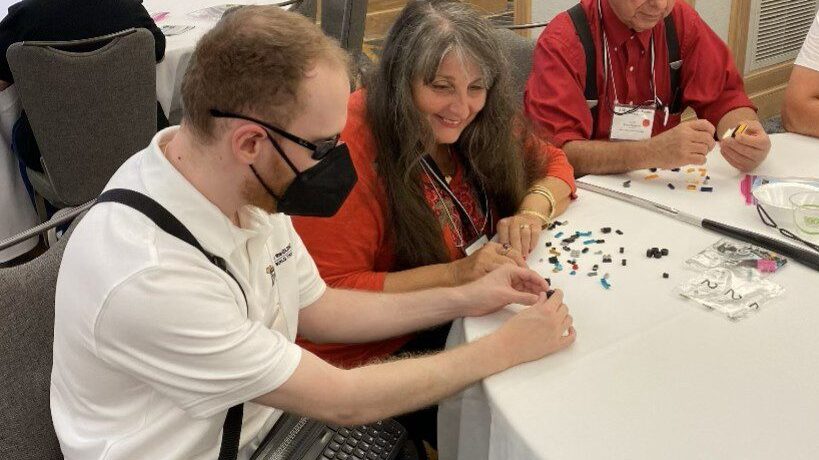
Bricks for the Blind is a nonprofit that brings the joy of Legos to the sight-impaired. Courtesy photo
Alistar Guild, a software engineer and a sighted writer in Scotland, got back into Lego building during Covid. After learning about Bricks for the Blind through an Instagram post, Guild thought it could be an opportunity to combine his hobby with an important cause.
“It’s nice to feel like I’m giving back a bit making Lego more accessible,” he said.
Each translation starts with a description of the box itself and then it defines the pieces and phrases the builder will be using throughout the process.
“The box is a deep blue,” reads a snippet from the text from the Harry Potter Chamber of Secrets set. “On the front right corner is an image of Harry, Hermione, and Ron from the film. A swish of magic curves around the border of the box.”
The process calls for a sighted person to sort the pieces into groups so the blind builder can build properly and is not overwhelmed by the number of pieces. From there, builders can use text-to-audio on the PDF or a braille translator.
“Place three tan 1×2 plates with three little triangles on one side, sideways with the triangles on the top, centered horizontally on the front side studs,” reads step four from the Harry Potter Chamber of Secrets set. “Repeat symmetrically on the back side.”
The time it takes to translate instructions varies based on the size.
“A small one could take a couple of hours. A large one could take a month or two, and by large, we mean, like 2,000 pieces,” Shifrin said.
Volunteers are paid small fees for their services. Writers have a slightly higher rate with a starting base of $50 plus the price of the set. Then they are also paid an additional 30 cents per piece in the set.
All translated instructions are available for free download on the Bricks for the Blind website, offering a range of sets from different collections and sizes. Users have downloaded instructions more than 30,000 times.
Bricks for the Blind, which reported $253,000 in donations and grants in 2024, gets no funding from Lego. However, because of Shifrin’s initiatives, Lego has also begun adapting instructions into braille and audio translations of their own.
A Lego spokesperson said she was unavailable for an interview but provided a written statement saying the company appreciates Shifrin’s work: “We applaud the work Bricks for the Blind is leading to increase access to play. Matthew’s story is inspiring and we’re pleased to have worked with him since 2017.”
Already this year, Bricks for the Blind has adapted 20 sets.
“The goal is just that the kid is able to go and get any set off the shelf and know for a fact that this is something that they will be able to build,” Shifrin said.
****
This story is part of a partnership between the Newton Beacon and the Boston University Department of Journalism.
Share This Story On:
BEACON SPONSOR

DONATE TO SUPPORT LOCAL NEWS
Your tax-deductible gift to the Newton Beacon keeps our community connected and its residents informed.
Get story alerts twice a week:
Related Posts






Upcoming Events