
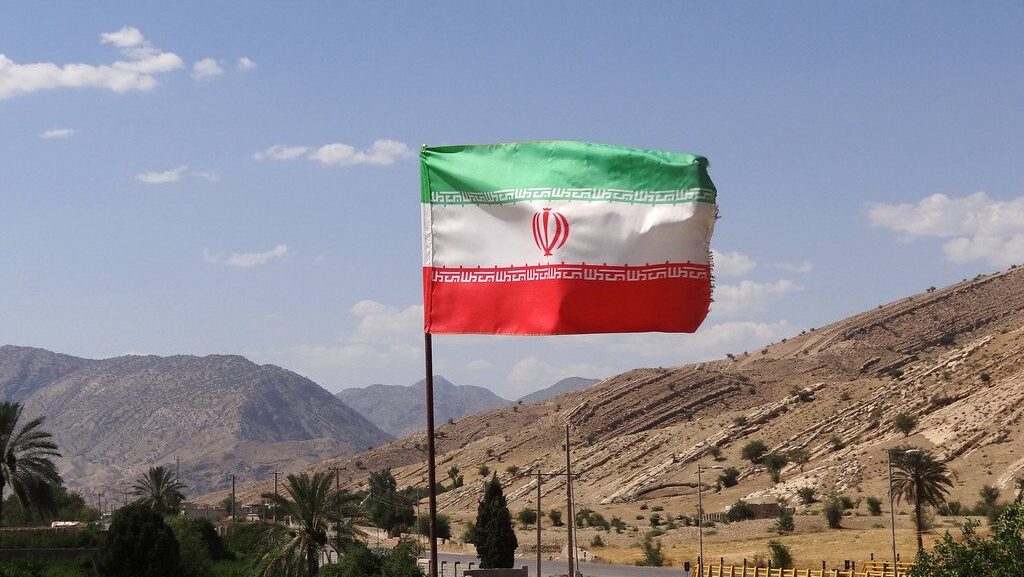
Iran
Iranian flag flying above an archeological site in southern Iran. Public domain photo
For Iranian and Lebanese residents in Newton, the war overseas feels both distant and dangerously close, unfolding through headlines, long silences and urgent phone calls from home.
“The biggest overwhelming feeling … has been helplessness,” said Daniel Hannoush, a Lebanese American student at Boston College.
The escalating conflicts involving Iran and Lebanon are rooted in long-standing political, social and economic tensions across the region.
In Iran, the latest wave of violence began Feb. 28 with U.S. and Israeli airstrikes targeting nuclear and military infrastructure. Iran responded with strikes on neighboring Gulf countries, including Qatar, the United Arab Emirates, Kuwait and Bahrain, widening the conflict into a regional war.
In Lebanon, the Iran-backed group Hezbollah entered the fighting on March 2, prompting an Israeli ground invasion in the south. On April 8, more than 100 bombs fell across the country in 10 minutes. The death toll remains uncertain, though Amnesty International has reported at least 254 people killed.
Reuters, citing the International Federation of Red Cross and Red Crescent Societies, reported at least 1,900 people have been killed in Iran and 20,000 injured in the strikes.
For diaspora communities thousands of miles away, those numbers are more than statistics—they are a fragile way to track the safety of friends and family back home.
Amid the uncertainty, many are grappling with a difficult question: Could this war bring lasting change?
“It’s almost impossible to answer succinctly,” said Cyrus P. Dahmubed, a newly elected Newton city councilor whose family belongs to Iran’s Zoroastrian religious minority. He said he hopes for a democratic and open Iran but remains uneasy about how change might come.
“You can want an outcome without liking how it’s happening,” he said.
The stakes are deeply personal. Dahmubed, who has never visited Iran, said his identity shapes his hopes for the country’s future.
“I’m half Persian and queer,” he said. “I want to see a society that is tolerant and embracing—including queer people.”
Still, he expressed concern about the war itself, particularly the lack of congressional approval for U.S. involvement.
“When you hear that dozens of schoolgirls have been killed, you know something is going wrong,” he said. “It makes you anxious, especially when you have family there.”
Dahmubed was referring to a March 3 U.S. airstrike in Iran that killed more than 100 children, according to Amnesty International.
Locally, he hopes the crisis can foster understanding within Newton’s diaspora community.
“My hope is that we come together to support each other and engage meaningfully in conversations about our homeland,” he said. “Even something as simple as pronouncing ‘Iran’ correctly—that matters.”
For Ashkon Roozbehani, founder of Persepolis Law in Newton, the war has brought fear rather than optimism.
“A lot of people in the diaspora believe this will quickly lead to the fall of the government,” he said. “I don’t see it that way. I’m actually very scared.”
Roozbehani, who is from Tehran and Lorestan province, said that fear has long shaped his relationship with Iran.
“Even when I visit, there’s an underlying sense of risk,” he said. “The government can be hostile to members of the diaspora. There have been cases of people like me—U.S.-born men—being detained.”
Unable to reach extended family members in Iran, he said the uncertainty has been especially difficult.
“I would love to live in Iran someday,” he said. “But that hope feels very slim right now.”
Having grown up during the Iraq and Afghanistan wars, Roozbehani said he worries about the long-term consequences of conflict.
“I’ve seen how those wars left countries in chaos,” he said. “I want change in Iran, but I’m deeply concerned about the cost.”
For him, the stakes are clear.
“If any of my family members were harmed or killed, it wouldn’t be worth it—regardless of the political outcome,” he said.
For students like Hannoush, distance itself is one of the hardest burdens.
“I’m privileged to be in the U.S.,” he said. “But that comes with a sense of distance. I can’t help in the ways I wish I could.”
Hannoush, whose family is from Zahle, Lebanon, remembers the country through moments of joy—walking along the Berdawni River with his grandfather, surrounded by shops and ice cream stands.
Now, he said, those images are overshadowed by war.
“I deleted Instagram about 45 days ago,” he said. “Even when I briefly re-downloaded it, I removed it again. I still use Twitter, but I try not to rely on social media for information.”
At Boston College, Hannoush serves as treasurer of the Lebanese Club, where students are planning fundraisers and cultural events to support Lebanon.
“We’re organizing a ‘Taste of Lebanon’ night,” he said. “It’s a way to share our culture while also educating people about what’s happening—in a positive and meaningful way.”
This story is part of a partnership between the Newton Beacon and the Boston University Department of Journalism.
Share This Story On:
BEACON SPONSOR
DONATE TO SUPPORT LOCAL NEWS
Your tax-deductible gift to the Newton Beacon keeps our community connected and its residents informed.
Get story alerts twice a week:
Related Posts


Upcoming Events