
Johnson1
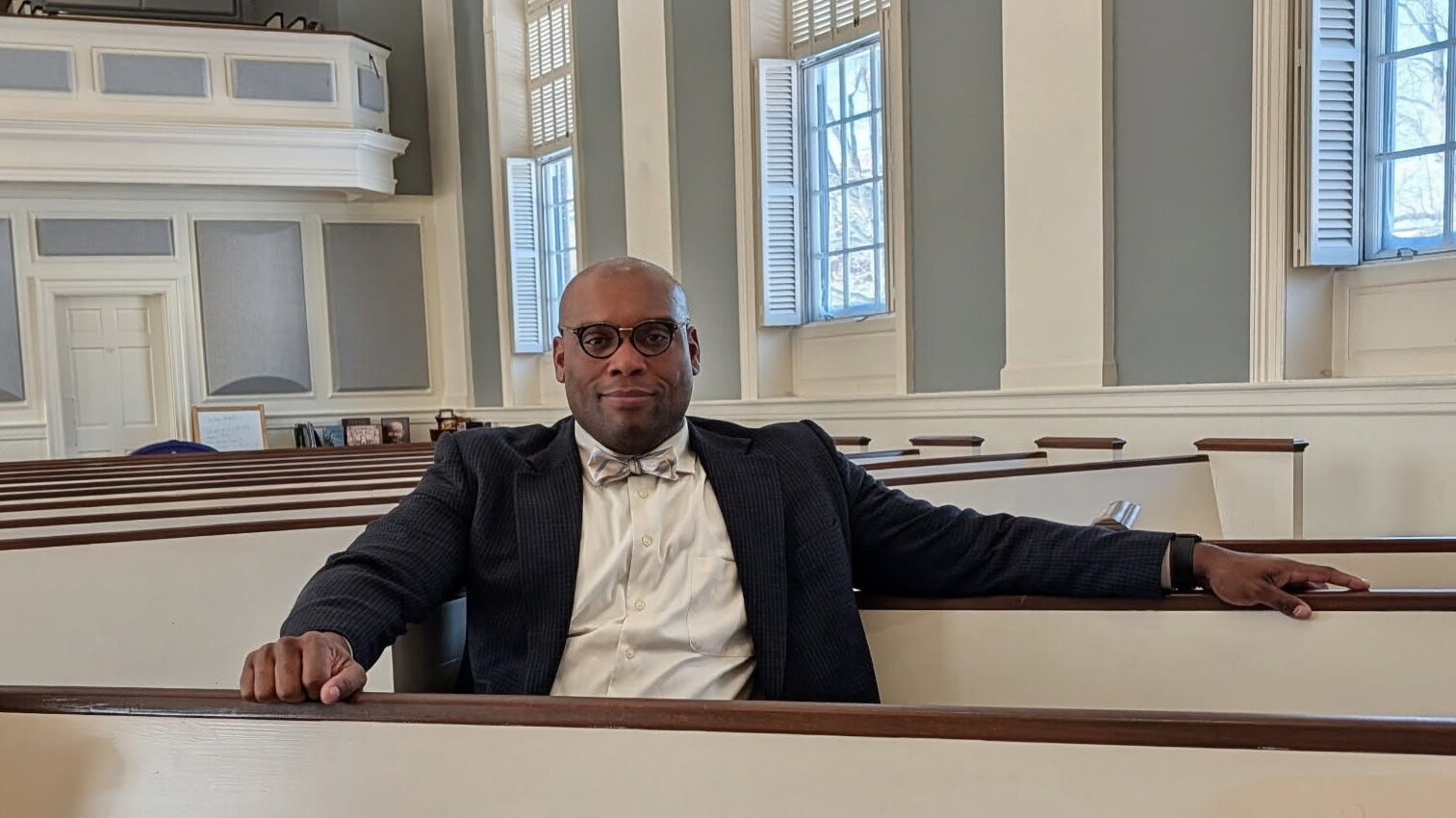
Pastor Eric Jackson of Eliot Church in Newton. Photo by Bryan McGonigle
In January, the Rev. Dr. Eric Jackson of the Eliot Church of United Church of Christ graced a packed crowd at the city’s Martin Luther King Jr. Day event with a passionate speech on justice and values, telling them they “can’t sit this one out.”
A month later, with the nation in crisis and people doom-scrolling through their days, Jackson is doubling down on that message, calling for unity and channeling the energy of the civil rights movement.
“We’ve never all had it right from the beginning. We’ve all had to grow and learn and help develop our justice muscle, if you will,” the pastor said as he sat down in a small conference room in his church, the day after a blizzard brought the city to a standstill. “We grow, and that’s part of being human.”
Awakening in Co-Op City
Jackson was forged in diversity. He was born in the Greenwich Village neighborhood of New York City and raised in a neighborhood near the Bronx called Co-Op City, the largest housing co-op development in the world.
Jackson came from a big family. One of his grandmothers had seven children, and the other had 12. Most of his extended family went to church every week, even though he and his mother and two siblings only went on special occasions.
As a child, Jackson dreamed of getting a Ph.D. and being a college professor, nurturing curious minds with the sustenance of knowledge.
But at some point, he had what he calls an awakening.
“I wanted to have a more direct impact in people’s lives, as opposed to just only shaping ideas and thought, ‘How can I have the most direct impact in people’s lives, and how can I do this with my faith?’” he recalled. “And I realized that it was in the local church, because you bring people together from all walks of life, different stories, even if they live in the same community.”
Jackson watched his own local church in New York do meaningful things—like build affordable housing for seniors, for example—that inspired him to seek a path of faith.
“I watched how my family, outside my home, my aunts, uncles and grandmother, went to church every Sunday, and I watched how much joy they had in their lives, and it made me curious,” he said. “And I went to church one Easter Sunday and never left.”
Whatever he found that Easter has stayed with him. His local church, where he served as a junior deacon, taught him how to work out life’s challenges, how to work with others and how to build relationships and community. It also helped him get over any nervousness he had about public speaking.
“At my church, we had about 700 to 1,000 people on a Sunday, so I had to stand in front of 700 to 1,000 people and pray,” he said. “I learned so many life skills in the local church, and it really helped to form who I was.”
Jackson’s family was supportive of his journey. Being at church was the only acceptable reason for breaking curfew.
On faith, politics and values
Jackson attended City College of New York and studied political science. Why would a man of faith study politics? Because religion and politics intertwine, and he discovered that “in the oddest windows.”
“I was big on political philosophy, I studied the ideas of Marx, Plato, the Enlightenment poets, and it taught me to approach society with more questions than answers,” Jackson said.
Examining societal systems and why they exist requires an examination of values, Jackson explained, with values shaped by religion often molded into public policy through politics. And values are part of any discussion about religion or politics, because both shape, and are shaped by, values.
Through that lens, the idea of separating religion and politics is impossible.
“I think back to the story in the Bible where Jesus tells the fishermen, ‘Come, leave your nets behind and follow me,’” he said. “It’s a total commitment, making fishers of people, right? If religion cannot be put into the conversation on what’s going on in the world, that means our religion is very limited. You have just limited God, and you’ve just limited religion.”
Jackson also wants us to rethink how we use the word “political.”
“When you think about it, it boils down to some things, like legislation, running for office, candidates, but there are certain things that happen in the political sphere that are moral, and religion is a moral enterprise, so religion must speak to what’s happening in this political sphere,” Jackson continued. “And I think sometimes we conflate politics with the moral and what we’re talking about here is how values and morals are lived out, systemically, interpersonally, institutionally and ideally. And it just so happens that, yes, these things show up in politics because they shape our systems, our institutions and our ideas, and ultimately, how we relate to each other. So what we’re talking about here isn’t so much religion in politics, it is part of religion, values and morality, speaking to wider society.”
Never one to shy away from diversity, Jackson brought that mindset to Hillsboro, N.H., when he was chosen out of more than 70 applicants to be minister at Smith Memorial Congregational Church.
Jackson was the first Black pastor at the church.
“I was the first black everything in that town,” he joked. “But it was a lovely, lovely experience and exceeded my expectation. And they hold me in their hearts, and I hold them in mine, and I still keep in touch with them.”
It was in New Hampshire that Jackson saw that community and shared emotion—grief, jubilation, curiosity, hope—can overcome political and racial divides. He saw that when police killed Michael Brown in Ferguson, Missouri, in 2014, and he helped organize a prayer vigil.
“And Republicans in town and Democrats in town all showed up in the town center, because they said that was horrible how that young man was killed,” Jackson recalled. “Now, if you go to other places a little bit more blue, you’ll only get the liberals that will show up, and maybe some moderates, but the hard right people—you won’t see them. But there [in Hillsboro], they had a more conservative group that ran one newspaper. Then they had slightly left-leaning liberals, and both of them, both sides, came out that day because they thought it was just horrific what happened to Michael Brown.”
In 2024, wanting a change, he looked into jobs at UCC churches from California to Florida and chose somewhere close: Newton, Massachusetts. Jackson was hired to be pastor at Eliot Church, founded by abolitionists in 1845. And he didn’t just land a job. He landed in a new home.
Newton is far more progressive than Hillsboro. But contrary to popular belief, that doesn’t mean a lack of religion or spirituality. Newton has an abundance of churches, temples and other houses of worship, actively involved in the city.
“The city is wonderful, and the church is very involved in the community itself,” he said. “So they believe serving locally is very important, and being active in the city of Newton and being concerned is an important part of who they are. I find the church to be very big on inclusion, and has an expansive theology, expansive faith. So you can have somebody who may have Jewish origins, or Buddhist origins, Hindu origins, and they’re all in the pews on Sunday because something within the Christian story moves them.”
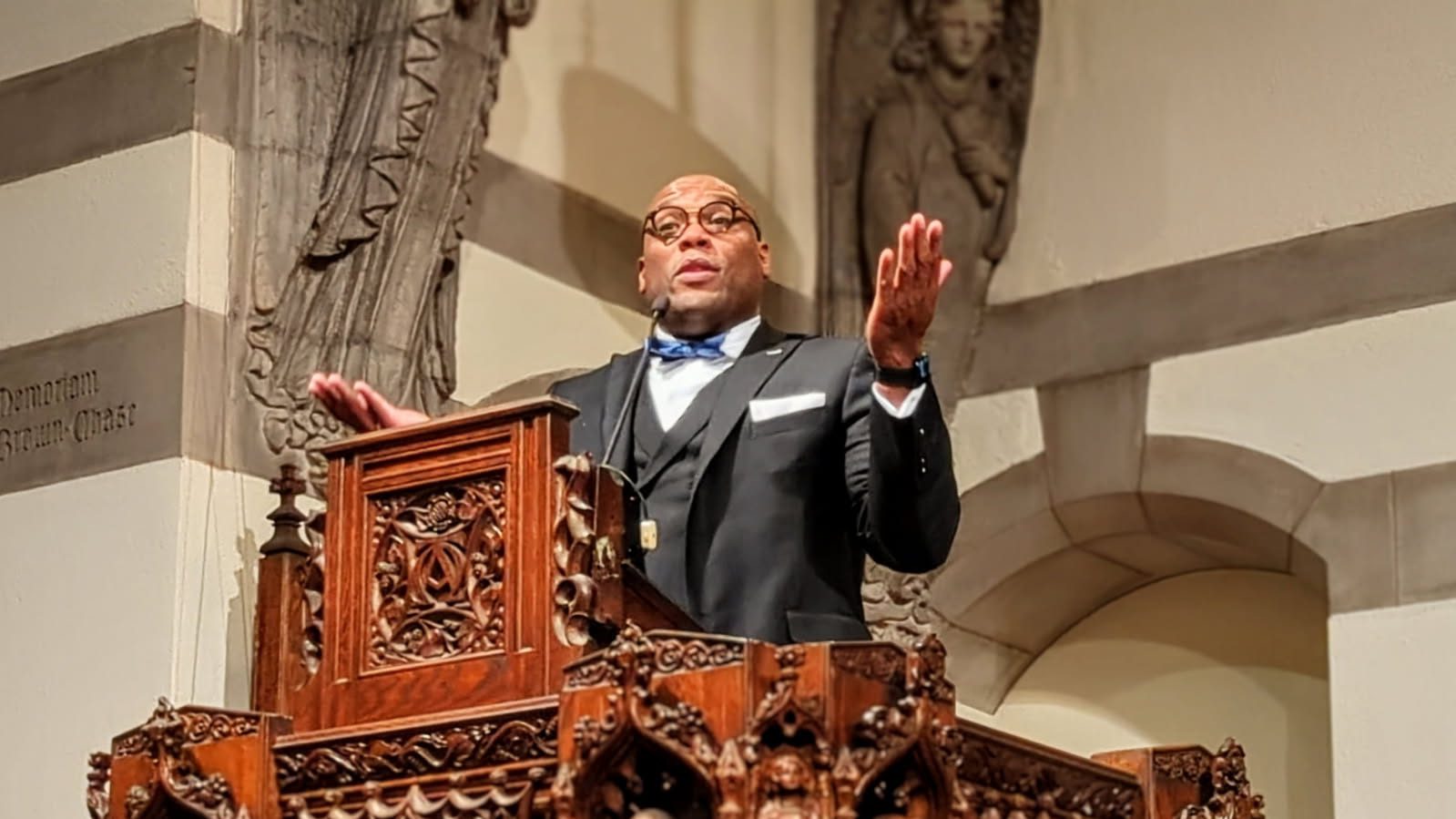
Rev. Eric Jackson of Eliot Church delivers remarks at the Harmony Foundation’s 58th Martin Luther King Jr. Community Celebration on Jan. 19, 2026. Photo by Bryan McGonigle
‘We’ve seen this movie before’
As the nation observes Black History Month, Jackson points out how the trouble he sees today—widespread racism, government-sanctioned brutality, an escalating battle for the nation’s soul and values—has been part of the Black experience in America since the nation was founded 250 years ago.
“We’ve seen this movie before and lived through it, through segregation in the 1950s, and I can go on and on—from Ronald Reagan talking about ‘welfare queens’ to all this we’re seeing now,” Jackson said. “I would say this moment in time, though, when you look at what’s happening, it’s not just an assault on African Americans. It’s an assault on anybody who is not in alignment with those who have the most wealth in our nation, in the world.”
Jackson emphasized that he doesn’t dislike wealth, as long as it’s spread out enough that there isn’t widespread poverty. But in today’s reality, with the wealth gap growing rapidly and so many Americans facing food and housing insecurity, scarcity is the sin. And that affects working class people of all races.
“So it’s not just African Americans that are impacted. Everyone’s impacted here; people who happen to be white and poor, people who are Latinx, people who are same-gender-loving, trans people,” he said. “Yes, right now we’re seeing a primary assault on black and brown, but it’s a ripple effect. Eventually the train will hit everyone.”
So what is it time to do? For that answer, Jackson points to the 1950s and 1960s, the civil rights era that saw swift and dramatic change in both culture and public policy.
“What can every American learn from the civil rights movement?” he asked. “It’s not that, ‘Oh, just don’t do this bad stuff,’ because people who want to continue exercising power in a very toxic way right now don’t care about that message. But what we can learn from it is look at how they resisted with nonviolent direct action, they organized, they came together.”
Black people, organizing in Black churches with white allies, put enough pressure on government and society at large to demolish the century-old Jim Crow laws that had segregated the nation for generations. And that kind of interracial, values-based movement can reverse the tide of trouble we see today, he said.
“Now we have even more demographics impacted as well—although the assault is primarily on black and brown bodies right now—but we have something to learn about people organizing and being a voice for change and really coming together to do the work of justice, to help bend that moral arc of the universe a little bit more closely toward justice,” Jackson said.
There are advantages to civil rights movements now compared with back then, largely with technology and outreach. Things were very disconnected in the 1960s, with no internet or social media to show the world what was happening. He sees that solidarity captured on countless videos coming out of Minneapolis, the epicenter of stepped-up Immigrations and Customs Enforcement operations that have resulted in federal agents killing several civilians over the past few months.
“Now, because of social media and cell phones and tech, everybody can be a reporter,” he said. “We also have the tools and the resources because of societal technological advancements, for example, to really be able to come together and form coalitions across the lines of difference, to resist. Because what we see over and over again, is that when people come together and stand up, change happens.”
It seems to be happening, albeit gradually. Unlike the days of Occupy Wall Street, protests under Trump 2.0 have seen a sharp spike in attendance, largely from older white moderates.
“I remember back in 2014 and 2015, in those days over a decade ago, protests were different in New Hampshire,” he said. “Now you have larger crowds that can barely be contained. It’s a lot different now.”
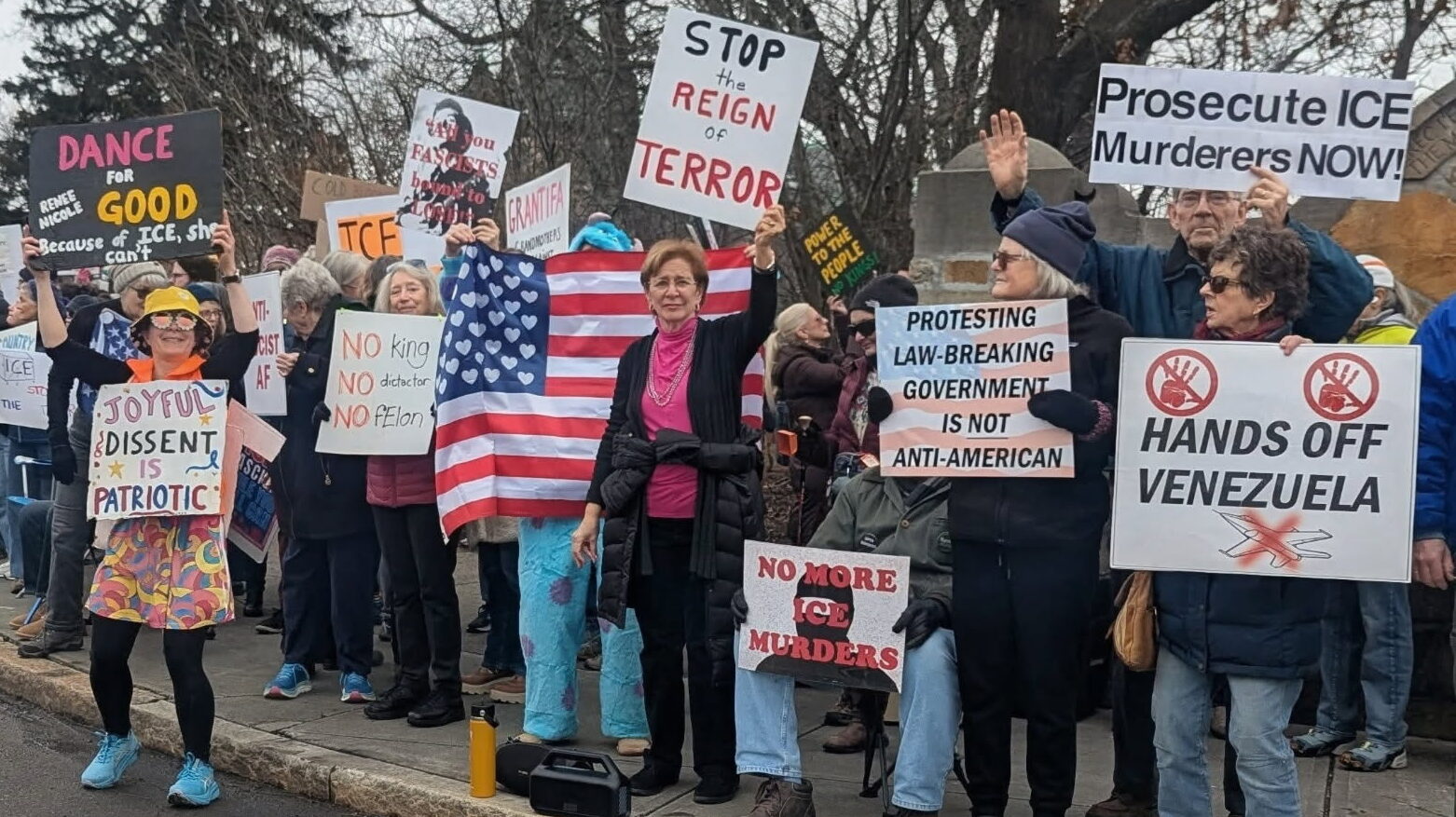
Hundreds protest against the Trump administration and Immigration & Customs Enforcement in Newton Centre on Jan. 10, 2026. Photo by Bryan McGonigle
Space for grace
Jackson said people need to be more curious about what others are seeing and experiencing.
“If you don’t feel like it’s your problem, at least the important thing you can do is bridge the gap by saying, ‘Tell me more. What do you need? What can I do to help?’” Jackson said. “Because when you peel the layers away and go down to the heart of really what’s at the issue of this, it’s stuff that affects all of us.”
Curiosity can lead to empathy, which can build solidarity.
“I was having a good conversation at the Harvard Breakfast Club with Doris Kearns Goodwin,” Jackson continued. “We were talking, and she made a very good point about affirmative action. She said those civil rights gains didn’t just benefit Black people. She said they benefited more than Black people. They benefited white women. It was a ripple effect that benefited—this was her talking—benefited multiple entities. These issues we’re seeing from the surface impact Black folk, they also impact all of us.”
And with cuts to social services and programs like SNAP and housing assistance affecting many people who voted for the current administration, Jackson cautioned that now is not a time for gloating or condescension.
“Unfortunately, empathy is a hard thing, and it’s very hard sometimes for people to learn it until it happens to them,” Jackson said. “And I think we have to have space for grace.”
With fights ramping up on many fronts, Jackson said he wants to see people focus on housing affordability, voting rights and protecting immigrants and the LGBTQ community.
“If we had to sum it up, I would say the big picture is looking at how we embrace our humanity across the lines of difference,” Jackson said. “That’s the overall thing. More technically, voting rights, housing, immigration, how we treat our LGBTQIA-plus community, even dealing with systemic racism, they all tie back to the same thing.”
Jackson is handling it all with the love of a girl—his beloved poodle, Scooter.
Readers will be seeing more from Jackson, who has signed on to be a regular columnist for the Newton Beacon. Look for that column soon.
Share This Story On:
DONATE TO SUPPORT LOCAL NEWS
Your tax-deductible gift to the Newton Beacon keeps our community connected and its residents informed.
Get story alerts
twice a week:
Related Posts





Upcoming Events