

THE JOURNEY
As I waited in Tokyo’s Narita Airport recently for the red-eye flight that would take me back to the United States—and, ultimately, back to my home in Newton—my epic 10-week, 10-country trip around the Asia-Pacific Rim was drawing to a close.
And I couldn’t help thinking how, somewhere in the last quarter century, the outlooks in Southeast Asia and the United States have flipped on the optimism and positivity scale.
The brighter mood was tangible across the Asian Pacific. It was most evident in Hanoi, where people, especially the younger set, seemed incredibly excited about life and the future. The 14th National Congress of the Community Party of Vietnam had just mandated the goals of becoming a high-growth, innovation-led economy by 2030 and a high-income developed nation by 2045. Ironically, it designated the private sector as the primary engine of development.
Sitting near me at Narita Airport was a group of charcoal-clad tech geeks, ranging in age from tattooed 20-somethings to pony-tailed 60-somethings, chattering about the amazing robotics and gaming wonders they’d seen in Asia.
I stood up and went searching for water before the long flight. Suddenly realizing my fellow travelers were non-Japanese, I was gripped by that wave of panic that had been absent for more than a month of traveling in a country where theft was uncommon.
My bags and phone! I’d left them sitting there, out in the open. I quickly found a machine and plunked in my remaining 160 yen for a bottle. (Wow, amazing—still no price gouging, even at the airport.) When I returned, my valuables were just as I left them. Japanese values held fast, even in this waiting lounge.
On the long flight back, I was flooded with memories of trips past. Setting out solo just before Christmas, on my first major trip without my wife Becky, who died last March, I wondered about the changes I’d experienced since our last visits—Southeast Asia in 2000, Oceania in 2006, and Japan in 2019.
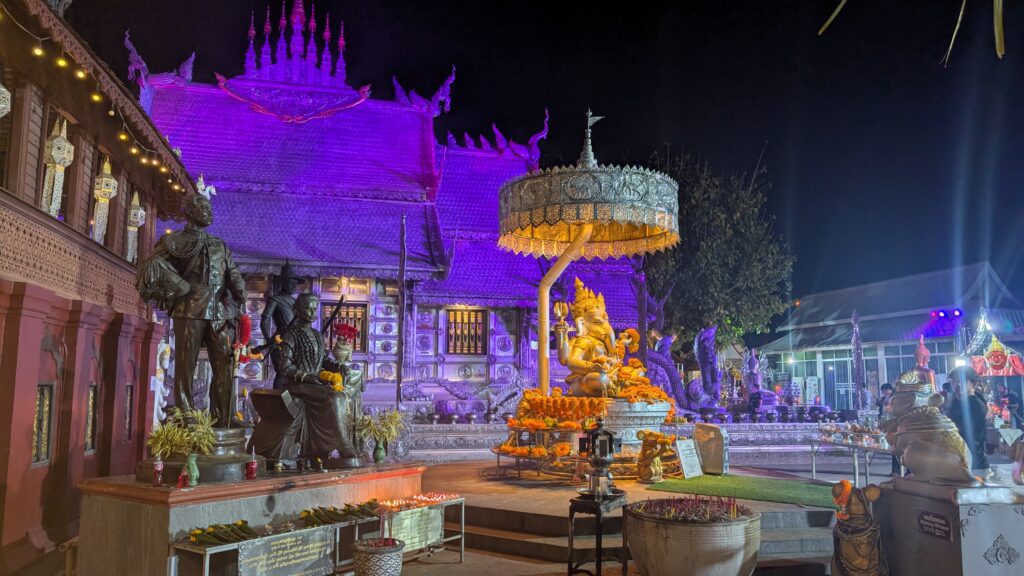
Chiang Mai, Thailand, night scene. Photo by Andris Vizulis.
Surely, technology would have changed dramatically in these nations of early adopters. But what about the mood of the people? Would they be trending upbeat at a time when, increasingly, optimism seemed in short supply among my friends in Newton and elsewhere in America?
When we crossed the Pacific in the year 2000, America was riding an upward, optimistic wave. The attacks of 9/11 hadn’t yet happened. The federal budget seemed tamed, and our tech prowess seemed invincible. Southeast Asia was still recovering from its decades of war, starting in a new direction.
The internet and web were in their infancy, with dial-up desktops and pixelated pictures. Google was a toddler, only three years old. In Southeast Asia, internet cafes were everywhere, since people didn’t have connections at home. But in spite of that, they were already using new technology to leapfrog infrastructure deficiencies.

Riverboats on the Mekong in Luang Prabang, Laos. Photo by Andris Vizulis.
In Newton, we still used old fashioned landline phones, though email was already prominent. I received my thick, heavy Newton School Committee packets by courier. We had just started posting important public documents online and announcing school closings on our website.
I was heavily into my PalmPilot, a personal digital assistant that was popular way before Blackberrys and iPhones. Europe led in mobile phones and Short Message Service (SMS) texting. Phone cards made international calls affordable, especially in Asia.
Gasoline and diesel powered all transportation. General Motors had squandered world leadership in electric vehicles, scrapping production of the EV-1 automobile. Meanwhile, Toyota had surged ahead with its hybrid Prius. Southeast Asia’s streets were clogged with carbon-spewing cars, motorcycles and tuk-tuks, three-wheeled motorized vehicles.
Before our trip in 2000, I had bought 20 rolls of slide film. Small, low resolution digital cameras were available, but it still made sense to lug around my Canon AE-1 and its heavy lenses.
Today, the landscape in Southeast Asia is vastly different. As expected, much of the change is due to technology, with smart phones and digital interfaces affecting all aspects of daily life, altering human behavior regardless of country. But apart from the tech, here are some lasting impressions of four cities:

Burberry and Gucci coexist with Communism in Hanoi, Vietnam. Photo by Andris Vizulis.
Bangkok, Thailand: Modern skyscrapers and megamalls are booming but coexisting with old style street markets. Tourists are everywhere; streets are extremely safe, even at night. The “Grab” ride-hailing platform is cheap and virtually instantaneous, using Chinese EVs. Unchanged from 2000, restaurants are still inexpensive and awesome.
Chiang Mai, Thailand: Due to its low cost of living, mild mountain climate, good health care and vibrant, relaxed vibe, it has become home to lots of retired expats. An abundance of high-tech work hubs make this an ideal base for remote businesses and workers. Cheap ride-hailing services and Chinese EVs proliferate.
Luang Prabang, Laos: Still a throwback to the Southeast Asia of old, its relaxed, Mekong River economy with French architecture coexists with traditional Lao culture. The hammer and sickle are prominent on government buildings—Laos is still a communist state—but unintimidating.
Hanoi, Vietnam: In terms of visible changes since the 2000 visit, Hanoi is off the charts. Back then there were no megamalls; now there are 10, each at least five times bigger than the Mall at Chestnut Hill. Gucci and Burberry storefronts gleam across the main square, just beyond posters of Ho Chi Minh’s outstretched arms. The city’s old street markets are still magnificently chaotic, and restaurants continue to thrive. Vietnam’s own VinFast EVs are everywhere, zipping around as ride-hailing taxis. Somehow, its swarms of motorcycles avoid hitting tourists despite the scarcity of traffic lights.
I had a conversation with a young man in a Hanoi bakery, a salesman for an agricultural products exporter. He left me with a message for the people of Newton that said it all: “If you come visit, you’ll see that our vibrant, young and loving energy will make you all feel welcome. And our energy will only keep growing!”
Andris Vizulis is a Newton neighbor, indefatigable traveler and technology futurist. He can be reached at avizulis@gmail.com.
Share This Story On:
DONATE TO SUPPORT LOCAL NEWS
Your tax-deductible gift to the Newton Beacon keeps our community connected and its residents informed.
Get story alerts twice a week:
Related Posts







Upcoming Events