
MATTERS OF FAITH
On the day after Easter, just over a week after I’d spoken at the “No Kings” rally in Newton Centre, I took up an invitation from executive director Dr. Kyle Roberts to tour the Congregational Library and Archives in Boston. Its Sacred Rebellion exhibit, tracing a thread back to the American Revolution, felt like a mirror for today.
After a week of services and Easter dinner, visiting the library, once the national headquarters of Congregationalism, might sound ambitious. But when the present feels tangled, looking back brings clarity.

A portion of the “Sacred Rebellion” exhibit. Courtesy of the Congregational Library and Archives.
The Sacred Rebellion exhibit marks 250 years since the Revolution, but it isn’t the usual story. It’s about congregations who didn’t just watch from the sidelines. Some helped shape the moral argument for resisting English rule. Reverend Jonathan Mayhew stood out. In 1750, he delivered a sermon called “A Discourse Concerning Unlimited Submission and Non-Resistance to the Higher Powers.” Today we’d call it “No Kings.” He argued resisting unjust rulers was a moral responsibility rooted in faith. That idea helped spark leaders like John Adams. Reading those sermons, it’s clear that No Kings has echoed in faith traditions for a long time.
While some called out slavery as a betrayal of freedom, guess what, other faith communities justified the practice. Religion in America has always been a tale of two cities. One city where faith props up power, and another city where faith inspires resistance to oppression. Both cities were alive then. Both are alive now.
“I am struck again and again in sharing our Sacred Rebellion exhibition with visitors,” reflects Roberts, “by just how often they see connections between present-day and Revolutionary-era Boston. Congregationalists then and now strive to be passionate supporters of individual liberties, zealous advocates of social justice, and fierce opponents of authoritarian overreach. The questions and concerns our ancestors wrestled with are still the ones we face today.”

Dr. Kyle Roberts (left) with the Rev. Dr. Eric C. Jackson. Courtesy of the Congregational Library and Archives.
So, the No Kings spirit in American religion isn’t new. Passover is a story of saying No Kings to oppression. Easter is another No Kings moment. Jesus, executed by the Roman Empire, was a reminder of who held power, but the empty tomb and resurrection proved that death and empire don’t get the last word. These are ancient declarations that no king, empire, or power has unchecked power. This is why, when thinking about religion in America, we cannot throw the proverbial baby out with the bath water.
Let’s fast forward to March 28, 2026. That tension was alive again on the streets of Newton, just before Easter and Passover. The No Kings rally drew 8 million people across the nation, and clergy and faith leaders helped mobilize a strong representation of people from their congregations. Newton was one of thousands of places across the country acting together.
Speaking at the No Kings rally didn’t feel disconnected from what I saw in the archive. Centuries separate those sermons from our gathering, but the basic question is the same: Does religion reinforce power or help us challenge it?
That’s why the No Kings rally is part of a much longer story, a story of sacred rebellion. Progressive religion still matters, not as a slogan, but as a living practice. It reminds us that silence has consequences, and so does showing up. We’re making choices now, as others did before us, about which city faith we’ll live in—the one that aligns with power, or the one that brings people together to resist evil and build a more loving world.
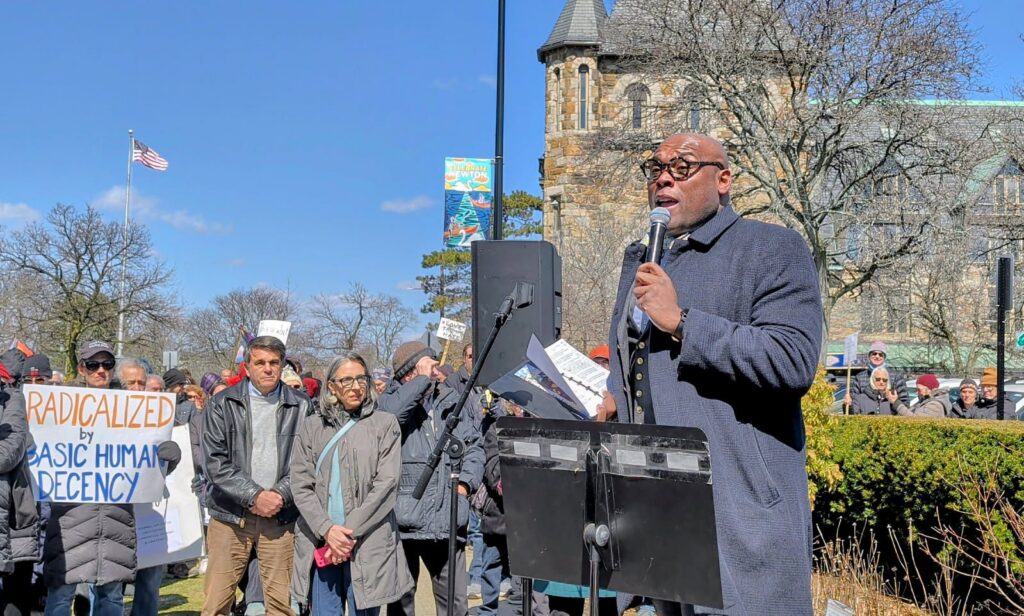
Rev. Eric Jackson speaks at Newton’s “No Kings” rally on March 28, 2026. Photo by Bryan McGonigle.
We must not forget that today there are many progressive faith communities hearing a call to stand with the vulnerable and challenge injustice. They march for civil rights, confront racism, welcome immigrants, fight for climate action and LGBTQ rights, and more. Are they perfect? No. But, isn’t that the case whenever two or more gather together?
Yes, there is the bible beating tradition, where faith is used to defend power and justify exclusion from the pulpit. Some, in the name of religion, fight against marriage equality, and tell women and queer people they don’t belong. Why, most recently, some U.S. officials and certain Christian pastors have described the conflict with Iran as a holy war, using scripture to justify violence and division. They claim God is on the side of bombs and state power, totally against what so many people of faith believe.
I’m proud to be serving as a pastor of a congregation that historically stood for justice and has made room for a diversity of beliefs and people since 1845. I’m proud to be part of the United Church of Christ, a denomination of firsts—the first to ordain an African American, the first to ordain a woman, and the first to ordain an openly gay person. This tradition of barrier-breaking faith is in our bones.
The No Kings rally on the streets of Newton is part of a 250-year tradition of sacred rebellion. Faith is alive in the mess of our times, calling us to act, to hope, and to build a world where freedom and justice are not only stories from the past, but possibilities in the present.
The Rev. Dr. Eric C. Jackson is pastor of Eliot Church of Newton, UCC. He welcomes your feedback at pastoreric@eliotchurch.org or invites you to join him for coffee and conversation after the 10 a.m. service each Sunday.
———-
You can learn more about resources for studying the American Revolution, including the Sacred Rebellion exhibition, on the Congregational Library & Archives American Revolution 250th Anniversary Resource Guide.
Share This Story On:
DONATE TO SUPPORT LOCAL NEWS
Your tax-deductible gift to the Newton Beacon keeps our community connected and its residents informed.
Get story alerts twice a week:
Related Posts




Upcoming Events