
MOVING AROUND
Sooner or later, most of us in Newton will need to go to Boston Logan International Airport. But then there is the dilemma of how one gets there.
There are multiple options, from driving and car services to buses, trains and water taxis. But even with all the choices, getting to the airport remains tougher here than in many cities around the world.
This has been perplexing people ever since the first commercial flights started carrying passengers between Boston and New York in 1927. In the past 100 years, Logan has grown to six runways and four passenger terminals on about four square miles of land.
About 16,000 people work at the airport, which served 43.5 million passengers and had 407,000 aircraft operations in 2024. More than 9 million international travelers transit through Logan each year. One of the most recent expansions has been at Terminal E, the airport’s primary terminal for international flights, which was expanded by 320,000 square feet in 2023 at a cost of $680 million.
Logan was the first airport in the United States to have a rapid transit connection. In 1952, East Boston rail service was extended from the Maverick station to Revere and the Airport station opened. This is now the Blue Line, which offers service on dual mode trains that run on a third rail in a tunnel and on overhead catenary above ground, switching near the Airport station. The cost to take the subway is $2.40 each way. However, the station poses a “last-mile” conundrum. It’s one mile away from the terminals and requires a shuttle bus to transfer.
Since 2005, bus service has been provided between South Station in Boston and Logan via the Silver Line bus service through Boston’s Seaport district.
Until 2023, service was provided by dual mode buses that operated as electric trolley buses when running underground in the South Boston Piers Transitway leaving South Station, but then ran as diesel buses after emerging from the tunnel. Currently, the MBTA runs five fully electric buses on this route. About 1 million people per year take the Silver Line from the airport to South Station, and the route costs $2.40 to the airport but is free when leaving the airport.
Several additional bus routes exist to provide service to Logan Airport. Logan Express runs routes from Braintree, Danvers, Framingham and Woburn ($9), and also from Back Bay ($3 to the airport, free leaving the airport). Blue Apple Bus is a new service that started in November 2025, providing trips to Logan from Mansfield ($22) and Riverside in Newton ($15).
Ferries also take passengers to the airport, including the MBTA’s Hingham-Hull-Long Wharf ferry and the Boston Water Taxi service.
A number of car-based taxi services exist, and they provide service to the airport from Newton for around $60 each way. Since being launched in Boston in 2011, ride app services have challenged and then surpassed the use of standard taxi service to the airport.
On-demand ride-app services (Uber and Lyft) are available for trips to the airport, and they generally cost around $50 to $60 per ride, although the cost can vary based on type of vehicle, time and demand, with rides in premium vehicles costing $100 to $150.
In the past year, there were 9.4 million ride app pick-ups and drop-offs at Logan. To reduce driving to the airport, the Massachusetts Port Authority, which operates Logan, recently announced that new high-occupancy shared van service via Uber (from Boston and Cambridge) and Lyft (from Somerville and Cambridge) started in April 2026 for a cost of approximately $15 per trip.
The most common way that most people go to Logan Airport remains the private car. It is estimated that car-based trips represent about 77 percent of the trips that take place to the airport. This includes private cars, taxis and ride shares.
In a private car, using the Massachusetts Turnpike and Ted Williams Tunnel, a one-way trip from Newton costs $3.20 in tolls plus fuel costs. If someone is being dropped off at the airport, a round trip toll to and from Newton is $6.40. To park at the airport, the one-day cost is $37 at the economy parking garage and $46 for the central parking garage. There is an option to park at the Wonderland garage on the terminus of the Blue Line, which costs $7 per weekday and $2 for weekend days.
Parking expansion occurred in 2004 with the addition of three levels (2,800 spaces) of parking at the central garage and 3,000 parking spaces in a new west parking garage. The number of parking spaces at Logan Airport is frozen at 20,938 spaces due to a long-term Massachusetts Department of Environmental Protection parking freeze. Even with the freeze, a new 10-story parking garage and additional roadway construction is planned for completion in 2030 at a cost of about $800 million.
Despite the many options and efforts to reduce car trips to Logan, driving to the airport remains the simplest, least expensive option for many.
More needs to be done to improve high-capacity transit access to the terminals. Many international airports have a direct train connection to their airports, and Logan should follow suit. Building a single new train stop at the location of the central garage would provide access via pedestrian bridges located on Level 4, allowing for a short, three- to 10-minute walk to any terminal on moving sidewalks.
Could the Blue line airport station be moved one mile so that there is a stop at the Central airport garage? What if there was an automated driverless people mover on a small-scale rail-based transit spur between the current Airport station and the Central garage? It would be less than perfect, but much better than what we have now with dozens of buses circulating between the terminals.
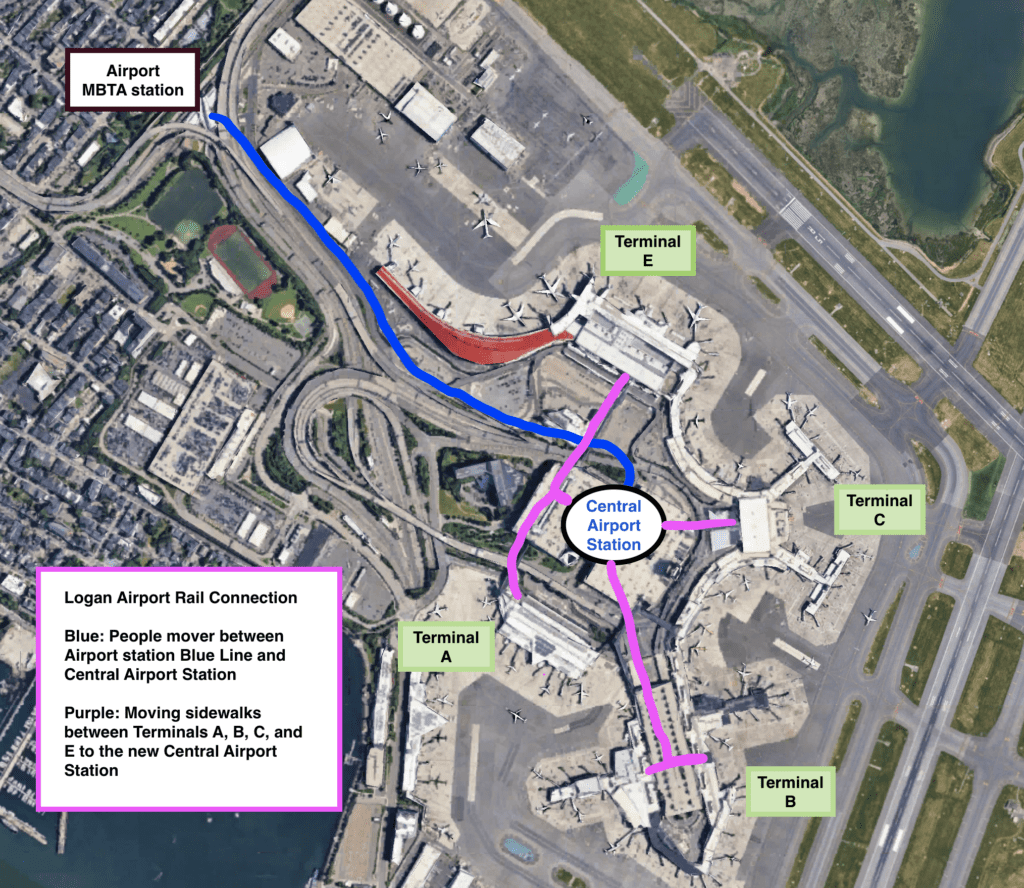
Proposed new “people mover” rail connection at Boston Logan International Airport.
Any Blue line connection would benefit from better integration of the existing subway system, including completion of the Red-Blue connector in downtown Boston. Another option to bring high-capacity transit to the airport would involve converting the current Silver Line bus to a rail line, but this would require substantial construction and engineering, including a new tunnel under the harbor.
How can we fund these kinds of transit expansions? A surcharge of $10 per traveler to pay for transit improvements on the 43 million trips that take place per year could go a long way toward paying for these improvements.
Hundreds of millions of dollars have been spent on parking garages and roadway projects at the airport, and parity is needed to improve transit. It’s high time that we bring Logan’s transit connections to the levels of access that are enjoyed by travelers in many of the world’s top airports.
Dr. Srdjan S. Nedeljkovic, a resident of Newton Highlands, serves on the Newton Transportation Advisory Group.
Share This Story On:
BEACON SPONSOR
DONATE TO SUPPORT LOCAL NEWS
Your tax-deductible gift to the Newton Beacon keeps our community connected and its residents informed.
Get story alerts twice a week:
Related Posts









Upcoming Events