
barney1
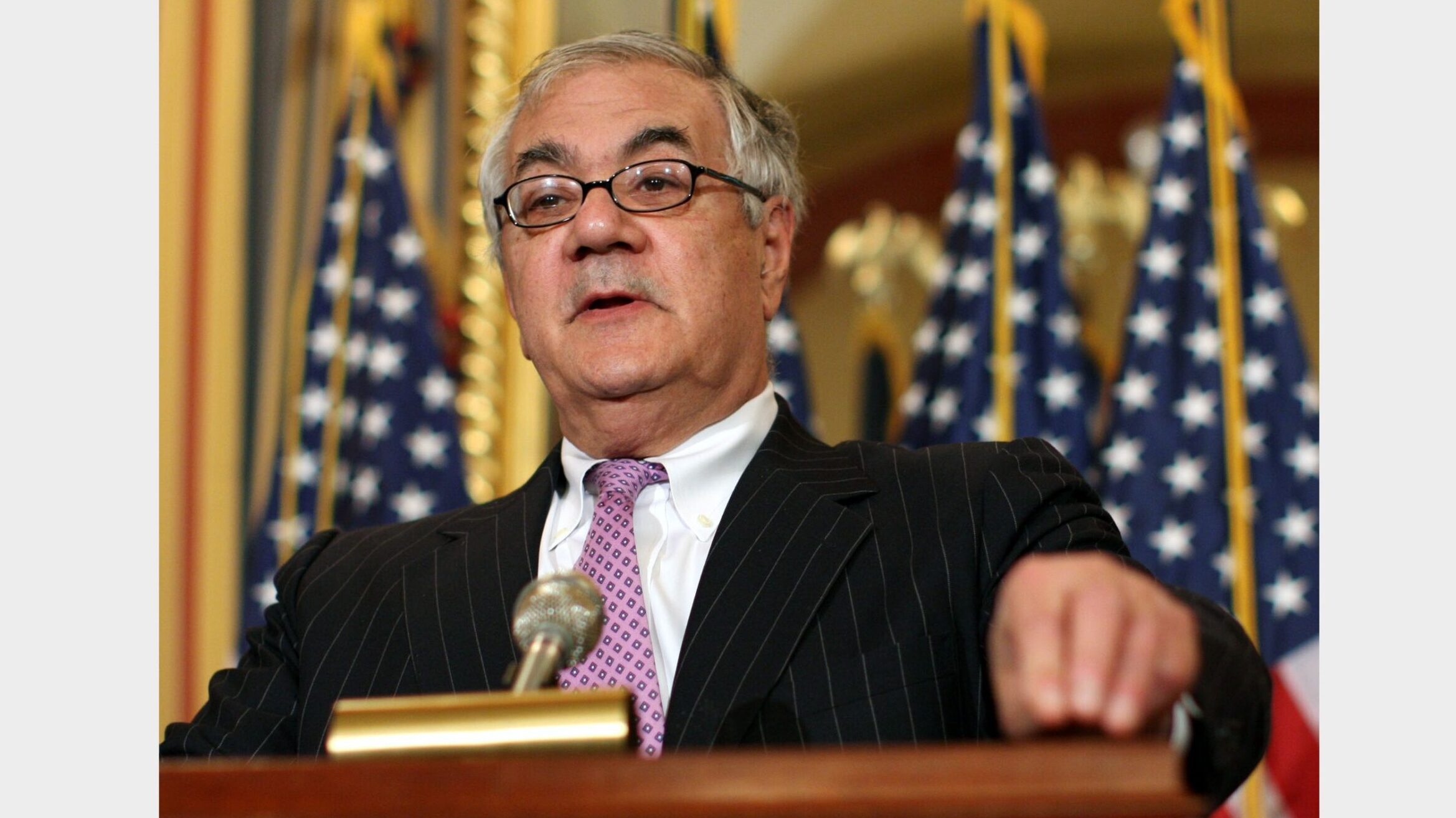
Former U.S. Rep. Barney Frank, D-MA, served in Congress from 1981 to 2013. Public domain image
Barney Frank, 16-term congressman, the nation’s first openly gay congressman, and longtime Newton resident, died on Tuesday at the age of 86 after a long battle with congestive heart failure.
“Barney Frank devoted his life to public service with uncommon intellect, courage and wit, leaving an indelible mark on Newton, on the commonwealth, and on this nation,” Newton Mayor Marc Laredo said. “His leadership helped expand opportunity, protect consumers, and advance equality. On behalf of the people of Newton, I extend our deepest condolences to his family, to those who love him and admire him, and express our profound gratitude for his enduring legacy.”
Frank was born in Bayonne, N.J., where his father ran a truck stop (and later served time in prison for refusing to testify against a family member in a fraud case) and his mother was a receptionist for a New York law firm.
Frank graduated from Bayonne High School in 1958 and moved to Massachusetts to attend Harvard College. His father died while he was in college, and when he graduated, he went to Mississippi to volunteer in the Freedom Summer Project—a coordinated effort to register as many Black voters as possible in Mississippi—giving him an intense introduction to civil rights work that would translate into a political career.
His political passion in such a tumultuous time had him dropping out of a Ph.D. program to work for Boston Mayor Kevin White in 1968, the same year Martin Luther King Jr. and Robert F. Kennedy were assassinated and the Democratic National Convention erupted in violence.
And in 1972, Frank jumped into electoral politics with a run for state representative, campaigning on civil rights and social justice, and he defeated Republican incumbent Virgil Aiello. He studied law at Harvard University—he was even a student of the late Henry Kissinger—and practiced law while teaching at Harvard and Boston University.
Frank served in the legislature for eight years.
In 1980, Pope John Paul II declared that Catholic priests should not be in politics. Newton—where Frank was living at that time—was represented in Congress by U.S. Rep. Robert Drinan, a Catholic priest. Drinan resigned, so a special election was needed, and four Democrats ran for the newly open 4th district seat. Frank won the primary and then defeated Republican Richard Jones in the general election.
Frank faced an uphill political battle two years later, when redistricting added the large blue cities of Fall River and New Bedford to the district. Those communities had been part of the district represented by Republican Margaret Heckler, and she and Frank were running for the re-designed 4th district seat.
By shifting his campaign focus from civil rights to working class economic woes and President Ronald Reagan’s tax cuts for higher income brackets, he was able to defeat Heckler with a decisive 60-40 victory.
That was the only uphill battle Frank would face at the ballot box until 2010, when—during the “red wave” midterm elections that were seen as a rebuke of President Barack Obama and the Affordable Care Act—Republican Sean Bielat polled within striking distance of him. Frank won that election, but the next year he announced he would not seek reelection in 2012.
While he was spared electoral challenges throughout most of his career, his time in office was marked by controversy.
In the mid-1980s, Frank—a gay man in the closet at the time—hired a sex worker named Steve Gobie. They began a relationship in which Gobie stayed at Frank’s house and Frank hired him as an assistant and housekeeper.
After Frank found out Gobie was still doing sex work while living with him, he threw Gobie out. Gobie tried selling the rights to his story, which made the whole situation public when it was published in the Washington Times.
A House Ethics Committee cleared Frank of criminal wrongdoing and cleared his name of various allegations Gobie was making publicly.
Frank came out as gay in a Boston Globe interview in 1987, making him the first openly gay person to serve in Congress.
And he became somewhat of a financial sector legislation powerhouse, authoring legislation to increase access to homeownership and business opportunities to more communities. He served as House Financial Services Committee chair from 2003 until he retired nearly a decade later.
As chair, Frank played a major role in crafting a financial rescue package with the George W. Bush administration following the 2007 subprime mortgage crisis and financial sector collapse.
After that crisis became a global recession, he and U.S. Sen. Chris Dodd, D-Conn., crafted landmark legislation in 2010 aimed at preventing banks and investment companies from causing another financial sector implosion.
That period brought Frank controversy again when it was revealed that he had received campaign donations from Fannie Mae and Freddie Mac, and that Fannie Mae issued grants to a nonprofit run by Frank’s mother and gave his partner a job. Frank denied any unethical practices and accused his opponents of a smear campaign in the midst of a recession.
In retirement, Frank and his husband, Jim Ready, moved to Ogunquit, Maine.
Frank published several works throughout his career, starting with his book “Speaking Frankly: What’s Wrong with the Democrats and How to Fix It” in 1992. He published “Frank: A Life in Politics from the Great Society to Same-Sex Marriage” in 2015 and “The Hard Path to Unity: Why We Must Reform the Left to Rescue Democracy” earlier this year.
Share This Story On:
BEACON SPONSOR

DONATE TO SUPPORT LOCAL NEWS
Your tax-deductible gift to the Newton Beacon keeps our community connected and its residents informed.
Get story alerts twice a week:
Related Posts





Upcoming Events