
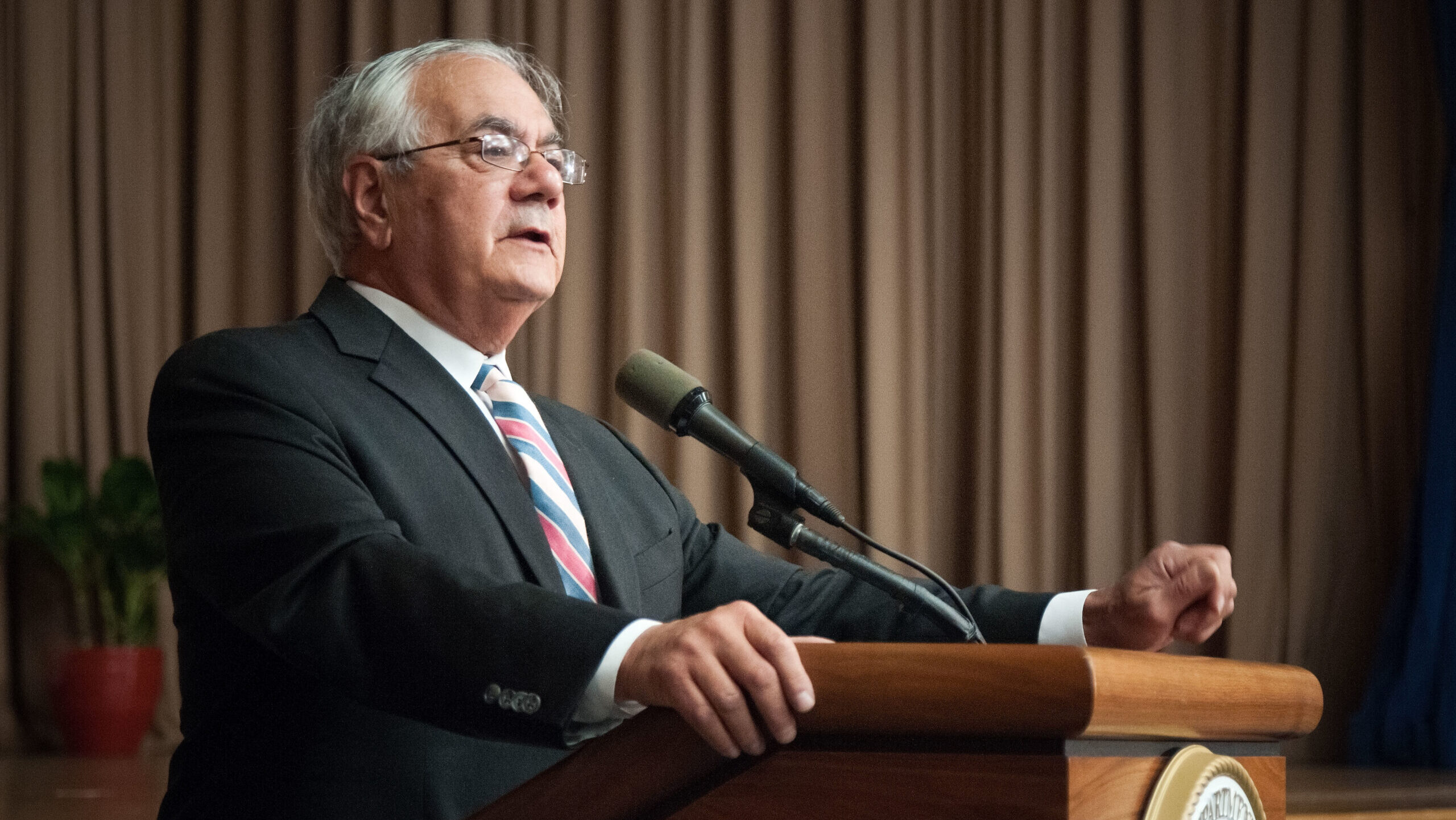
Barney2
U.S. Rep. Barney Frank speaks at the 2012 Washington, D.C. Pride Observance Ceremony in July 2012. (USDA photo Bob Nichols)
Barney Frank did what very few politicians have ever done: He operated in the public arena without a filter.
His colleagues have described him as smart, witty, clever and, at times, downright nasty. Journalists often caught the sharpest arrows, but he saved a few for his fellow lawmakers and unruly constituents at town halls.
“As a mentor and a friend, he made me a better lawmaker, and he made me laugh,” U.S. Rep. Jake Auchincloss said in remarks on the House floor Thursday. “My staff and I, representing the district that he faithfully served for three decades, will always treasure his stories, his encouragement and his advice.”
The 16-term congressman and longtime Newton resident died Wednesday at the age of 86, leaving behind a legislative legacy and a bounty of memories for those who knew him.
‘Unflappable’
State Sen. Creem came to know Frank when he moved into an apartment in Creem’s sister’s building on Floral Street in Newton 46 years ago.
“He was running for office, and he was just so funny,” Creem said, laughing as she recalled how he would leave his door open while he shaved and her mother was visiting.
Over the following years, Creem and her husband hosted dinner parties for Frank’s congressional campaigns—he had 16 of them—and she got to know him as an astute political mind as well. She mentioned his coming out as gay in 1987 as an example of his courage—he was the first openly gay member of Congress—and pointed to the Dodd-Frank Act aimed at protecting the nation from another financial sector collapse as an example of his determination.
“He was unflappable,” she said.
But with that wisdom came a lack of patience. He was often heard throwing snappy retorts at the press or voicing his discontent with the subtlety of a grenade.
“I was at an event, and he told someone they were as dumb as a table,” Creem continued. “And people worried, because, the thing is, you really can’t do that in a professional way. But these people did keep asking the same question over and over again. I do understand how he lost his patience. For many of us who bite our tongues and never say anything like that, we could look at someone who just said what he wanted.”
And his gruffness was forged by decades of legislating experience at a time when the religious right movement was coming for the gay community everywhere.
“He got away with it, because he researched everything, so he knew what he was saying,” she said. “He wasn’t just talking. It was hard to argue with him because he had studied the topic.”
And he had a silly side.
“As Barney would say, because he was so witty, that he had three three strikes: He was a left-handed, Jewish gay man,” Creem said.
Grab what you can, and come back for more
For all his bluntness and bluster, Frank was a pragmatic problem-solver, a firebrand who mastered the art of compromise.
He spoke with a passionate voice but peddled pragmatic incrementalism. That often put him at odds with his colleagues in the Democratic party who wanted to move further faster—people like LGBTQ activist and former City Councilor Holly Ryan, who would later appreciate his approach.
“When I first sat down to talk to him, when I came to the table, when I was a street activist on trans rights, he taught me how to reach across the aisle, how to support some things that I wouldn’t normally support, so these people would support my issues,” Ryan said.
Ryan came out as transgender in the 1990s and got right to work advocating for the transgender community. She had passion. She had energy. Barney Frank had the wisdom that comes from decades of lawmaking.
Frank advised Ryan on her push for transgender rights and inclusion, and he told her to get whatever she could and then go back for more.
Ryan points to a piece of legislation in 2011 and a ballot question from 2018 that expanded public accommodation rights to include gender identity. The 2011 bill protected transgender people from discrimination in work, loans and criminal law. But it didn’t grant them access to restrooms that conformed to their gender identity.
“But we came back for public accommodations later, and it passed in 2018, so that’s what he was talking about,” she said. “He was right, you know.”
In these hyper-polarized times with social media turning up the volume for political fighting, Frank’s style of pragmatic compromise fell out of favor with many on the political left. And he knew that. When he entered hospice a few weeks ago, he did so while publishing a book criticizing what he saw as the left wing of America’s politics going astray with demands the general public won’t meet.
His comments received backlash from progressives and many LGBTQ allies. But Ryan, who kept in contact with Frank after he retired, agreed with his recent comments. She’s lobbied for transgender rights and respect for more than three decades and said there are some things, like transgender athletes in sports, that don’t have as wide a consensus as protections from work discrimination and restroom use.
“Those of us who know, know what he was talking about,” Ryan said, dismissing the idea that Frank wasn’t an ally to transgender people and noting that Frank had one of the first transgender legislative aides in Congress.
A star next door
To former City Councilor Rick Lipof, Frank was a lifelong family friend. His parents—Alderman Michael Lipof and Rabbi Emily Lipof—were early supporters of Frank’s campaign.
“I grew up knowing Barney and then tangentially worked with him in politics,” Lipof said. “We ended up having our offices in the same building on Crafts Street and would often walk across the street together to get lunch. He would always ask how my parents were and reminisced about the past.”
Lipof added that Frank’s long list of talents included the ability to grab hold of a room.
“Whenever Barney spoke in a living room or at a political event, I was always captivated by his lightning sharp intelligence and wit,” Lipof said. “He could explain the intricacies of legislation or the human condition like nobody else. Our state and country are better off because of Barney’s fight for those who could not fight for themselves. He will be dearly missed.”
Share This Story On:
DONATE TO SUPPORT LOCAL NEWS
Your tax-deductible gift to the Newton Beacon keeps our community connected and its residents informed.
Get story alerts twice a week:
Related Posts



Upcoming Events