
laredobudget3
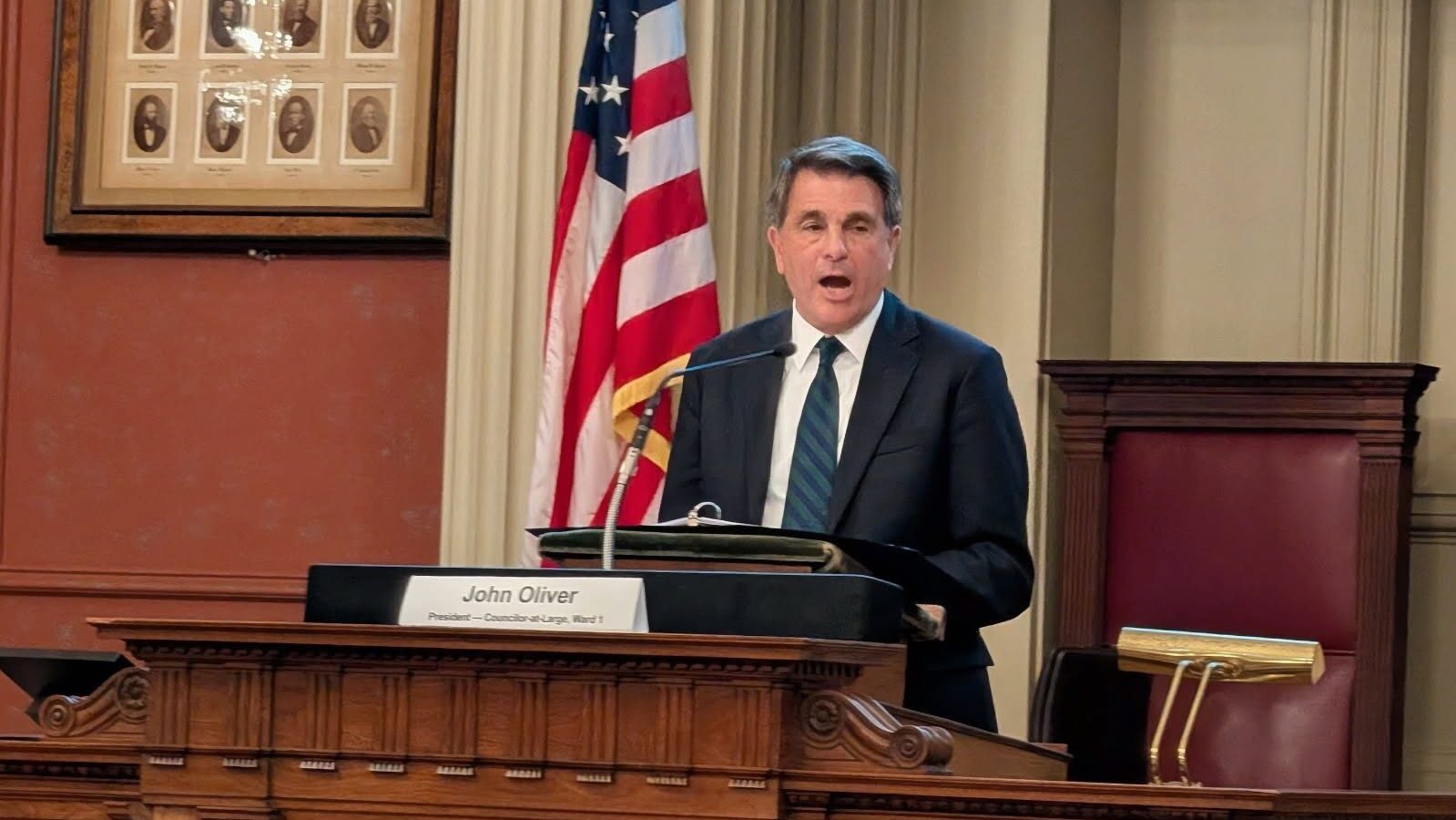
Mayor Marc Laredo presents his FY2027 budget on April 27, 2026. Photo by Bryan McGonigle
“It’s great to be back up here,” Mayor Marc Laredo quipped as he took to the podium in the City Council Chamber Monday night to deliver his first budget presentation, one that comes with more a than $578 million price tag and a restructured pension payout plan.
He was joined by Newton CFO Maureen Lemieux, who was set to retire this June but—as Laredo announced Monday—has agreed to stay on.
While the podium was familiar ground for the former City Council president, Laredo used the moment to display a decisive change at the wheel in the mayor’s office, a drive to go bold in these bold times and a deliberate departure from the practices of his predecessors.
For starters, the mayor made sure to highlight his more than 7 percent increase for the schools, after years of NPS budget crises that included a two-week teacher strike.
“That’s a very large increase, much larger than has ever been done in recent years, and we did that for a reason,” Laredo said. “Our schools need the money. We want to provide the best possible education for our children, and I think this is our highest priority.”
That wasn’t enough to keep the district from making cuts to DEI, sustainability and behavioral support staff, but the budget is able to fund a district-wide math overhaul a long time in the making.
“It provides for more academic rigor, because our math was not really at the right place, and too many kids were resorting to private resources,” Laredo said “And it provides an opportunity for growth, not just for some of our middle school kids, but for all of them. This is a terrific initiative. The superintendent deserves tremendous credit for putting it forward, and I’m very excited that this school budget includes that.”
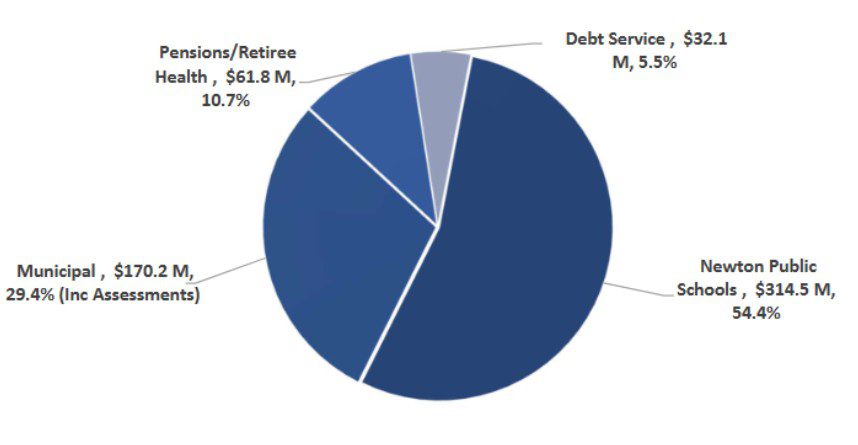
This pie chart shows appropriations in Newton’s FY2027 budget. It’s important to note that some school expenses are included in the municipal side of the budget, so percentages shown here may be slightly skewed. Image by the City of Newton
Much of Laredo’s focus was on the pension payout schedule, which has wrapped the city in a chokehold as inflation has driven costs up.
State law requires all cities and towns to pay off their pension liabilities by 2040, but years ago, Newton reworked its schedule and moved its payoff year to 2032, which would free up lots of money after that year. The NPS Stabilization Fund was created to help keep the NPS budget, which is on shaky ground every year, on track until then.
Then, a dramatic rise in health insurance and utility costs has thrown plans into chaos, and NPS was looking at another potential budget crisis.
Recently, the Retirement Board voted unanimously to approve a rescheduling of the pension payoff from 2032 to 2035, meaning the city doesn’t have to pay as much each year into its pension liability.
And going further, Laredo wants the city to issue a pension obligation bond “to pay off all or most of our pension obligation now and allow us to smooth the payments over a longer period of time.”
The city has to petition the legislature for that, and the City Council voted to approve it right before Laredo’s presentation.
In exchange for the Retirement Board pushing back the payment schedule, the city is supporting an increase in the cost-of-living adjustment for pensions, phased in over a three-year period.
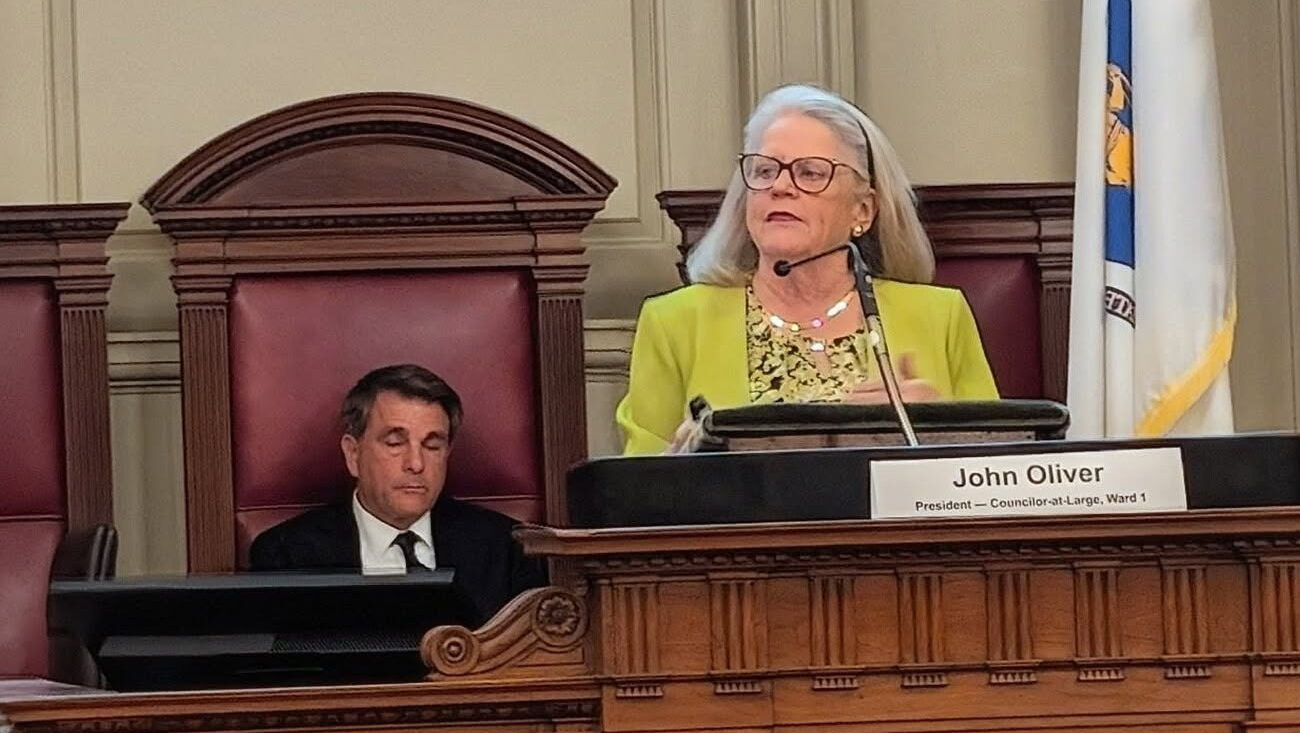
Newton CFO Maureen Lemieux addresses the City Council to talk about the Laredo administration’s FY2027 budget plans on April 27, 2026. Photo by Bryan McGonigle
Laredo is also parting ways with his predecessors by budgeting 99 percent of anticipated revenues.
“One should never budget to 100 percent of anticipated revenues,” he said. “But budgeting too conservatively is equally problematic and poses significant challenges.”
Having excessive amounts of free cash that should have gone into an operating budget to begin with creates an array of issues with future budgeting, he said, since free cash isn’t typically used for ongoing operational expenses.
“We want to give the schools and our municipal departments the expected money they need, so they’re not looking for free cash later on to find the operating shortfalls,” Laredo said.
Nearly 85 percent of Newton’s revenues come from residential property taxes, Lemieux noted, making it easier to more accurately predict those revenues.
“And people in Newton pay their property taxes,” Lemieux said.
Budgeting 99 percent of anticipated revenues actually increases available revenues in the budget by $5 million, and pushing back the pension payment schedule to 2035 frees up another $5 million, Lemieux said. And a pension bond would mean more savings in the future.
Perhaps the most exciting part of the budget was in three feasibility studies it funds: one for a new police station, another for a Newton South High School renovation, and a third for a possible consolidation of the Ward and Underwood elementary schools.
There’s a lot to unpack as the councilors vote on Laredo’s budget piece-by-piece (despite the City Council having no actual budgetary authority) in the coming weeks.
Meanwhile, you can watch the entire budget presentation here.
Share This Story On:
DONATE TO SUPPORT LOCAL NEWS
Your tax-deductible gift to the Newton Beacon keeps our community connected and its residents informed.
Get story alerts twice a week:
Related Posts









Upcoming Events