
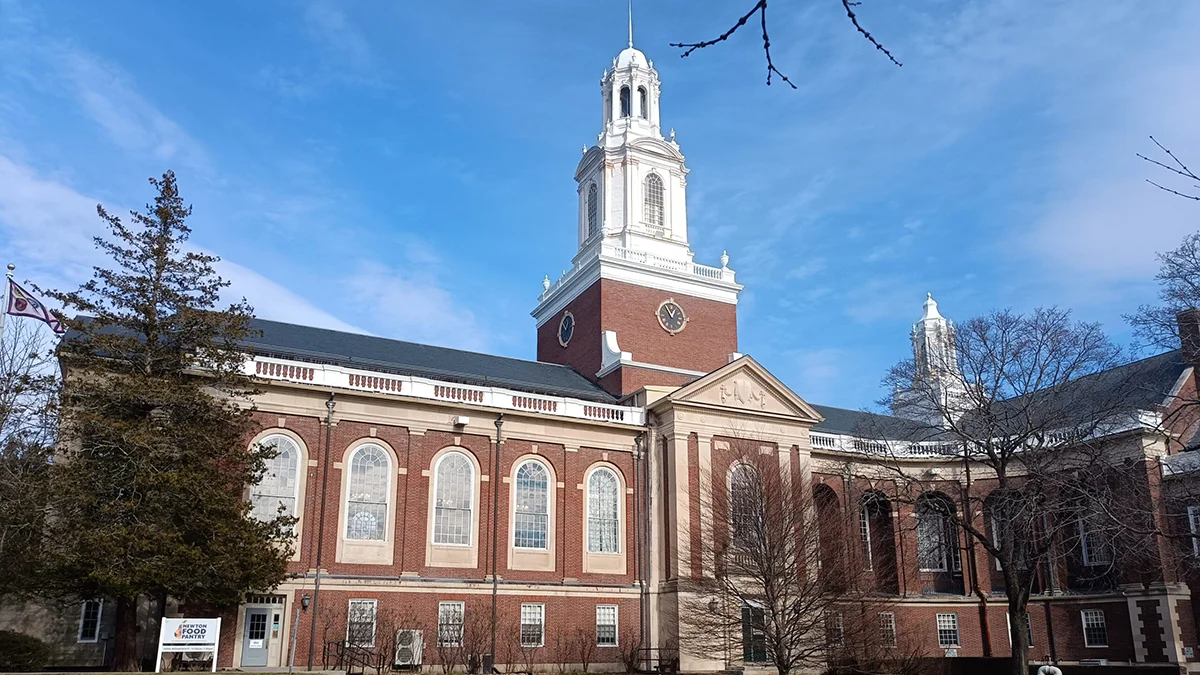
city-hall
Darius Baily, the BERDO administrator in Newton, recently presented to the City Council Committee of the Whole the first draft of regulations for the Building Emissions Reduction and Disclosure Ordinance.
The ordinance targets commercial buildings over 20,000 square feet, requiring them to track and report their greenhouse gas emissions and, eventually, reduce them to meet Newton’s 2050 carbon neutrality goal, according to Green Newton. Commercial buildings in Newton account for 23% of emissions, so they will be prioritized over residential buildings.
The legislation determines these regulations which are not voted on by the city council. Baily, along with a nine-member commission worked on these draft regulations for seven months, said Baily. As of March 2, the regulations are available on the city website for 30 days for public comment.
“Starting today, we will be asking the public, not just the city council, to weigh in on the draft regulations that are up on the website,” said Baily.
Buildings are ranked in tiers based on size under the new regulations, and state and federal buildings are exempt, said Baily. For large commercial buildings, tier one, the energy reports are due as soon as September 2028 and the emissions compliance year is 2027. For smaller commercial buildings in tier four, reports are due by September 2031, while their emissions compliance year is 2030.
Baily presented the draft regulations as well as the policies and procedures to the committee. City staff and consultants began drafting regulations for BERDO in Summer 2025.
“The first drafts were definitely based heavily on other jurisdictions examples so taking a lot from Boston and Cambridge, but also Denver and D.C,” said Baily. “Over the course of 10 meetings the commission members reviewed iterative drafts of each section of the regulations and debated ways to improve the draft language.”
The reporting process outlined in the draft regulations refers to how building owners should report energy emissions data every year, how to calculate size of the building, classifications and other conditions. Building owners are responsible for data accuracy.
Baily said that he and his team wanted to specify regulations for third-party verification that the ordinance did not cover. Initially, the ordinance called for full energy reports from buildings every year, but the commission suggested they have to report every five years to ease the amount of data businesses have to collect.
“One of the main sticking points, which was adjusted through talk with the advisory commission, was about when and if verification is necessary across all years,” said Baily. “Through discussion with the advisory commission, we decided to be a little more lenient of costs and imposing the financial burdens on building owners by lowering the amount of data they would be asked to verify.”
The regulations also cover building’s emissions and compliance flexibility, which outlines regulations for people who own multiple buildings, alternate payments if compliance is not met, and hardship compliance plans.
“We’re just specifying exactly how they need to verify their baseline data and how they have to submit plans for reductions over that period,” said Baily.
The most dense and time consuming step in forming the regulations, said Baily, was developing plans for buildings that cannot comply with the energy restrictions. They came up with a comprehensive plan that explores why it may be impossible for a business to comply and how they propose to fix it, and a prescriptive plan, which uses short-term “on-ramp” plans to help buildings to comply.
The commission suggested modifying the ordinance to remove the requirement for a retroactive five-year verification, and add an appeals process for commercial building owners who have issues complying. They also recommended language clarification about data reporting on electricity and residential compliance.
“It seems to me there’s been a wavering of commitment at the state level, and that concerns me, and I’m wondering if that is filtering down here,” said Newton City Councilor Alison Leary in response to the presentation.
Baily said he believes the state government is pushing forward with plans like these across Massachusetts, and have posted Large Building Energy Reporting Emissions benchmarks. He acknowledged that the less MassSave funding there is, the harder it is to do this kind of work.
“To view regulations, the draft is up now and you can find it at Newtonma.gov/newtonBERDO,” said Baily. “And then we are collecting regulations comments at newtonberdo@newtonma.gov. For the next month we will be collecting comments on the draft regulations.”
Share This Story On:

DONATE TO SUPPORT LOCAL NEWS
Your tax-deductible gift to the Newton Beacon keeps our community connected and its residents informed.
Get story alerts twice a week:
Related Posts







Upcoming Events