
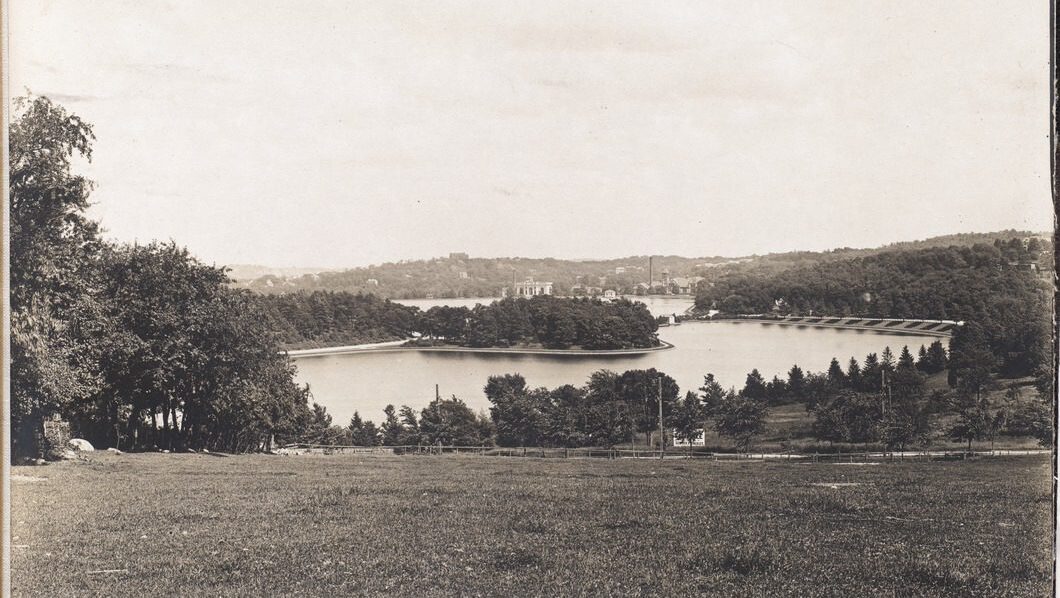
LawrenceBasin
The Lawrence Basin, shown in this 1905 photo, was filled in by Boston College in the 1950s to make space for buildings. Photo courtesy Digital Commonwealth
Boston College in the post-war era had a problem: it was rapidly running out of space.
More students meant more cars, and it also meant more demands for athletics facilities, and the campus had little place for either. When Ignatius of Loyola was instructing Jesuits on where to locate their colleges, he told them to “take special care that you obtain a good and sufficiently large site, or one that can be enlarged with time.”
Thomas Gasson, the Jesuit priest who moved Boston College to Chestnut Hill, had chosen a site that could be enlarged. The school had room to grow. The only issue was that the closest available land was underwater.
Between 1866 and 1870 the state had purchased over 200 acres of land in Chestnut Hill to flood to add to the water supply for the rapidly growing city of Boston. Hundreds of laborers and horses turned the land into a reservoir with two basins. The Lawrence Basin, opened in 1868, could hold 180 million gallons of water. The Bradlee Basin opened in 1870 and today holds 550 million gallons. The Lawrence Basin was named for wealthy industrialist Amos Adams Lawrence; the state purchased 58 acres of his land for the site. When Boston College relocated, it purchased the remainder of his estate.
The new Boston College consisted of a few buildings, huddled together on the heights above the reservoir. Gasson dreamed of an “Oxford of America,” but unlike Oxford—or Harvard or Holy Cross—there were no dorms. Throughout the early 20th century, it remained a tiny college serving a small number of Catholic young men from the Boston area who were interested in a liberal arts education. But its students were also keenly interested in athletics. One disgruntled young man in 1914 wrote that it was unfair that Boston College could not put “Boston” alone on its pennants, since everyone knew Boston University was more interested in professional schools than sports.
WWII was a challenging time for the college, as the United States turned its full strength of both monetary resources and young men toward the war effort. But after the war, the GI Bill gave returning veterans money to attend college. Boston College’s fall enrollment went from 453 students in 1945 to 2,811 in 1946 and 4,572 in 1947. While the school welcomed this influx of students, it also created new challenges: where would they go? The campus was cramped, and it would only grow more cramped during the 1950s.
Boston College did add dorms, but it remained primarily a commuter school, and cheaper cars meant more students driving to class. In 1947, the school’s newspaper, The Heights, reminded readers that Newton police would be on the lookout for student cars blocking local residents’ driveways. There were other space constraints: BC’s football team had been drawing large crowds since the 1920s, but this meant that many of its football games were played at Fenway Park or at the Boston Braves stadium on Commonwealth Avenue. And there were also many young men who, while not on a varsity team, were interested in places on campus to play sports.
Conveniently, the state had declared the Lawrence Basin inactive in 1948. The Quabbin Reservoir, created by flooding four towns in western Massachusetts in the 1930s, had finally fully filled with water by 1946. There was no need to continue to maintain so many tiny reservoirs. In 1949, the state leased the reservoir to BC for 99 years, and later sold it outright. (The Metropolitan District Commission, which managed local reservoirs, had sold another former reservoir property to Tufts in 1944).

Boston College campus. Photo by Bryan McGonigle
The process to fill in the reservoir began, with local construction companies asking for donations of debris material. But it was not so easy to return the parcel to land, and in 1950, much of what had been filled in was underwater again. The track and field coach used this to encourage his players, telling them to try and throw their implements into the water. As the water was successfully pumped out, the further they had to throw, and they achieved greater distances in javelin, discus and shotput. “Will every college in the nation seek an idle reservoir or two as a prerequisite for a successful track season? Will a new American fortune be founded by the man who corners the reservoir market?” asked The Heights in 1951. The same article noted that a poll of the reservoir guppies showed they had an unfavorable view of filling in the reservoir.
Slowly, the reservoir was filled in, making space for a large football stadium, intramural playing grounds, and other campus buildings. And, of course, parking. Students were frustrated by how many cars were on campus and the insatiable demand for more places to put them. “If we were to let some people have their way, they would probably replace our reservoir and Bapst Library lawn with a colorful carpet of automobiles,” wrote Martin Nolan in The Heights in 1958.
“We might even suggest the total elimination of campus parking for both faculty and students as the most efficient means of coping with this problem, which is gradually changing Boston College into a Gothic parking lot,” wrote The Heights in 1959. But there was not enough campus housing for all students even if they had wanted to live on campus, and the cars were there to stay.
The university was aware that people enjoyed the reservoir, but filling it in was also the most obvious way to have more space.
“I am being murdered at present for filling in that reservoir because it destroys the beautiful little pond we have down there,” said Boston College president Michael Walsh in a 1963 interview with The Heights. But he wanted more space for intramural sports, specifically tennis, and he was considering soccer as well. The same newspaper issue also had an interview with Walsh about more girls’ dorms, as the school slowly became co-educational. BC was expanding in new ways that Gasson likely would not have envisioned.
The last part of the reservoir was filled in in 1970 for new modular student dorms. These buildings were intended to be temporary, but the “mods,” as they became known, are so popular with students that the university has kept them standing. Because of the way the mods were built on construction debris, the college had to hire architects to shore up the buildings in the 2010s so they wouldn’t sink into the ground.
Today, a visitor would not know that the BC lower campus had once been underwater; and likely also would not think that the Chestnut Hill reservoir had once been farmland. But they were. The next time you want to take a stroll around the reservoir or watch a college football game, remember that the Newton landscape has been shaped and reshaped by human will.
Share This Story On:

DONATE TO SUPPORT LOCAL NEWS
Your tax-deductible gift to the Newton Beacon keeps our community connected and its residents informed.
Get story alerts twice a week:
Related Posts






Upcoming Events