
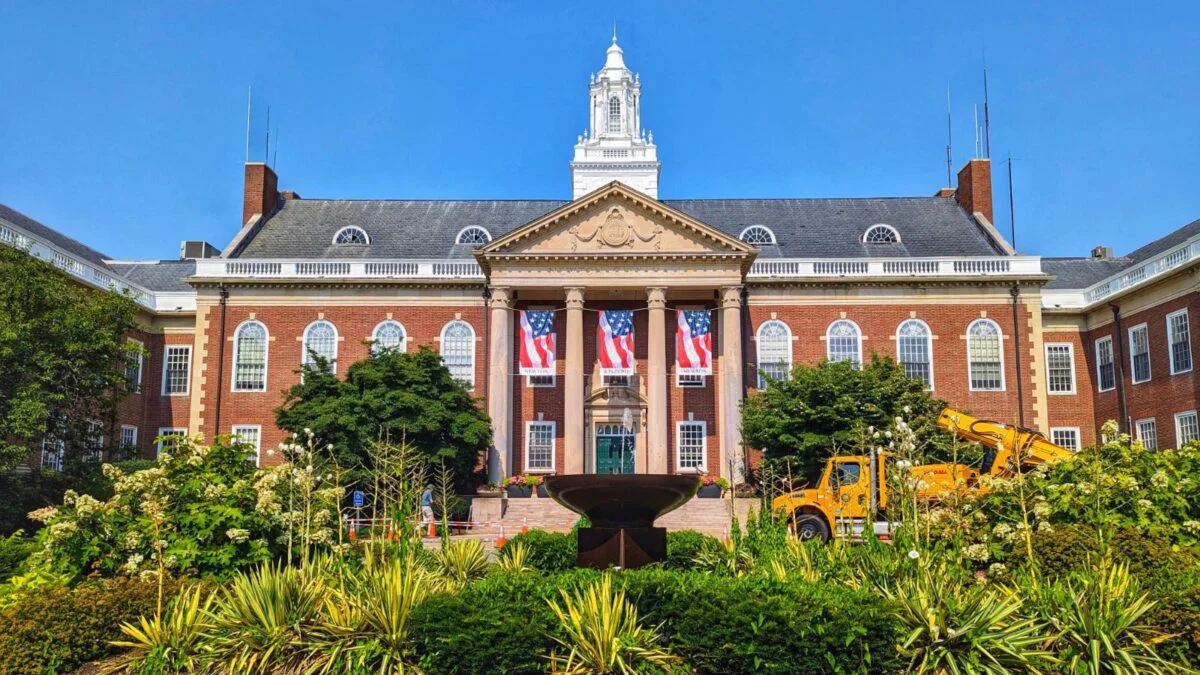
Newton City Hall, June 2023. Photo by Bryan McGonigle
Community Preservation Program Manager, Molly Hutchings, had requested $34,626 from CPA funds to install additional bike parking at both high schools and many public parks during summer 2026 as a part of a three-part improvement plan.
The Community Preservation Act funds bring in approximately $4.5 million per year, and $1 million of the fund is dedicated to open space, recreation, historic resources or affordable housing projects. This project falls under the recreation funding category. The funds will be matched by a greater contribution by the state under the Boston Region MPO Community Connections Program.
Hutchings said this is phase three in a three-part initiative that began between 2019 to 2023 to install more bike parking to locations that are at capacity, or without parking infrastructure at all. Phase one and two covered village centers and the elementary schools.
The plan adds 10 bike hoops to each of the two high schools, and additional covered parking, as a result of the broken plexiglass-covered bike parking at both high schools. They are exploring more robust materials to replace the shelters, said Jenn Martin, director of transportation planning for Newton. The plan also adds 67 bike racks at 18 parks across Newton, and additional racks at City Hall.
Hutchings said that parks on conservation land don’t allow bikes inside of the park. Additional parking at the entrance would allow residents to commute with a bike without bringing it into the park.
“If locking up was the main concern that was keeping people away from biking to the park, then this would alleviate that, hopefully,” said Ahron Lerman, director of Parks & Open Space in Newton.
Each park has different rules to abide by, said Martin in an email statement, which allows certain parks to protect certain natural resources and abide by all types of regulations.
“Bike parking also supports the City’s Climate Action Plan by helping reduce trips by private vehicle and makes it easier for residents to choose a healthy, practical way to get around for everyday trips, including trips to parks, fields and recreation areas,” said Martin.
The initiative aims to alleviate pollution and get kids involved.
“A lot more students care about the environment and trying to access schools in more sustainable ways,” said Keren Wainger, the chair of the Safe Routes to School Taskforce, “and I think having access to parking is removing a barrier to getting there.”
Wainger works with parents, representatives from the public schools, police department, public works department and transportation division to ensure safe commutes for students.
“Especially at the high school level, if you think of the 2,000 students and staff needing to get to the same point at the same time everyday, just alleviating the traffic and congestion around the schools improves air quality,” said Wainger. “Also, for students to have an active commute, it helps improve their focus.”
Doug Cornelius from Bike Newton, a local bike advocacy group, commends the city for investing in Newton’s kids. They agree that the bike parking installations will generate visibility in the community and motivate people to bike more, however, there is still room for improvement.
“We are excited to see the City investing in the Newton’s kids. The high school bike parking is inadequate,” said Cornelius. “These new bike racks will help alleviate the overcrowding when 200 bikes are fighting for space at Newton North.”
Wainger said she conducted a “bike count” at Newton North high school in October and found there were over 140 bikes parked around the school.
“We are glad to hear that covered bike parking will be increased so that biking to school can be less unpleasant on rainy days,” said Cornelius. “We hope the City will continue to invest in cycling infrastructure.”
Martin said, in a Newton Finance Committee meeting, that Newton North needs more bike racks and Newton South is also often at capacity. She suggested the cost as a barrier to construct more.
“The bike racks themselves are fairly inexpensive, it’s the installation that’s expensive,” said Martin.
She said that she is open to additional racks, but said it is good to construct them in scale.
“By offering an option beyond driving, it ensures access is not constrained by the amount of on-site or nearby vehicle parking,” said Martin.
Share This Story On:
DONATE TO SUPPORT LOCAL NEWS
Your tax-deductible gift to the Newton Beacon keeps our community connected and its residents informed.
Get story alerts twice a week:
Related Posts

Upcoming Events