
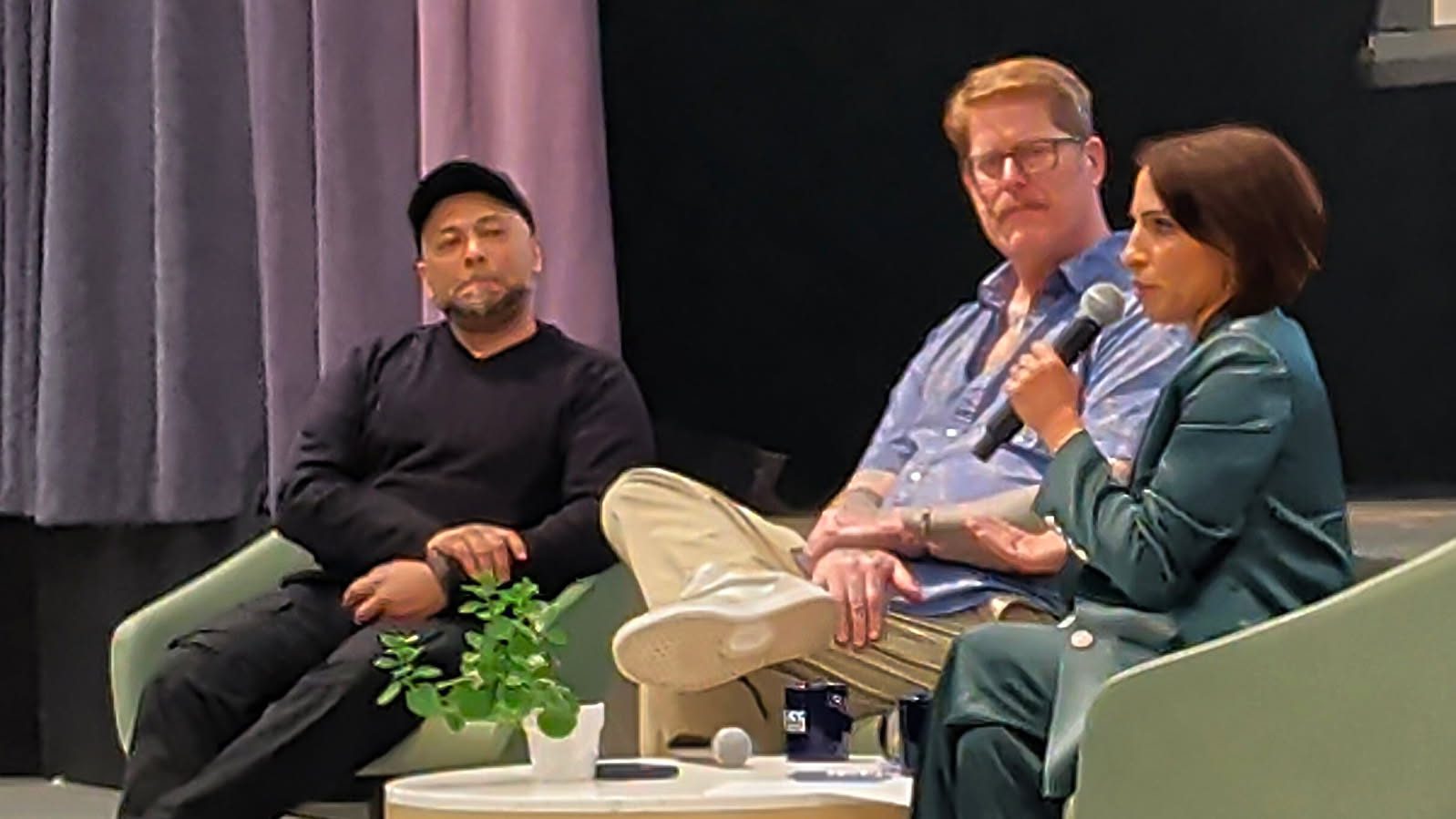
JCCevent1
Dr. Miri Bar-Halpern of Parents for Peace hosts a discussion about coming back from violent extremism with former jihadist Mubin Shaikh, left, and former neo-Nazi Arno Michaelis, middle, at the Jewish Community Center of Greater Boston on Wednesday, April 29, 2026. Photo by Bryan McGonigle
Arno Michaelis once hated Jewish people so much he started a neo-Nazi metal band. Now, he dedicates his life to fighting antisemitism.
On Wednesday night, Michaelis was part of a discussion at the Jewish Community Center of Greater Boston about combating hate, as part of the JCC’s “Hot Buttons, Cool Conversations” series.
Michaelis was joined by Mubin Shaikh—former jihadist turned counterterrorism expert—and host Miri Bar-Halpern, Israeli psychologist and director of trauma services for Parents for Peace.
The rush of the rage
Arno calls himself “an outlier” because his story doesn’t start with childhood trauma, as is the case with many violent extremists. He was a happy child with a pretty normal family living in a nice house in a safe neighborhood.
“That happy little kid had a pretty idyllic childhood, honestly,” he said. “Growing up and having the grace to travel around the world, I understand that there are probably literally billions of children on this planet who would feel like they won the lottery if they switched places with me as a kid.”
His parents pampered him with praise.
“In fact, throughout my childhood, all the adults in my life would just fawn over me and be like, ‘He’s so wonderful, he’s so gifted,’” Michaelis recalled.
His dad was an alcoholic, but a “fun” one, lighting off fireworks in the yard and shooting pistols in the basement with the kids.
Looking back, Michaelis said that praise and his dad’s fun antics may have actually helped set him on his destructive path that began with him bullying classmates.
He would later become addicted to alcohol and drugs, but his strongest addiction started in elementary school with vandalism and hurting people.
“I got a kick out of it. I felt a rush,” he said. “I felt a high by disrupting the world around me, and I quickly became addicted to that antisocial behavior. And the more chaotic I was, the more chaos I was able to cause, the more of a buzz I got.”
By the time he turned 16, Michaelis was “a full-blown alcoholic,” he said, and a violent one.
“Violence was a normal part of my life, and hate was just another part of this rush that I was constantly chasing,” he said. “Hate was just another substance to be addicted to.”
Things escalated when Michaelis got into white supremacist metal bands in the 1980s.
“This music told me that I was a white man and I had to fight for my race against this evil Zionist plot to kill all the white people on planet Earth,” he said. “Now that should sound ridiculous to any thinking person, because it is ridiculous, but to 16-year-old Arno, who was addicted to antisocial behavior and addicted to offending people and shocking people, it was literally music to my ears. I started my own white power skinhead band with some skinhead buddies of mine.”
What changed the tune of the soundtrack to Michaelis’s life? The TV show Seinfeld, which his girlfriend had started watching.
“And God bless this woman’s courage, because she came home and she’s like, ‘Arno, you gotta see this show,’” he said.
So, he gave it a try. And the second episode of Season 2, “The Pony Remark,” reeled him in.
“And despite being as hopelessly goyish as anybody could possibly be, the Jewish humor just really vibed with me,” he continued. “This awkward discussion at the dinner table that this family had, and all the chaos that ensued reminded me of my family. And so I became addicted to Seinfeld at this point.”
With a nudge from Jerry, George, Elaine and Kramer, Michaelis pivoted onto a path of redemption and learned to let go of hate. He gave up alcohol and drugs, too.
Now, Michaelis travels around talking at events like the one Wednesday night, sharing his story and lending his voice to the fight against antisemitism.
‘I wanted to join them’
Shaikh was born and raised in Toronto, the son of Indian immigrants, and, as a kid, he had both secular public and religious education.
“I went to Quran school from the age of 5,” Shaikh said. “And this was boys sitting on the floor, at wooden benches, rocking back and forth, reciting the Quran but not understanding what we were reading, because we’re Indian, and Arabic is not our first language. So we learned how to recite for ritualistic purposes.”
That school was very strict, he added, and punishment often included physical abuse, in an environment he calls “sadistic.”
Shaikh said his public school was, in contrast “a caring and nurturing environment.”
“This public school, this secular community, gave me a whole other way of viewing the world,” Shaikh said.
And there, he thrived. Shaikh emphasized that his origin story isn’t one of a loner driven to extremes. In fact, he was popular. His friends had a rock band.
“I wasn’t bullied. I wasn’t picked on. I wasn’t the victim of racism,” he said. “We were actually the cool kids in school.”
In 1995, when he was 19, Shaikh traveled to India and Pakistan, and while in the Pakistani city of Quetta, he met members of the Taliban in an encounter that would warp his worldview for years.
“And I became enamored with them,” he said. “I wanted to be like them. I wanted to join them. I started to dress like them. I started to talk like them.”
He cut ties with friends and family. The once popular “cool kid” was now self-isolated, marinating in hate. He thought about going to Chechnya to join the Muslims fighting for independence from Russia. At one point, Shaikh said, he fantasized about blowing up a synagogue in Israel.
But Shaikh’s extremism was shattered on Sept. 11, 2001, when he watched the terror attacks in New York and Washington, D.C., unfold and couldn’t reconcile his conscience with the murder of innocent civilians.
Shaikh went to Syria in 2002 and studied Arabic and Islamic studies, and he embraced Sufism—a mystical belief system within Islam—and rejected the violent extremism that had defined his life for years.
Shaikh returned to Canada and began working with the Canadian Security Intelligence Service, infiltrating and disrupting extremist groups and terror plots.
In 2006, he helped stop a plot that involved detonating truck bombs and shooting guns into crowded areas across Ontario. With Shaikh’s help, CSIS arrested 18 people, known as the “Toronto 18,” who had been inspired by al-Qaeda.
‘Butterfly moments’
“When people ask me to describe myself, my initial instinct is to say, ‘Before or after Oct. 7?’” Bar-Halpern said, referring to the Oct. 7, 2023, Hamas terror attacks against Israel that killed more than a thousand Israeli civilians and was followed by a hostage crisis that lasted more than two years.
“I feel like my identity completely changed,” she continued.
Bar-Halpern was raised during the Second Intifada. Her father-in-law was killed in the Sept. 11, 2001, attacks. But the Oct. 7, 2023, Hamas attacks sparked a “fight-or-flight response” in her.
“I was feeling completely traumatized, and I realized I had to do something,” Bar-Halpern said.
So, she posted on an Israeli Facebook group saying she was a trauma expert available to help anyone who needed it. She was flooded with calls, and other therapists joined her effort. They were able to give free trauma counseling to the Jewish community for a year.
And just like with patients she saw before the Oct. 7 attacks, she discovered that people whose trauma over the attacks is invalidated or minimized can experience more anxiety and depression as a result.
“And even if you’re resilient, it doesn’t counter that,” she said.
Bar-Halpern has put her passion to work, and she recently testified at the State House about the impacts of antisemitism on young people as the state works to battle antisemitism through guidance for schools.
“I have this trauma. I carry it with me. I’m not erasing it, but I became a butterfly,” she said.
Bar-Halpern then asked the two men what their “butterfly moment” was.
Michaelis said his came in 2009 when he took a meditation class with his daughter, who wanted to be a Buddhist. He had been unable to forgive himself for hurting so many people, and he thought holding on to that guilt was a way to honor them. The meditation—which he’s done every day since, changed that.
And Michaelis ended up becoming a Buddhist.
For Shaikh, the butterfly moment came when he returned from Syria after deconstructing his extremist beliefs and joined Canadian intelligence. Eventually, his identity and activities were made public, and he lost a lot of Muslim friends who felt he had betrayed them.
“I just had to deal with so much crap from so many different places,” he continued, “and it was at the end of it when the court case was done and the judge validated me.”
You can read more about the JCC’s “Hot Buttons, Cool Conversations” series here.
Share This Story On:

DONATE TO SUPPORT LOCAL NEWS
Your tax-deductible gift to the Newton Beacon keeps our community connected and its residents informed.
Get story alerts twice a week:
Related Posts









Upcoming Events