
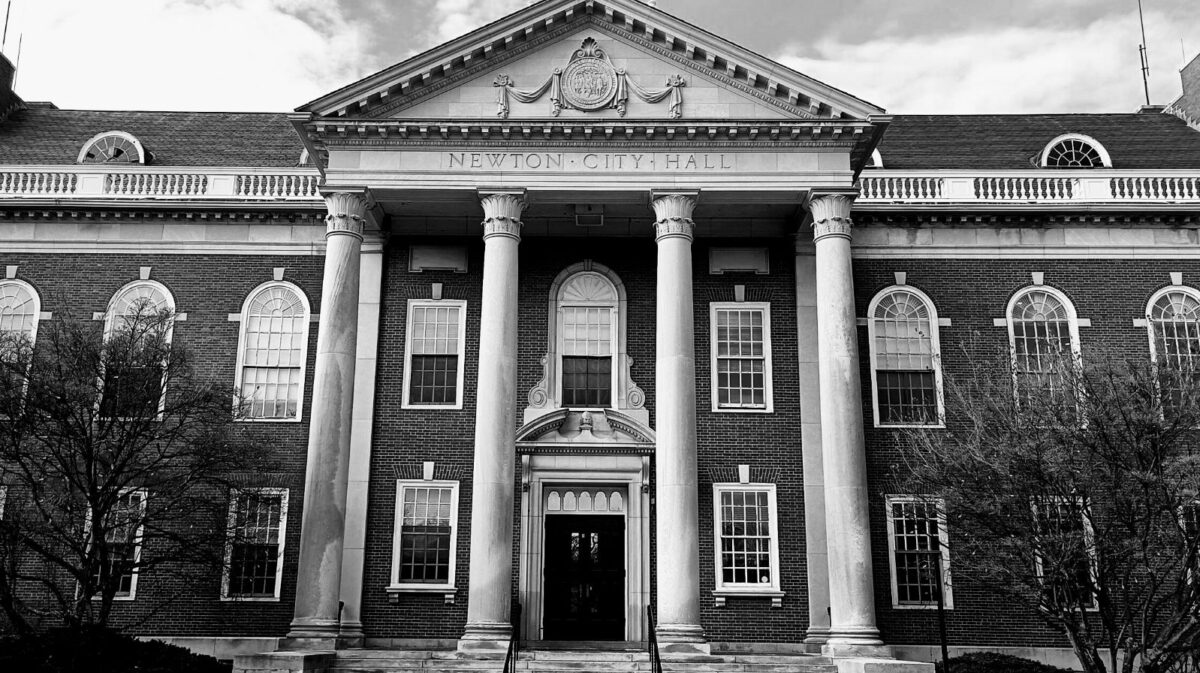
CityHallB&W
“We are living in very strange times,” Mayor Ruthanne Fuller said as she began her presentation of the city’s long-range financial forecast to the City Council Monday night.
“We’re delivering both a five-year and 10-year perspective on the health and financial future of the city when you literally have to check, almost twice a day, to see what’s happening in the world.”
Moody’s has maintained Newton’s AAA bond rating, citing the city’s diverse local economy and CFO Maureen Lemieux’s financial management, but the Moody’s report also noted some challenges. Newton has slow revenue growth, an above-average residential tax burden compared with other communities, and limited potential for new development given the fact that Newton is mostly built out.
The Boston Federal Reserve has put out warnings about consumer confidence declining, unemployment potentially rising, housing prices and more.
The federal government shutdown adds to that chaos, with more than 40,000 federal workers living in Massachusetts, the Trump administration has threatened to cut funding to the state and the state has seen weaker job growth and an exodus of young adults in what Fuller calls “a perfect storm for Massachusetts cities and towns.”
In addition to pressure from the feds and the drying up of state funds, Newton faces rising health insurance costs, a massive pension liability and other retirement costs.
“As hard as we’ve been working on pensions and retiree health care, we’re still so far behind,” Fuller said.
The forecast is dicey. The city is expected to see a 4.4 percent increase in revenues for Fiscal Year 2025 but then 3.4 percent for the next several years.
“The good news is we’re seeing close to a $15 million increase for the Newton Public Schools, bringing them up close to $310 million in funding—a 5 percent increase for next year—but after that, they can likely only count on 3.5 percent. It will likely be higher, but building that into the cost base is going to be challenging.”
And free cash, which was massive after a settlement with Eversource and higher-than-expected interest income landed more than $40 million in surplus money last year, is going to decline in the coming years, too, Fuller added.
Lemieux said that the city’s free cash was recently certified at around $22 million, and the Fuller administration is recommending that the next mayor request $10 million of that be set aside for the NPS Stabilization Fund, which is used to help fill gaps in the NPS budget.
“As I think most of you know, that Stabilization Fund, with the current trajectory of how we expect to use it, will be depleted in 2030,” she said.
Lemieux said if city’s pension liability is set to be paid off by 2032, moving the $10 million to the NPS Stabilization Fund now would hold the NPS budget over until savings from the pension liability payoff materialize in 2032.
You can watch the entire presentation on NewTV’s YouTube channel.
Share This Story On:
DONATE TO SUPPORT LOCAL NEWS
Your tax-deductible gift to the Newton Beacon keeps our community connected and its residents informed.
Get story alerts twice a week:
Related Posts









Upcoming Events