
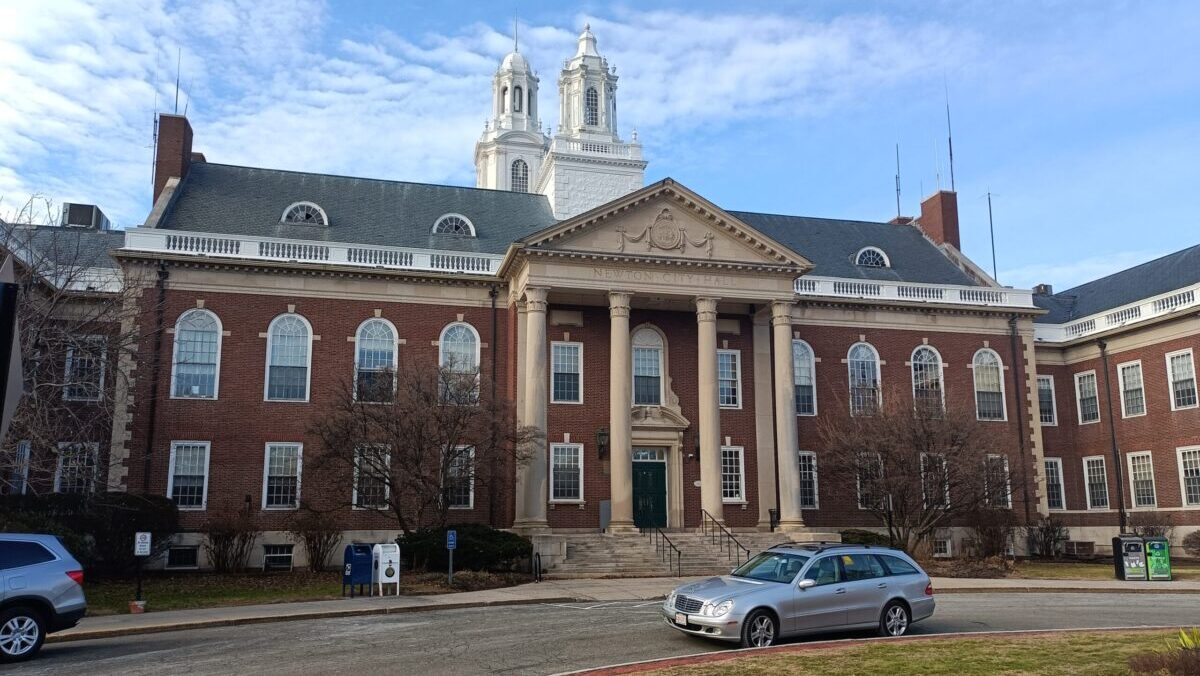
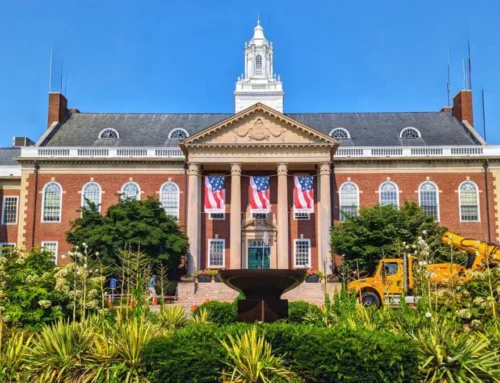
cityhallfront
Newton City Hall. Photo by Dan Atkinson
On Monday, the Newton Commission on Disability (COD) voted to create a subcommittee dedicated to housing research for disabled people in Newton.
COD member Sandra Lingley noted that units in Newton, which had been earmarked as accessible, don’t always go to disabled people, raising concerns that there aren’t enough accessible apartments available.
“I am concerned about people living in apartments who don’t need an accessible apartment, but they’re not getting moved because the apartments aren’t getting listed in the places they need to be listed,” Lingley said. “When someone moves into an accessible apartment, they’re supposed to understand and have an agreement that if someone with a need for that apartment comes up, they need to move out.”
According to Lingley, even housing units listed as accessible lack some basic accommodations because there are no clear inspection standards for what “accessible” actually means.
“Something passes, and the city says they gave it permits and everything, and you move in, and there’s no grab bars in the shower, and there’s not enough counter space beside the oven, and the refrigerator that’s required,” said Lingley.
COD member Lucie Chansky said that housing inspectors should receive training on what different levels of accessibility in a housing unit look like to combat that issue.
COD co-chair Ima Jonsdottir added that units should be properly designed as accessible before review, to save time to ensure that all the correct accommodations are in place.
“If you’re inspecting after they’ve already built it, it’s too late, right?” Jonsdottir said. “And I think that’s often the issue.”
Chansky then highlighted that disabled people who have a limited ability to work are often not included in discussions on affordable housing as well.
“Most of the ones I know are people with intellectual disabilities or severe autism, and they are living on government benefits only,” Chansky said. “They don’t have any other sources of income, so they’re very, very low income, and their income is lower than what affordable housing could offer them.”
Jack Lovett, COD co-chair, seconded Chansky’s point that people with intellectual disabilities are being overlooked, citing that in the past some COD members have prioritized physical disability over intellectual disability in the committee’s work.
“About two years ago, I had a Newton resident come in to talk about her experience basically opening up a group home for her child with an intellectual disability with a few other parents,” Lovett said. “I guess to be blunt, a couple of the COD members, I think, pushed back on that because they felt the commission should be more focused on accessibility.”
A motion to create a four-person housing subcommittee was then passed unanimously by the COD to research housing options for disabled Newton residents. The subcommittee is scheduled to report back to the COD in July.
****
This story is from The Heights, an independent, nonprofit newspaper run by Boston College students with which the Newton Beacon has a partnership.
Share This Story On:
BEACON SPONSOR

DONATE TO SUPPORT LOCAL NEWS
Your tax-deductible gift to the Newton Beacon keeps our community connected and its residents informed.
Get story alerts twice a week:
Related Posts





Upcoming Events