
Garden City
When Joe Waters moved to West Newton 25 years ago, his interest in gardening began. He enjoyed working in his backyard where hydrangeas, hostas and other typical suburban landscape plants grew. But something was missing. He noticed the garden was quiet. There were no birds chirping, no bees buzzing, no hummingbirds humming. What was wrong?
Waters did some research and discovered that his yard was a food desert for wildlife. There were no birds because there were no insects or caterpillars to eat; no bees because there were no native flowers for collecting nectar and pollen; no hummingbirds because the garden lacked the insects and the native tubular-shaped flowers they feed on.
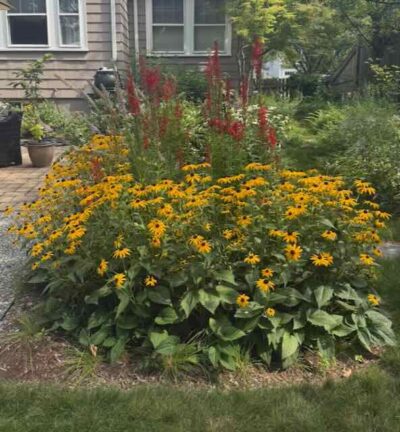
A stunning display of native cardinal lobelia and black-eyed susans in Joe Waters’ garden. Photo by Marian Prokop
Waters got to work and over the years he has converted his quarter-acre property into an almost exclusively native plant garden that is both beautiful and a haven for birds, bees and other beneficial insects.
Today, his garden is alive with coneflowers, spotted bee balm, red lobelia, spigelia, New England aster, columbine, black-eyed susans and many others. His goal is to make his garden 70 percent native plants, the level recommended by famed entomologist Doug Tallamy to sustain local birds and insect populations.
Waters’ garden is among the approximately 18 gardens that will be on view as part of the annual Newton Pollinator Garden Tour that will be held Saturday, Sept. 19, from noon to 4 p.m. (Rain date is Sept. 26). In its fourth year, the tour is organized by the Newton Community Pollinator Project with support from the Newton Conservators, Newton Parks & Recreation Department, Green Newton, Friends of Cold Spring Park, Friends of Wellington Park, and Mothers Out Front Newton.
The event is free but registration is requested. Registrants will receive a map and information on the gardens in advance via email, as well as notification if the tour needs to be rescheduled.
The self-paced tour will feature gardens on primarily residential properties where attendees can see how other residents are using native plants in their gardens. Some of the sites will be public gardens. Organizers hope that the event will inspire residents to add more native plants to their gardens.
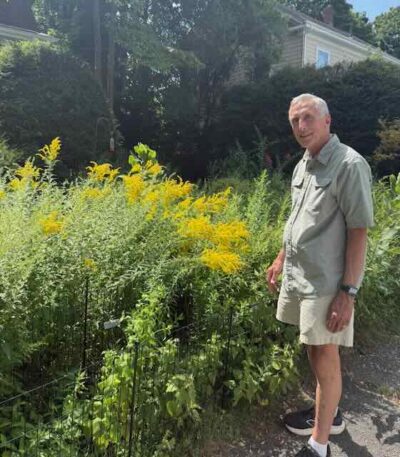
Ted Kuklinski uses this showy goldenrod, an important food source for insects in late summer, in his front yard garden. Photo by Marian Prokop
“The goal of the tour is to educate people about growing native plants, especially pollinators,” said Ted Kuklinski, one of the tour organizers and a former board member and president, now a consultant for the Newton Conservators.
Kuklinski’s garden, which is also on the tour, has dozens of milkweed plants, the host plant for the monarch butterfly. If you’re lucky, you might spot a monarch caterpillar munching on the milkweed, which is the sole food source for these insects. Without milkweed, there will be no monarchs.
What’s a native plant?
“We have not tried to develop a strict definition of native,” said Alan Nogee, one of the event’s co-chairs, a board member of Newton Conservators, and president of Friends of Cold Spring Park. “We encourage gardeners to choose straight species that were present in the Northeast before colonization, preferably close to home, that provide good wildlife support. We don’t rule out near-natives that support biodiversity.”
Gardens on the tour must meet certain criteria: they must be mostly native, at least 50 percent, or in transition to becoming mostly native; or they must have aesthetic or educational value in teaching about native plants and pollinators. Those with significant invasive or “problematic” plants were excluded. Organizers also require a host gardener at the site to provide information on their gardens.
While gardens may be past peak in September, “fall is an important time for flowers to be blooming since many pollinators are most active this time of year and are in need of resources to sustain them,” said Ann Dorfman, an event organizer. “This is also an important time for seeds and berries to ripen to support birds and other critters, so having the tour in September allows us to educate gardeners about the importance of the garden in the fall.”
Previous tours have been held in late spring and after Labor Day and the plan is to continue to alternate seasons.
“Alternating between spring and fall allows us to show attendees plants and gardens in various different stages,” Dorfman said. Although gardens may reach peak bloom in summer, organizing the tour then is difficult because many people are traveling or on vacation.
Since it began in 2023, the number of gardens in the tour has grown. In the first year, there were nine gardens—four private residences and five municipal sites. This year the tour is emphasizing gardens at private residences and only four of the 18 sites will be public gardens. However, the tour guide will include 10 municipal sites with native gardens that visitors can view any time.
If you have a garden featuring native plants and would like to participate in future garden tours, contact Dorfman at dorfmanann@comcast.net.
To learn more about the importance of native plants, read Lisa Gianelly’s column.
Bonus butterfly festival and native plant sale
To get a jump on adding native plants to your garden, visit the native plant sale at the Newton Farmers Market at Cold Spring Park, 1:30 p.m. to 6 p.m. on Tuesday, Sept. 15.
And if native plant gardens aren’t enough for you, the sixth annual Monarch Butterfly Festival will be held the morning of the garden tour on Sept.19, from 9 to 11:30 a.m. at Wellington Park, Kilburn Road.
Marian Prokop and Lisa Gianelly, who alternate columns, are Newton residents and certified master gardeners. They welcome your suggestions for column ideas and news to share of gardening-related events throughout the city. They can be reached at beacongardeners@gmail.com.
Share This Story On:
BEACON SPONSOR

DONATE TO SUPPORT LOCAL NEWS
Your tax-deductible gift to the Newton Beacon keeps our community connected and its residents informed.
Get story alerts twice a week:
Related Posts








Upcoming Events