

TASTE OF NEWTON
As spring arrives, many of us prepare our gardens for tomatoes, cucumbers and other crops to supplement our summer menus. Yet more than 100 years ago, during America’s involvement in World War I, planting vegetables was considered a patriotic duty in Newton and nationwide.
After America entered what was then called the Great War in 1917, citizens were encouraged to help the war effort by increasing the local food supply. That freed up canned goods and staples to be sent to U.S. troops and to hungry civilians in Allied countries devastated by the war.
Part of increasing the food supply took place on a small scale, in “war gardens”—later renamed “victory gardens” because they kept going after World War I ended.
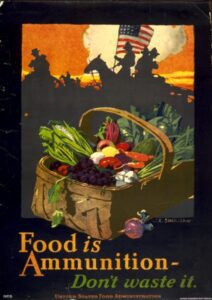
A U.S. Government poster urges citizens to plant vegetable gardens to help the war effort in World War I.
Under future President Herbert Hoover, then the head of the U.S. Food Administration, the federal government led efforts to promote gardening and to convince citizens to produce more food and waste less. Hoover helped to implement “Meatless Mondays” and “Wheatless Wednesdays.” The act of economizing on food during this time was dubbed “Hoovering.”
Newton participated by creating a Committee on Food Production and Conservation and sending circulars to each household asking: “Have you land for a garden? If so, will you cultivate it yourself?” People were also asked if they would give up excess land for someone else to garden, or if they would go to someone else’s land and tend a garden.
Each of 10 villages in Newton soon established a gardening headquarters to coordinate the efforts. In 1917, Newtonians planted 1,206 gardens. In 1918, that number rose to 3,390. Signs were posted in English and Italian, a nod to the city’s immigrant population, warning people not to trespass and pick vegetables.
The city’s Committee on Food Production also organized canning classes at Newton Technical High School (a vocational high school that opened in 1907) and other community centers. Adults and children could learn the latest canning techniques and other principles of economical cooking. An agricultural fair at the Norumbega Park amusement park in Auburndale, held in September 1917, showed off the canned goods.
Public schools joined gardening efforts, too. In Newton in 1917, regular courses in nature study were dropped in favor of gardening instruction for children in grades 4 through 8. The schools created 91 gardens at 24 schools and on adjacent city land, such as the Newton Centre Playground.
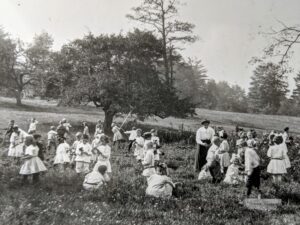
Students plant a vegetable garden in Newton Centre during World War I. Image from the Archives at Historic Newton.
Each grade had its own garden. Most students grew practical plants, such as potatoes, beans and corn. But at one school, sugar cane, sweet potatoes, mangel beets and castor oil bean plants were grown as “new” crops.
During the summer, four children were selected to handle the maintenance and upkeep of each garden. This was considered an honor; those who did this work received special pins. Children were also encouraged to garden at home and those who did received a pin recognizing their “Patriotic Garden.”
Newton’s Girls Scouts also got into the war effort. At a performance of “The Forest Princess” in 1918, the girls noted in their program that they canned 175 quarts of food products and were starting a scout garden.
Though World War I ended in November 1918, victory gardens made a comeback in the 1940s, when the United States entered World War II. Food supplies could once again be harnessed to help the war effort. A new generation began gardening in the Garden City.
The Archives at Historic Newton provided research materials for this column. Clara Silverstein is a cookbook author with extensive knowledge of Newton history. She can be reached at clara@clarasilverstein.com.
Share This Story On:

DONATE TO SUPPORT LOCAL NEWS
Your tax-deductible gift to the Newton Beacon keeps our community connected and its residents informed.
Get story alerts twice a week:
Related Posts










Upcoming Events