
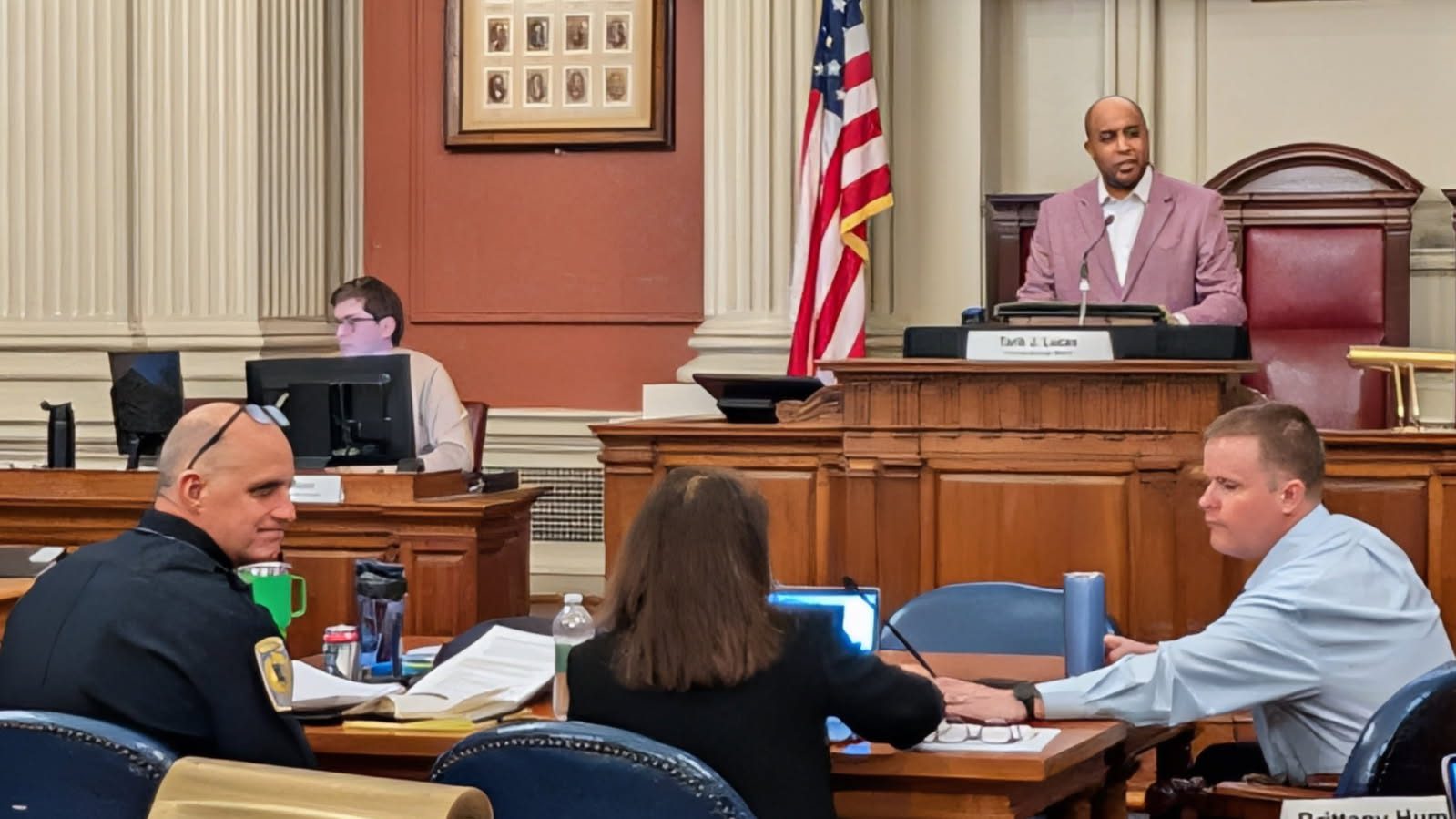
councilmeeting1
Police Chief Tim Cohoon, City Solicitor Alissa Ocasio Giuliani, Chief Operating Officer Josh Morse meet with the City Council's Public Safety & Transportation Committee, chaired by Councilor Tarik Lucas. Photo by Bryan McGonigle
If Immigration & Customs Enforcement agents arrived in Newton to conduct training exercises or an all-out raid, what would the city and its police do in response?
That was the topic of a lengthy and thoughtful discussion Wednesday night between the City Council’s Public Safety and Transportation Committee, City Solicitor Alissa Ocasio Giuliani, Chief Operating Officer Josh Morse and new Police Chief Timothy Cohoon. And the conversation is far from over, as it revealed even more questions about what to do when local ordinance and federal law enforcement are at odds.
As temperatures hit a boiling point across the nation, some Newton elected officials are demanding clear guidance while public safety leaders work to navigate a new, unprecedented era for local law enforcement.
On the books
In 2017, Newton enacted a Welcoming City ordinance, similar to that of a “sanctuary city,” in which city employees are prohibited from assisting with federal immigration operations (where immigration is the only criminal offense a person is wanted for). It also bars ICE from using city resources for its operations.
“We do not notify federal authorities about the release or the upcoming release of any person for immigration purposes,” Ocasio Giuliani said. “We do not cooperate or enforce any federal program requiring the registration of individuals on the basis of their religious affiliation or their national origin.”
A few months ago, as images and videos of violence poured out of Minneapolis and ICE agents were shown gunning down civilians, Mayor Marc Laredo issued an executive order reiterating the points of the city’s Welcoming City ordinance.
What constitutes “city resources?”
- City buildings
- City employees
- City phones
- City facilities
- City property
Gov. Healey has issued a similar executive order statewide and established a portal for reporting ICE activity in Massachusetts.
And, Ocasio Giuliani emphasized that the city does not have an agreement to collaborate with federal immigration authorities—commonly referred to as a 287(g) agreement—and no other communities in the area do, either.
The only 287(g) contract still in effect in all of Massachusetts is with the Plymouth County House of Correction. That also means the Massachusetts Department of Corrections is the only state agency in all of New England that still has a 287g contract with the Department of Homeland Security. New Hampshire’s state police last year entered into a collaboration with ICE for training but it’s not technically a 287(g).
So, if ICE agents show up in Newton, they’re not allowed to use the city’s parking lots, buildings, parks, phones, computers, printers, vehicles or other city property, and they’re not allowed to ask city staff for help with immigration enforcement operations.
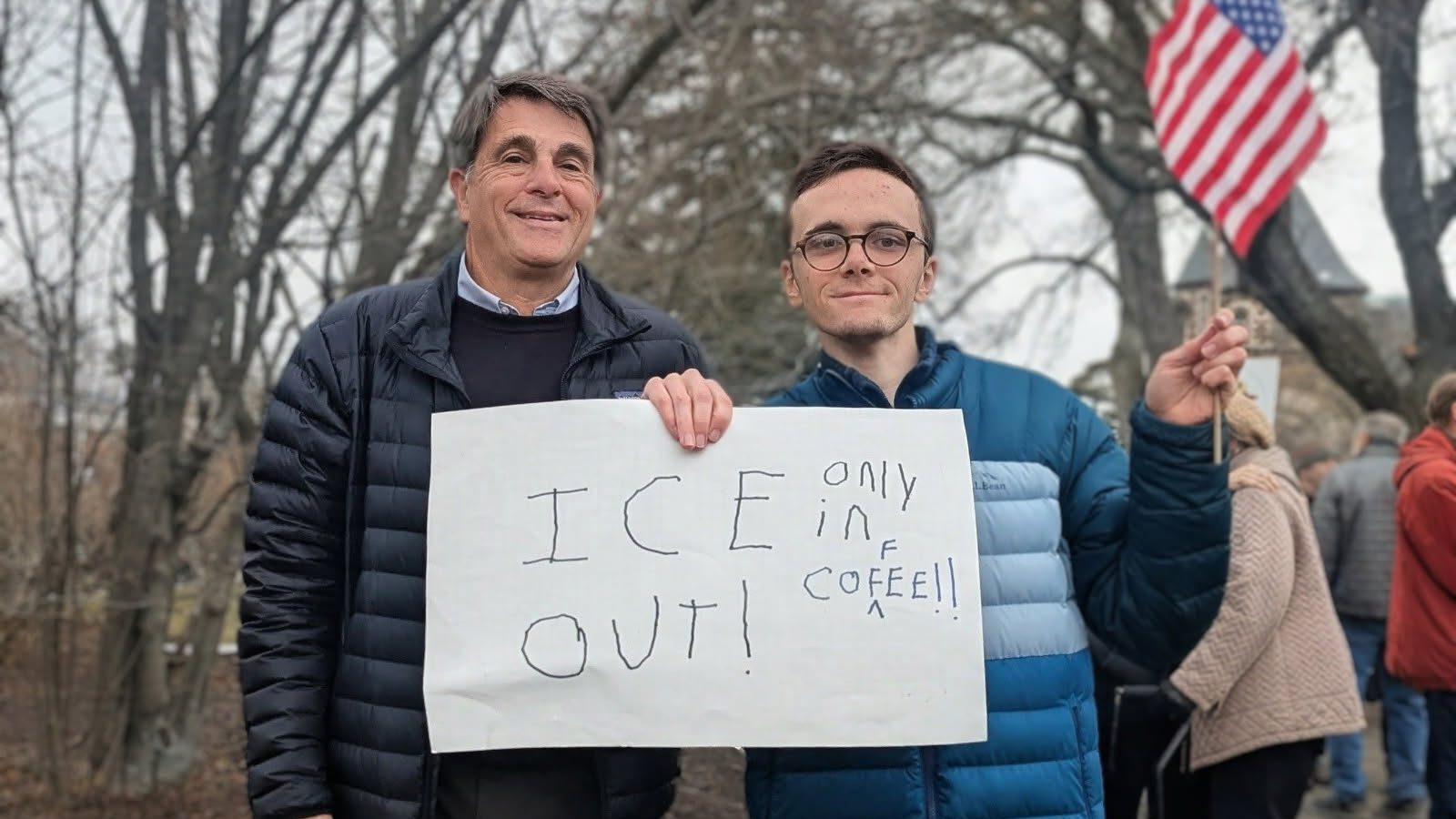
Marc Laredo, shown here with Nathan Persampieri, attends a protest against the Trump administration and Immigration & Customs Enforcement in Newton Centre on Jan. 10, 2026. Photo by Bryan McGonigle
‘A general anxiety’
Several city councilors have asked for policy clarification and enhancement of the city’s Welcoming City ordinance and Mayor Marc Laredo’s recent executive order reiterating that ordinance, after what Councilor Maria Greenberg called “overly aggressive tactics” used by ICE agents, including the wearing of masks, grabbing suspects without identifying themselves as federal agents, shooting bystanders and more.
“These actions have spread fear, mistrust and confusion in our communities across the country, and many of our residents are experiencing a high level of anxiety and uncertainty as we watch federal enforcement actions unfold,” Greenberg said. “There are widespread concerns about the use of a lawful excessive, even lethal force, violation of civil rights and the detention of individuals who pose no threat, including in some cases, families and children.”
The docket item discussed Wednesday was the start of a larger look at both the city’s policy of not supporting federal immigration operations and what the city can do—if anything at all—should federal agents thumb their noses at that policy.
Greenberg said she was grateful for Laredo’s executive order but added that such an examination is needed for practical reasons but also to help quell fears among those who live and work in Newton.
“One such action that would provide reassurance to our residents and city employees would be for the mayor’s office to develop clear guidance and training for the frontline workers of our city’s departments, particularly our schools, clerk’s office and social service agencies, so they understand their roles and legal responsibilities if they encounter federal immigration enforcement,” she said.
Greenberg added that families with kids in the schools are especially afraid.
Morse wouldn’t speak for the school administration office or the School Committee, but said the mayoral administration is working behind the scenes with the state and other communities to update both policy and practices when it comes to dealing with federal immigration operations. There are updates coming to the city’s website, for example.
“It’s not going to be a static system,” Morse assured the room. “This can’t be a static system because it’s ever-changing. So stay tuned. There will be some new material on our website. I don’t assume that that’s the end. I’d love it to be the end, because that could mean that we’re in a far better place as a country.”
Councilor Brittany Hume Charm said she wants to make sure the violence seen elsewhere involving ICE does not happen in Newton and that people who live and work in Newton feel safe.
“What more can we be doing?” Hume Charm asked.
She noted the weekly rallies on the Newton Centre Green as one way people are taking action but said more is needed from the city in terms of planning and clarity, especially for Newton’s large immigrant community.
“There is general anxiety among our residents who are vocal, passionate people here in Newton, and then also an acute anxiety among a smaller population,” Hume Charm said.
Hume Charm works in the City of Boston’s Office of Economic Opportunity and Inclusion and said that the city has received guidance and enacted policy on what to do if ICE shows up, and she asked why it’s been difficult to produce a two-page document with similar guidance to be distributed to city employees in Newton.
“I don’t mean to be cute about that question,” she said. “I just think that this is something that is a natural next step coming out after an executive order.”
Ocasio Giuliani said there were conversations taking place between department heads, and Morse replied that a written document wouldn’t do as much as behind-the-scenes collaboration is already doing.
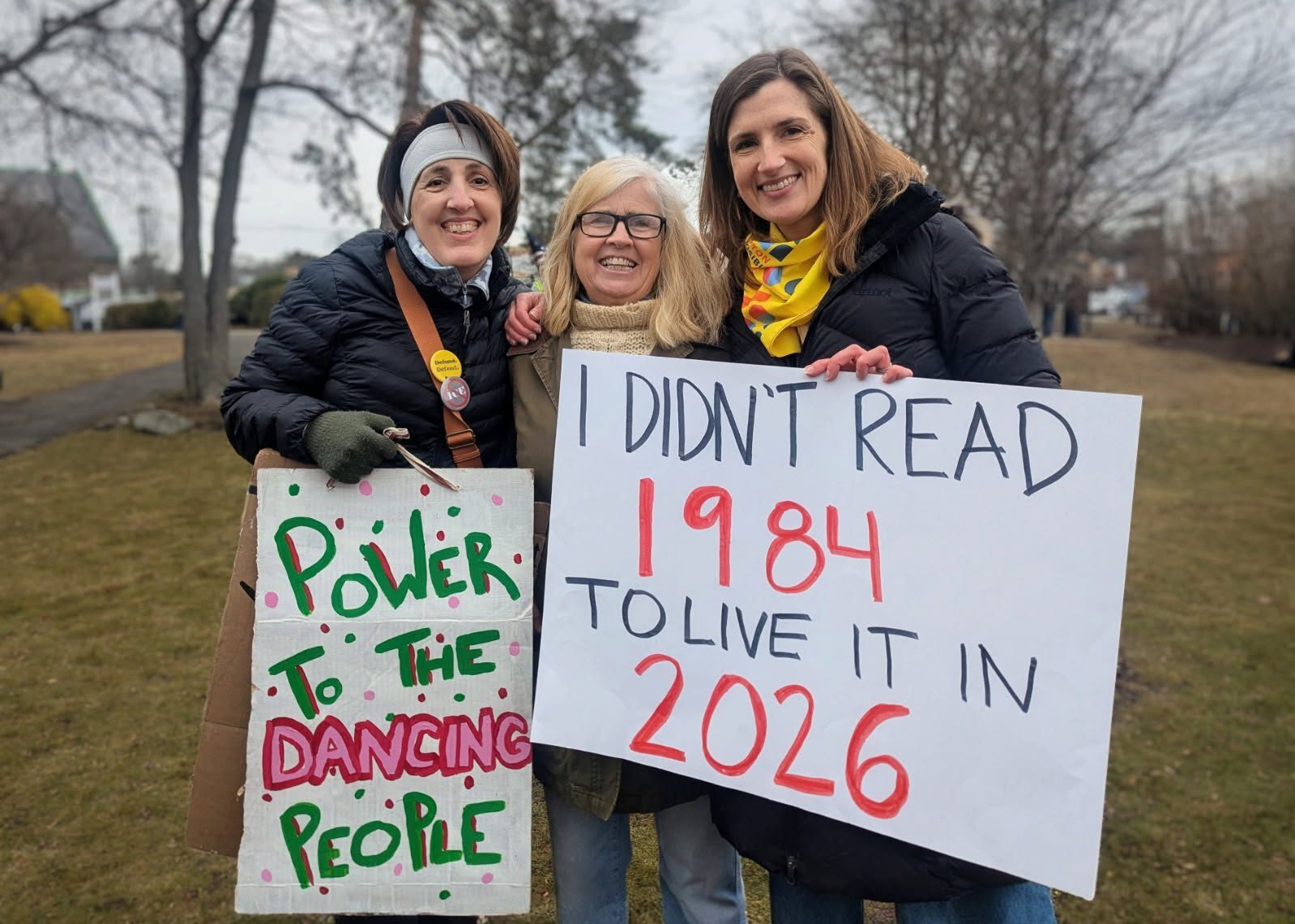
Left to right: City Councilors Maria Greenberg, Alison Leary and Brittany Hume Charm, attend a protest against the Trump administration and Immigration & Customs Enforcement in Newton Centre on Jan. 10, 2026. Photo by Bryan McGonigle
‘A new paradigm’
Chief Cohoon said the city is working in a “new paradigm” when it comes to law enforcement and immigration.
“Local police, state police and federal authorities do work together, and that information flow is important,” Cohoon said. “However, in this context, we’re not only prohibited from providing or sharing information related to civil immigration enforcement, but it’s also not within our purview.”
Law enforcement agencies across the state have been working on finding and clarifying best practices of local law enforcement within the new rules of cooperation (or non-cooperation) that have sprung from the national chaos.
“There are no simple answers but I can tell you those discussions are robust and ongoing,” he said.
Cohoon said a key to navigating these choppy waters is communication. Police departments need to maintain communication with each other and with their city governments and schools, and police also need to keep lines of communication open in the community.
The Newton Police Department recently negotiated an up-and-coming pilot program, potentially to be funded in the Fiscal Year 2027 operating budget, that would put body cameras on police officers throughout the city, Cohoon said.
“I can tell you I wish we could have them tomorrow,” Cohoon said. “I can tell you it’s a priority. The mayor’s office wants it, the city wants it, the cops want it. It’s going to be a great tool for us, not only in making sure there’s proper oversight, but I think it’s going to be a huge tool to show the community exactly what we do.”
Councilor Sean Roche, a former New York City prosecutor, asked about the possibility of what’s called “blue-on-blue” engagement, which would be when local and federal law enforcement accidentally engage each other in fight. It happens in the military (“friendly fire”) and, albeit rarely, it can happen in law enforcement, Cohoon acknowledged.
Cohoon said the best way to avoid that kind of catastrophe is through constant communication among agencies.
“But that’s accidental,” he continued. “What we don’t want to do is, on purpose, have two armed police forces opposing one another. And that’s where I want to take a step back to make sure we’re not putting police officers in an unwinnable position.”
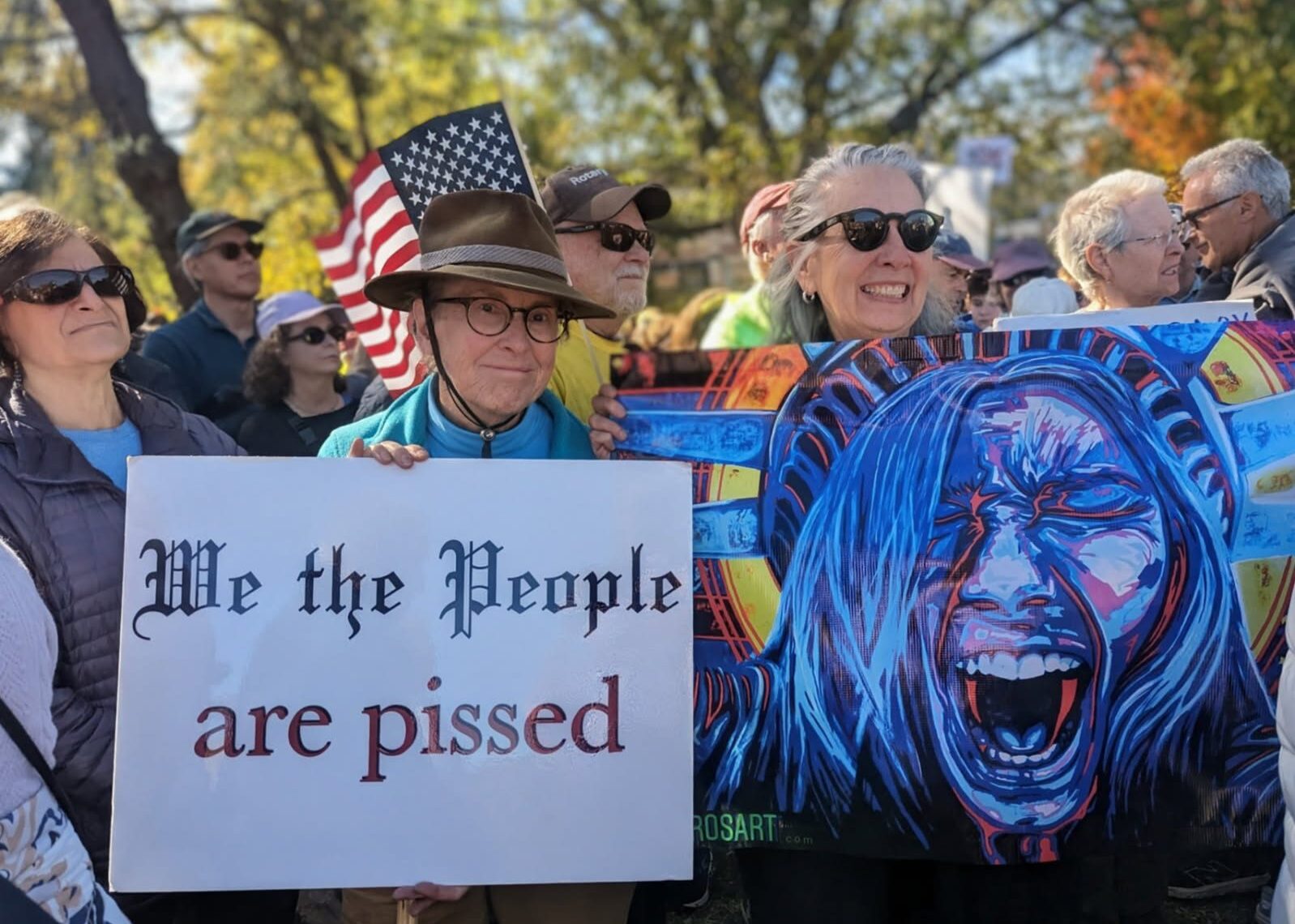
City councilors Julia Malakie, left, and Rena Getz, right, hold protest signs at Newton’s “No Kings” rally on Oct. 18, 2025. Photo by Bryan McGonigle
About that ‘what if’
So, what if ICE agents thumb their noses at the city’s ordinance and the mayor’s executive order and set up a training station on Albemarle Field? Or what if the agents set up a detainee holding area in the Riverside Station parking lot, owned by the state?
“I think it comes down to wanting that reassurance, that guidance,” Ward 5 Councilor Julie Irish said. “I’m going to be very blunt about it. If they were to just show up tomorrow on the streets of your neighborhood, what do we do? Do we go on the website? Do we call the LUCE Hotline? I think that’s where people just want to know tomorrow or next week, there’s a plan.”
And that is what the bigger discussion is about. What can the city do in the grips of a federal crackdown? What can elected officials do for their constituents when people are scared all the time? What can local police do for the community in the face of a federal immigration enforcement surge?
For starters, Cohoon said anyone who sees what they suspect is ICE activity should call the police department’s business line, not 911 (unless it’s an emergency needing first responders). The business line number is 617-796-2100.
Beyond that, Morse said the city is considering various options including posting signs in multiple languages about the Welcoming City ordinance, collaborating with nonprofits that serve immigrants and focus on social justice, and other ideas discussed Wednesday night.
Asking for trouble?
What was not decided was whether or not to have a public hearing about the issue. Roche said he understood why public comment would be wanted but cautioned that it might “attract some folks who might have ulterior motives that are non-productive” and put the city on the radar of a vengeful federal government.
Whatever people’s motives may be, one of those people with an opposing view was in the audience: Al Cecchinelli, a conservative attorney who ran against Marc Laredo in last year’s mayoral election.
“I found this meeting disgusting,” Cecchinelli said, accusing the City Council of setting the stage for Minneapolis-level violence. “Texas, Louisiana, Georgia, Florida–all have had 10-to-80 times more deportations than Minnesota did, but Minnesota didn’t cooperate. They empowered—and that word came up twice tonight—empowered their citizens to interfere. This is wrong.”
Cecchinelli suggested the city welcome ICE and assist federal agents against anyone trying to stop them from doing their work and offered what guidance he thinks should be written out and distributed to city employees.
“They should welcome, comply and assist any federal agency,” he said. “To think that the police are going to step between somebody trying to obstruct an ICE officer and his lawful duty, and not thinking that there’s going to be consequences. I mean, they don’t understand that when they call 911, and the police show up, they’re going to get between these people in ICE and they’re going to arrest anybody that tries to interfere or assault an ICE officer. It just… It’s another dimension.”
Possibly not having public comment, Cecchinelli said, is another smack in the face to Newtonians who actually support ICE.
In Newton, about 23 percent of voters picked Donald Trump for president in 2024, and Trump ran on a promise to carry out ICE raids and mass-deportations. There’s no way to say how many of those Newton Trump voters still support him and the ICE activity, but with nearly a quarter of voters having picked Trump and his policies in the last election, it stands to reason that a sizeable lot would have different opinions on Trump’s policies than their neighbors or the members of the City Council.
“I don’t want to see my neighbors putting their body between an ICE agent and a pedophile that they’re going to come to pick up, because right now, that’s what they’re out doing,” Cecchinelli said. “Now, if there’s somebody else that gets caught up, of course they’re going to take them. But these are targeted things, and you know, anybody that shouldn’t be here, eventually they’re going to get to that. But if ICE goes out and they go to somebody’s home, and there are seven people there that are illegals, and only one is the person they’re looking for, guess what? They’re going to take them all.”
One thing that was clear Wednesday night was that there is a lot of discussion to get through before the city has a clear, robust guidance to accompany its Welcoming City ordinance in these tumultuous times. What’s not clear is what that guidance will entail and whether the public at large will be included in those talks.
Share This Story On:
BEACON SPONSOR

DONATE TO SUPPORT LOCAL NEWS
Your tax-deductible gift to the Newton Beacon keeps our community connected and its residents informed.
Get story alerts twice a week:
Related Posts


Upcoming Events