
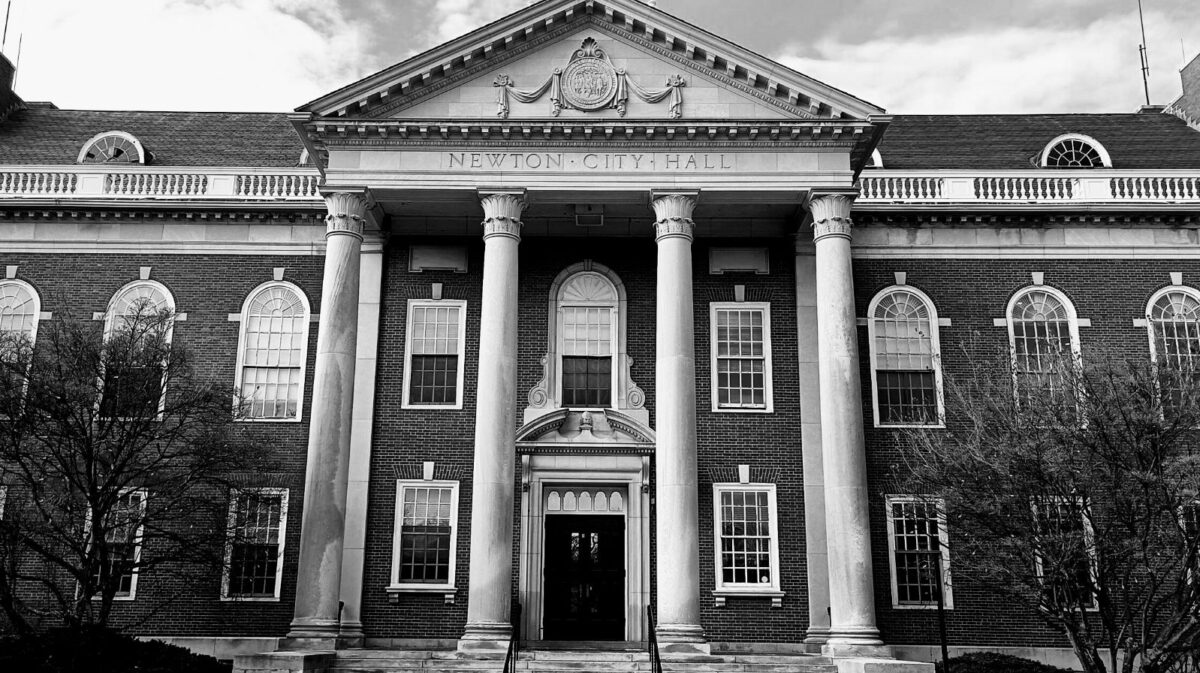
CityHallB&W
In 2023, after former Ward 6 Councilor Brenda Noel received inappropriate text messages from her colleague, Ward 8 Councilor At-Large Rick Lipof, she wrote a letter to the City Council asking to, “establish a set of standards by which we conduct business that is more in line with what you might expect in a professional setting.”
The Programs and Services Committee, chaired by recently re-elected Ward 4 Councilor-at-Large Joshua Krintzman, took up the issue and began tedious discussions on a possible ethics code.
The item was docketed late that year, re-docketed in early 2024, and this April the Rules Subcommittee discussed the topic of Codes of Conduct in other cities and in organizations to review and inform their own approach.
Ward 5 Councilor Bill Humphrey was tasked with drafting the new code. In early November the Committee finally moved to pass a newly adopted code to the full council for a final vote.
The motion was adopted with six “yes” votes and Humphrey abstaining, placing it on the docket for the Dec. 1 meeting.
A strong start
The code was brought before the council with a list of amendments, set to be discussed and voted on during the latter half of Monday’s meeting.
Krintzman, commenting on the document before debate began, noted, “there were situations that came up within the city council over the last number of years that some folks were frustrated there was not a mechanism to handle.”
Ward 7 Councilor Lisle Baker introduced a set of very basic language adjustments to change wording in the document from “councilors shall [do something]” or “it is the duties of elected officials” to “councilors should,” mirroring his broader efforts to keep the document more recommendatory in tone.
He recommended keeping one “shall” in place as it related to the safeguarding of confidential information which, Baker noted, “is the important mandate that is different from others, which are advisory.”
His linguistic amendments passed with a resounding aye voice vote, setting a high bar that none of the following amendments would reach.
A string of failures
Humphrey offered up his own package of amendments intended to strengthen the drafted code’s language and clarify how the council should respond if a member is in violation of the code.
His proposals ranged from adding tougher wording to the harassment prevention section to clarifying enforcement and remediation, yet the majority of the council was against implementing defined inner-council enforcement and instead favored retaining the code as primarily a statement of principles.
First suggesting a change in the harassment prevention paragraph to add language that “it will not be tolerated,” Humphrey and supporters of the proposal argued that this would make the council’s stance on the matter unmistakable.
“I think adding ‘will not be tolerated’ at the end makes the statement even stronger,” Ward 2 Councilor-at-Large Susan Albright remarked in favor of the changes.
Opponents presented a simple argument—that such phrasing implies consequences which the enforcement section of the code does not define.
Ward 8 Councilor Stephen Farrell took issue with the implications behind the proposed wording saying, “when you say ‘will not be tolerated’ it seems to me there is a consequence attached to that, and if there is, I think it should be expressed.”
The amendment failed 9-14, a margin that would turn out to be one of the closer votes of the evening.
Humphrey next addressed the code’s acknowledgment process. He sought to add a written version of the acknowledgement to the wording of the code and make amendments requiring signed statements of acknowledgment to be kept on file and made publicly available, as well as requiring councilors to re-sign the statement if the code was revised during their term.
Baker warned this would create, “a rather cumbersome process and one which will make [the code] difficult to make as effective.”
Albright again sided with Humphrey, responding, “I don’t see how it makes it very cumbersome to just save the signed statements and put them in a file drawer and make them accessible.”
As pointed out by Ward 7 Councilor-at-Large Rebecca Grossman, and seconded by Baker, the argument was not against filing or saving the documents, but rather against language that was superfluous. Grossman put it plainly, “simpler is sometimes more elegant and more effective.”
Albright subsequently proposed her own friendly amendment to ease the language and simply have a statement which said the signed acknowledgment would be kept by the clerk and be available to the public.
Council President Marc Laredo intervened to push a vote, emphasizing that the council could just vote the following term to make any changes to the code.
“This is committee work right now … the idea that we’re going to amend amendments to have other amendments with linguistic changes on the floor of the council, I don’t think that’s good policy.”
Albright responded briefly, mentioning that changes were not so easy to come by and urged the body to “do the best we can tonight.”
Humphrey opted to keep his changes as presented for the vote, which saw the amendment fail 7-16.
Enforcement
Next came three enforcement-focused amendments, with Humphrey first proposing to give the council president the authority to ‘enforce the code’—with recusal alternatives if the president was the one in violation.
He explained the need by noting the code which came out of committee, “essentially didn’t really have an enforcement mechanism,” and that, “Every [added amendment] is up to discussion because we couldn’t come to an agreement on it.”
Laredo again offered up a rebuke. “It sounds like the committee came to an agreement, voted it out, and you’re differing with the vote here.”
The problem with the enforcement role, as voiced by Baker, was that, “this is formalizing the conduct that we want to undertake and be accountable to, but we’re ultimately responsible to the voters.” Similar to the previous vote, the amendment was shot down 7-16.
Humphrey then brought forward a proposal requiring any councilor who violated the code to apologize to the affected party(s) —and do so during public session if the violation was made in public.
Baker again rose in opposition, arguing that, “the committee report reflects that we felt this was something beyond the scope of a good start on the code of conduct.”
Joining Baker in opposition was Krintzman, who pointed out that he had already been advocating for a wholly separate enforcement mechanism—in the form of an ethics committee—which he had previously proposed to colleagues through email.
The amendment was put to a vote and failed 2-21.
Lastly, Humphrey proposed an amendment which broached the topic of ethics training for councilors who violated the code multiple times.
This was, yet again, opposed by Baker, who lauded the intent but explained his opposition by noting, “I don’t recall any [instance] where members of the council are required or even advised to undergo training for a violation of the rules.”
He was the only one to voice his opposition, and the vote was yet again 2-21 as Humphrey’s final amendment failed.
Code of Conduct passes as a rule
After debate and voting on all proposed amendments was concluded, Humphrey moved to have the council adopt the code as a proposed amendment to the rules and orders of the City Council, as suggested by the city’s Law Department.
“If it were instead something like a best practices document, that is pretty loosey-goosey and not really binding in any way,” he explained.
Baker, standing in opposition to Humphrey throughout the process, now stood in favor of adopting the code as a rule of the City Council.
Laredo had to confirm, “can I just make sure I understand you’re speaking in favor of Councilor Humphrey?”
Baker quipped dryly, “just because I disagreed with him so much, I wanted to make sure I stood when I agreed.”
The vote to make the code a part of the council’s rules passed 23-0 in a roll call vote, before a final voice vote was held to adopt the new Code of Conduct.
Share This Story On:
DONATE TO SUPPORT LOCAL NEWS
Your tax-deductible gift to the Newton Beacon keeps our community connected and its residents informed.
Get story alerts
twice a week:
Related Posts




Upcoming Events