
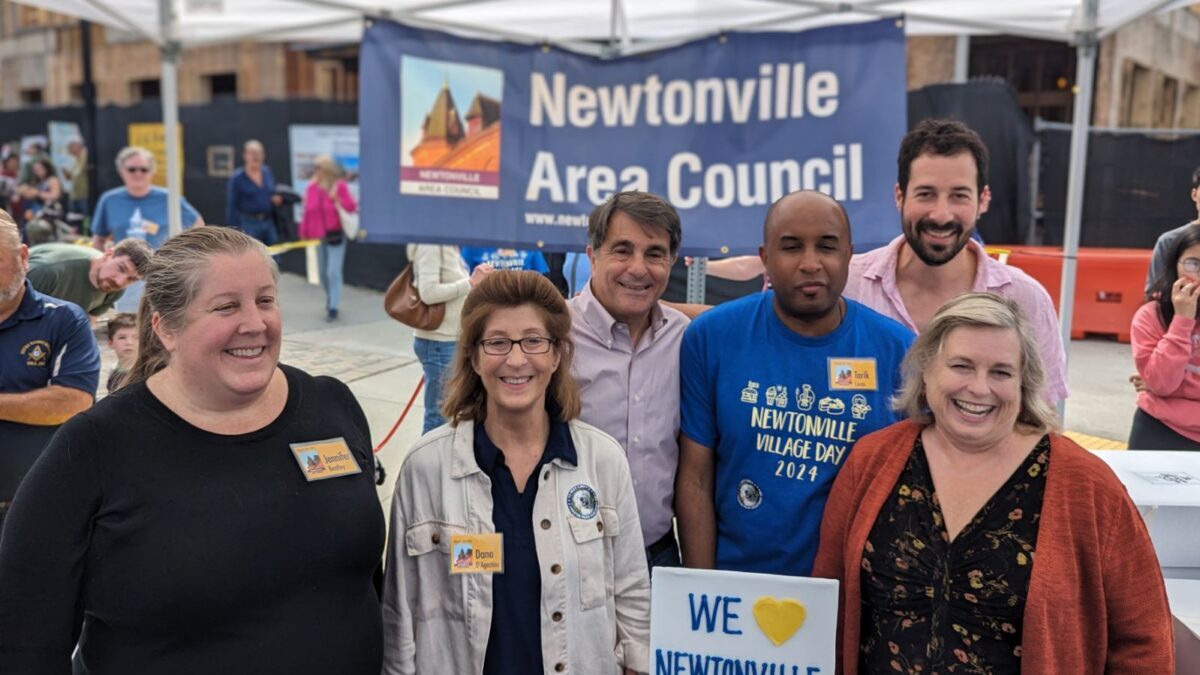
Newtonville8
Newtonville Area Council President Jennifer Bentley and Treasurer Dana D'Agostino pose for a photo with city councilors Marc Laredo, Tarik Lucas, David Micley and Pam Wright at Newtonville's Village Day on Sunday, Sept. 29, 2024. Photo by Bryan McGonigle
When Newton residents vote in this November’s election, many will choose candidates for neighborhood area councils in Newton Highlands, Newton Upper Falls, Waban and Newtonville.
But what are area councils, and what exactly do they do?
Julie Irish, president of Newton Upper Falls Area Council, says she thinks a lot of people don’t know—but she believes they should.
“I see a lot of benefit of having area councils,” Irish said. “It’s just another way to communicate and solve problems.”
Nomination papers for area councils (each candidate must have at least 25 signatures) are due Sept. 22.
How did area councils start?
A revision of Newton’s city charter that took effect Jan. 1, 1972, created a framework for area councils with the goal “to encourage citizen involvement in government at the neighborhood level by permitting limited self-government.”
Newton Highlands created the first area council in 1974, followed by Upper Falls in 2011 and Newtonville and Waban in 2013, according to each council’s by-laws.
Any Newton neighborhood can establish an area council. A resident must submit a petition, signed by at least 20% of the area’s voters, to the city council, followed by a public hearing and a city council vote.
“There has been some talk about creating other area councils,” said Jeremy Freudberg, Newton Highlands Area Council president. “It’s just a matter of whether or not there’s enough cohesion or consistent identity in a certain area to accomplish that.”
What is their purpose?
Area councils are “a bridge between city government and the local residents,” Freudberg said, and this “two-way street” helps bring residents’ questions and concerns to the city’s attention.
“A lot of people don’t know where to start as far as getting those answers,” he said. “The area council is there to bring up topics of interest in the community.”
Although each area council’s nine members are elected, they are volunteers and do not have governing power, Irish said. Rather, area councils’ relationship to the city government means they can effectively field residents’ questions and contact relevant city councilors or departments.
When residents brought up safety issues with the Upper Falls Greenway Splash Park, which opened in June 2025, Irish said the Upper Falls Area Council wrote a letter to the Newton Parks, Recreation and Culture Department. The department took action, and Irish could report to residents that the city heard their concerns.
“That’s kind of the perfect situation,” she said. “We hear from residents, we’re able to get to the next level, rather than having a resident write a letter.”
Each area council hosts a monthly open meeting to hear from residents. Newtonville also holds a monthly listening hour at local cafés, where residents can speak to councilors in an informal setting, said Laura De Veau, Newtonville Area Council president.
To De Veau, area councilors are “the face on the street and the boots on the ground” to address residents’ issues.
Area councils also plan community-building events, such as an annual Village Day, typically each village’s main event of the year.
How do they differ from neighborhood associations?
Some of Newton’s 13 villages, including Nonantum, Newton Corner and Newton Lower Falls, have neighborhood associations instead of area councils.
Both area councils and neighborhood associations volunteer to advocate for residents and sponsor community events, including individual Village Days.
One difference between the two groups is that area councils must follow the state Open Meeting Law, said Ward 2 City Councilman At-Large Tarik Lucas, who served on the Newtonville Area Council from 2018 to 2019. Area councils are required to publicize minutes and agendas from their monthly meetings, which are available on the city website.
“[Neighborhood associations are] not subject to open meeting laws, and they don’t have strict rules and regulations they have to follow, whereas neighborhood area councils do,” Lucas said.
Unlike neighborhood associations, Newton’s area councils are written into the city charter, so members must undergo a formal local election process. Area council members also host the Newton city election debates, which occur this year on Oct. 18 and 19.
How are members elected?
Area councilors serve two-year terms. Elections take place in November every odd year, on the same day as elections for city council, school committee and mayor. Election day is Nov. 4.
“It’s a contested race if there’s enough candidates,” Freudberg said.
Area councils are on a ballot separate from the citywide elections, and residents can vote for area council members only in person, either on election day or during early voting. As a result, Freudberg said, promoting area council voting can be difficult.
“All four area councils have been working with the city, the interim city clerk and some of the city councilors, who have been there to help advocate with us, to improve that process,” De Veau said.
To appear on the ballot, area council candidates must collect 25 signatures from residents in their catchment and submit nomination papers to the City Clerk’s Office, this year by Sept. 22.
This story is part of a partnership between the Newton Beacon and the Boston University Department of Journalism.
Share This Story On:
DOUBLE YOUR DONATION:
Through a matching fund created by your neighbors and foundations, your gift to the Newton Beacon by Dec. 31 will be doubled until we reach $100,000 -- tripled for new donors!
Get story alerts
twice a week:
Related Posts




Upcoming Events