
wardunderwoodpics
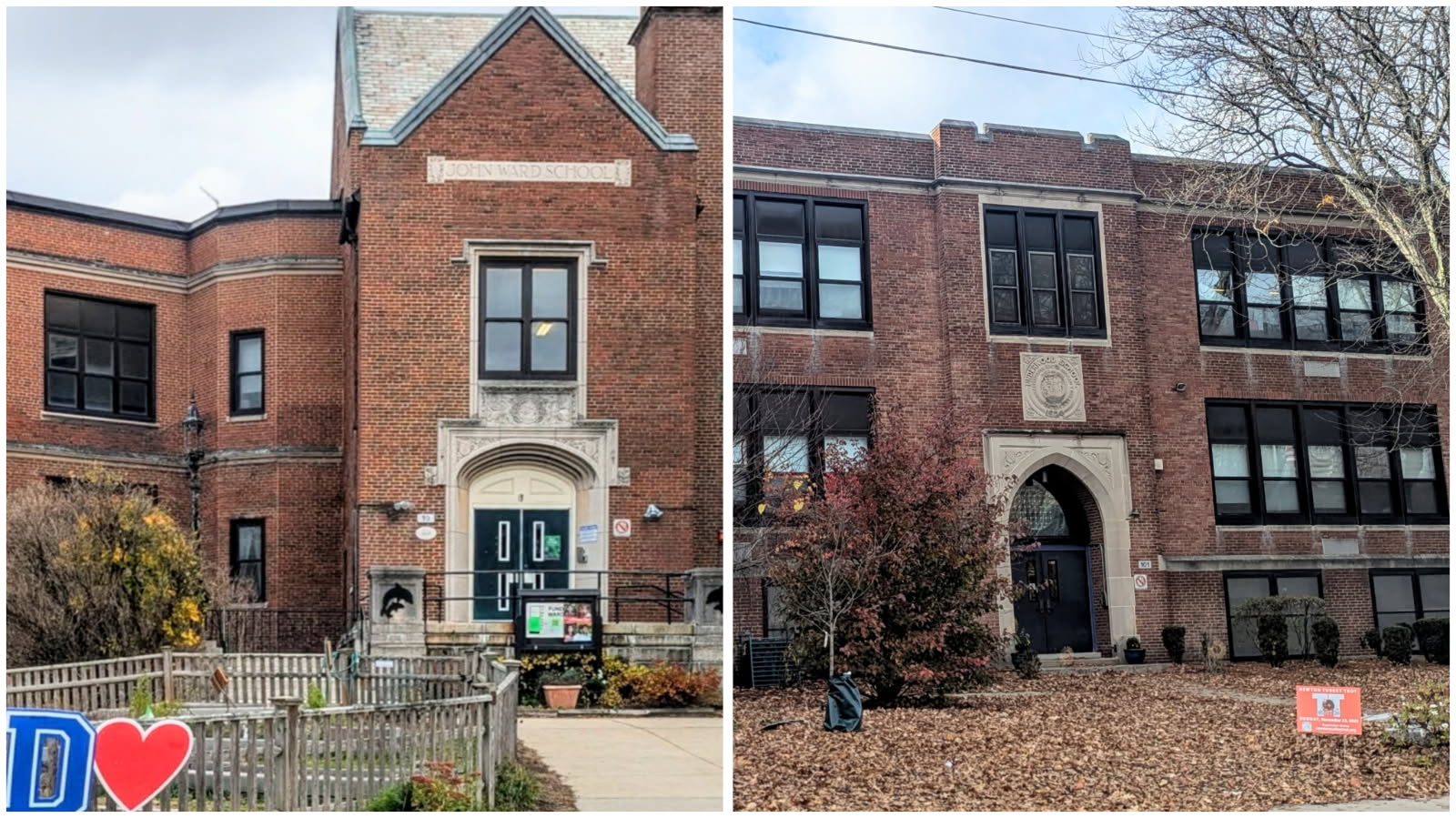
Ward Elementary School, left, and Underwood Elementary School, right, are in need of repairs. Photos by Bryan McGonigle
The Ward and Underwood elementary schools are each more than 100 years old and in need of repairs. And they’re both dealing with low enrollment, impacting the amount of programming and extracurriculars available in them.
Should the city close one of the schools and consolidate the students in the other? And if so, which school stays and which school meets the wrecking ball?
Parents and other community members gathered with the School Committee recently for a public hearing to talk about that. And comments tended to look at the big picture when it comes to school consolidation and what neighborhood schools mean to the community as a whole.
A group was formed in 2022 to figure out a plan for the schools, but Superintendent Anna Nolin shut the group down after she said it had devolved in to a “Lord of the Flies” situation, and that group had no official authority or direction.
Now, a long-range planning group—consisting of School Committee members Tamika Olszewski, Emily Prenner and Chris Brezski, Superintendent Anna Nolin, NPS Planning Director Stephanie Gilman and NPS Chief Financial Officer Liam Hurley—recommends the district submit a statement of interest to the Massachusetts School Building Authority for both schools and, as a required part of that process, “indicate a willingness to consider consolidation as part of that application,” Brezski said.
If the School Committee chooses to act on those recommendations next month, anything submitted to the MSBA would have to be approved by the School Committee, the City Council and the mayor in spring 2026.
“To be clear, what this is not: It is not a decision to close or consolidate any school, it is not a recommendation to close or consolidate any school, and it is not a foregone conclusion or decided policy,” Brezski explained. “This process will take years, and any decision that comes this December is binding on no one.”
The public hearing was one step in that long process, Brezski emphasized.
David Benjamin is a father of three kids who went to Ward and said his family has enjoyed the walkability that came with that school.
“We have walked to Ward, or biked, basically every day in this family for the last almost 10 years,” he said. “In zero-degree weather, in blizzards, no amount of rain has ever stopped us. It is that priceless to us to be able to walk to our neighborhood school.”
Benjamin’s daughter, Yael, spoke next and comically asked the Committee to “ignore the height” after she struggled to reach the microphone.
Yael agreed with her father’s points and added that kids need to learn some independence and not rely on extracurricular programs at Ward to give them emotional and mental growth.
“Kids do need to learn a bit of independence,” she said. “They can’t just be taught that all their boredom is solved by some gardening club.”
Elizabeth Gagnon, a psychologist who lives on Maple Avenue, had both of her kids in Ward when they were younger and said her family’s experience with that school helped shaped their lives as residents of Newton.
“And I’m saddened to think that future generations might not have the same opportunity,” she said.
Gagnon recalled living in East Boston years ago when a park near her home was demolished to build an extension of Logan Airport, prompting leaders there to pledge to create more parks and less development and inspiring the creation of the East Boston Greenway.
Today, in Newton Corner, Gagnon continued, development including a Massachusetts Turnpike traffic circle has impacted the village and cut it in half, leaving no center for gathering space. The village even had as library that was torn down years ago, forcing residents to go to Newton Free Library in Newton Centre.
“Because of the burden we have already shouldered, our neighborhood school deserves special consideration,” she said. “All of Newton, and additionally, neighboring communities, benefit from us having the traffic circle in our neighborhood. When it comes to asking voters from other parts of Newton to support the development of our new school, we need allies.”
Chris Moller and his family moved to Eldridge Street in Newton Corner two years ago for Newton’s public schools, “and because we could walk our daughter and son to school. That was one of the most attractive parts of moving to the Boston area for us.”
Moller said that while he understands the need to consider consolidation for the MSBA application, he wants city and NPS leaders to consider the value of village neighborhood schools.
“Underwood is a thriving, walkable school with a great playground and a great park,” he said. “It operates at a viable scale while staying deeply connected to its families. Nearly all of our friends in Newton Corner we’ve met on the playground. We don’t even have kids who go to Underwood yet, but we’ve already talked to people with toddlers who are our daughter and son’s ages, and we’ve talked about how they’d be in the same class and how excited we’d be.”
Emily Linendoll of Glendale Road has two kids in Ward Elementary School and has been involved with the Underwood community as well for the past year, and she said she doesn’t think the School Committee has done its job in defining what a neighborhood school is.
“And that is a guiding principle to what this conversation is, and I think what we’re hearing from everybody is that walking and community are two defining areas,” Linendoll said, urging the committee to focus on how the community would be impacted by a school closure.
Susan Thompson echoed that sentiment. She and her husband went to Underwood, and so did both of their sons.
“Really, all of our community, all of our neighborhood, we know from Underwood,” she said, adding that the now-closed library that Gagnon mentioned was also a community gathering spot.
“Every day, the people I see on the road, the people I recognize in my neighborhood, in the stores, we all went to Underwood together. We all went through Underwood as parents. We all volunteered. We were all there. If we prioritize, like other neighborhoods have done in Newton, that a community school is a necessity—is a hub, is important—then that should be the guiding principle for all of the actions going forward.”
There were several more commenters in the public hearing—which lasted nearly two hours and which you can watch in its entirety online.
A couple of weeks ago, Nolin and Brezski held a forum detailing the situation with Ward and Underwood, which you can also watch online.
Share This Story On:
DOUBLE YOUR DONATION:
Through a matching fund created by your neighbors and foundations, your gift to the Newton Beacon by Dec. 31 will be doubled until we reach $100,000 -- tripled for new donors!
Get story alerts
twice a week:
Related Posts




Upcoming Events