
midsummer
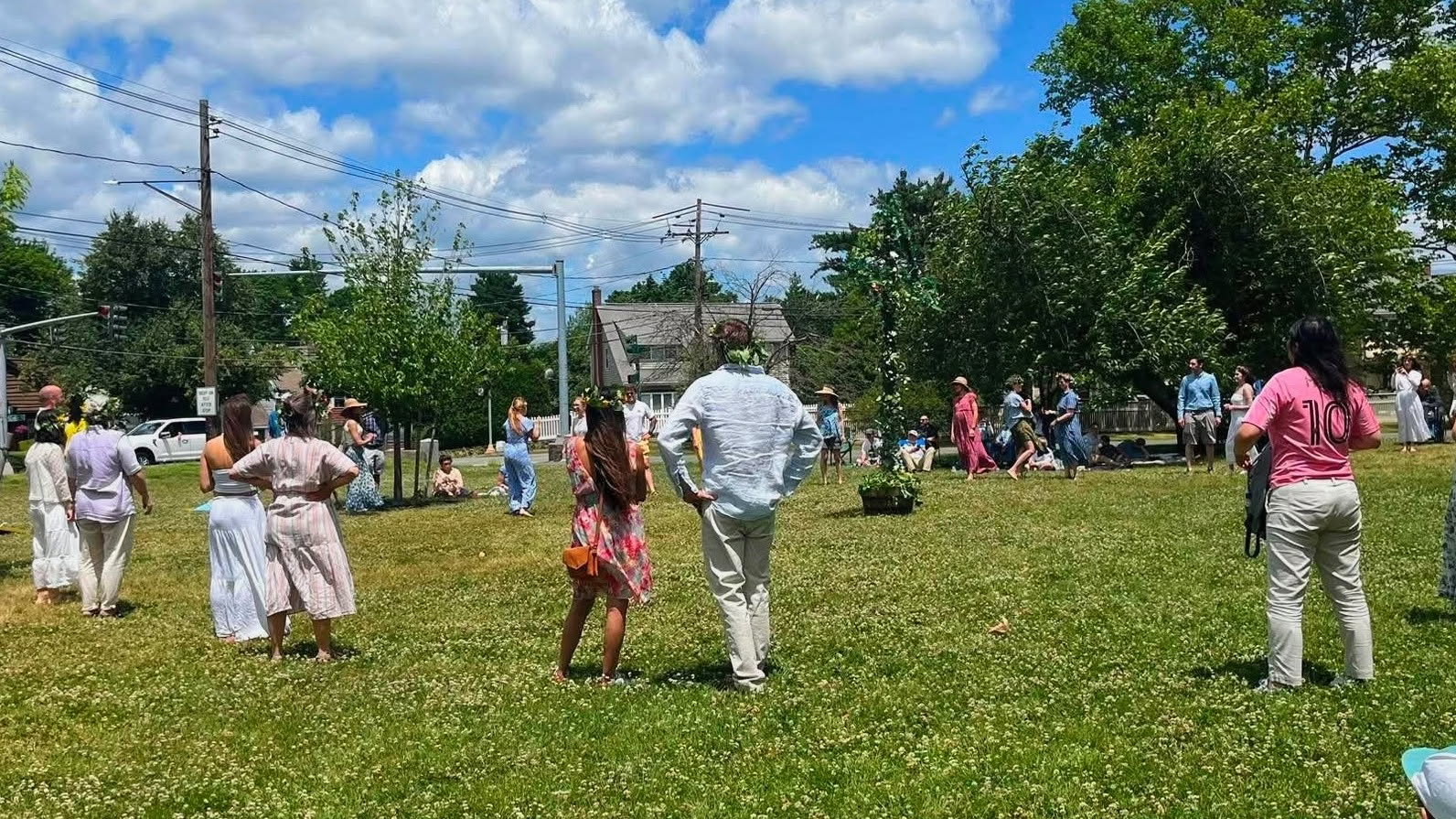
The Scandinavian Cultural Center's Midsummer Festival includes a traditional dance around a Maypole. Photo by Greta Gaffin
The Scandinavian Cultural Center in West Newton hosted a Midsummer Festival on Saturday, an annual Swedish tradition held on or near the summer solstice. It marks the longest day of the year and is a way to celebrate the end of winter. People make flower crowns and dance around a flower-covered pole while singing.
“It’s showing the abundance of the season,” said Elin Frank Anderson, board chair of the Swedish Women’s Educational Association in Boston. “It was originally a fertility festival—it goes back to pagan traditions,” she added. It’s not a religious festival, although one of the traditional songs at the festival is about a priest’s pet crow that tries to go for a ride without a driver and falls into a ditch, with an accompanying dance that involves mimicking falling over.
Among the variety of songs and dances was a song about a bear, in which several people act as the bear and try to tag those dancing. Those who have been tagged become the bear for the next round. Both children and adults participate. Anderson and other Swedish women who are part of the Swedish singing group Merulae also sang traditional Swedish songs, and more contemporary Swedish pop music was played as well via recording.
“I love it,” said Marie Mehegan, who is from Sweden but has lived in New Hampshire since 1987 and drove down for the event. “Midsummer is one of the biggest holidays in Sweden. All Swedes would be out in a field doing folk dancing.”
It’s an understandable time for joy after a long winter, especially since in a Swedish winter, it can get dark at 2:30 p.m.
“When you grow up there, you get used to it, but it’s so dark and cold,” she said—far worse than New England, which is much further south. Sweden’s northerliness, however, does mean that sunlight lasts longer in the summer, with sunset being around 10 p.m.
The festival also had traditional Swedish foods, like smörgåstårta or sandwich cake, which is a savory cake with seafood, Swedish meatballs, roasted beets, and prinsesstårta, a cake with raspberry jam and marzipan. While there aren’t Swedish bakeries in Boston, a Danish bakery with locations in Waltham and Medford makes princess torte.
“I love it. It’s so much fun,” said Scott Rohnstrom—who was helping with the food—about the Scandinavian Cultural Center. He was raised by a Swedish family on the South Shore and enjoys being able to continue to connect with the culture.
While the Scandinavian Cultural Center represents all five Nordic countries (Sweden, Denmark, Finland, Norway and Iceland), Sweden is by far the largest of the five and thus has the most immigrants in the Boston area. Swedish flags festooned the trees, and after the primary festivities were done, the Sweden/Netherlands World Cup game was shown inside. Other groups like the Swedish Women’s Educational Association partner with the Scandinavian Cultural Center to help promote Swedish culture in the Boston area and support Swedes who live in New England.
The event also attracted Swedish-Americans interested in their heritage, as well as some people from other Nordic countries (midsummer is also observed there) and Newtonians from other backgrounds who were just interested in another culture’s holiday.
The Scandinavian Cultural Center stopped publicly celebrating the festival for several years due to the COVID-19 pandemic, but this is the third year after it was restarted. It was a sold out event.
While Newton may not have winters quite as dreary as Sweden, after our own large snowfalls this year, celebrating warmth, light and flowers has a clear appeal.
Share This Story On:
DONATE TO SUPPORT LOCAL NEWS
Your tax-deductible gift to the Newton Beacon keeps our community connected and its residents informed.
Get story alerts twice a week:
Related Posts

Upcoming Events