
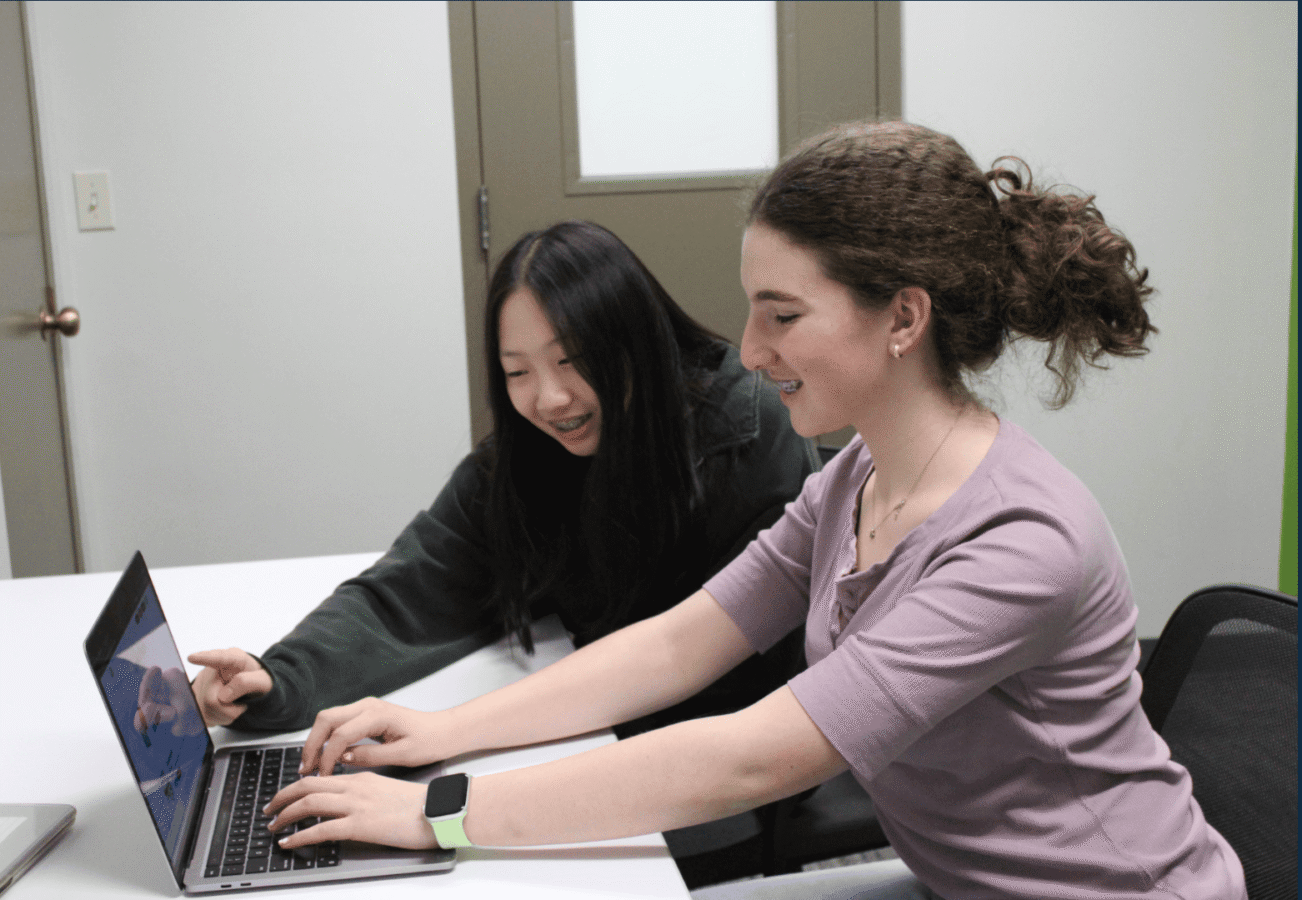
Fridman2
Eva Fridman and Chloe Jiang, co-founders of SySTEM Playground. (Courtesy of Fridman)
A Newton teen is launching an education nonprofit that will provide free virtual high school-level math and science classes to elementary and middle school students.
Eva Fridman, a rising sophomore at Boston University Academy, co-founded SySTEM Playground with fellow students Catherine Wang and Chloe Jiang. Classes will include statistics, economics, computer science and more—offerings that Fridman says are not taught elsewhere in an elementary and middle school student-friendly way.
“We’re not dumbing down any of the curriculum. It’s just working with the technical skills that they have at that age,” she told the Newton Beacon.
The program is sponsored by Hack Club, a nonprofit that supports teenage tech entrepreneurs.
“Hack Club provides free fiscal sponsorship to teenagers as part of our mission to enable young people to build real things in the real world. We’re happy to support Eva in building her nonprofit, SySTEM Playground,” said Christina Asquith, Hack Club co-founder.
SySTEM Playground is open to any student in the U.S. or abroad who speaks English and is between the ages of 9 and 13, according to Fridman. Each class will be offered once a year, either during the spring or fall semester. Fridman and her co-founders, along with a few of their friends, will create the curriculum for and teach each class.
Fridman has prior tutoring experience from serving as a math teacher at gbSTEM, a similar student-run education nonprofit that offers free virtual high school-level math and science classes to elementary and middle school students.
SySTEM Playground ran a pilot program in May. Fridman taught probability to one student, whom she said did very well in understanding the curriculum created entirely by Fridman and her co-founders.
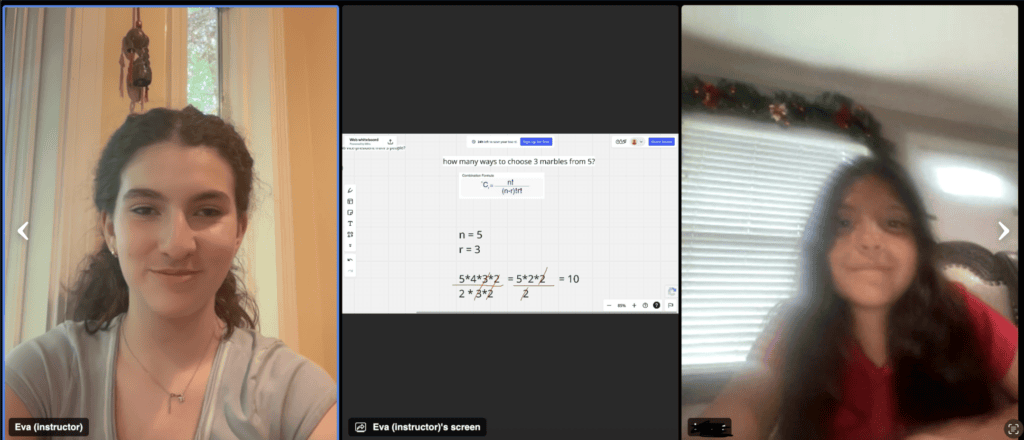
Eva Fridman teaching a student probability during the pilot program this past May. Courtesy photo
Fridman said the program’s curriculum is meant to be complementary to what students are learning in school, instead of supplementary. In her eyes, many education nonprofit are too underfunded to meet each student’s individual needs to help them succeed in school. She said she contacted the Newton Public Schools district as well as districts in Georgia that may have less access to tutoring resources to let them know about the program.
“This is really the only opportunity that these students have to be able to learn economics or object oriented programming,” she said. “YouTube videos might [only] be helpful for college students who can sit through a lecture and not get bored or not need an interactive element.”
All classes will take place virtually once a week for an hour, except for math, which will be held twice a week. Fridman said she used AI to create dozens of unique practice problems and that she will teach probability and statistics in the upcoming school year. She also plans to assign a lot of homework so that students retain what they are being taught.
“The fact that they are kids is not a weakness,” she noted. “It’s just that they are interested in different things than older people, and I think we have to tailor the curriculum to include game aspects … and show them real world applications.”
The classes will be made interactive by holding friendly competitions and encouraging collaboration. Fridman said that even in a setting where she is teaching kids who are 11 years old and kids who are 13 years old, the age difference disappears after asking them a simple question.
“I start off each class by saying, ‘Do you guys want to be treated like adults or like children?’ And I can guarantee that every single one of them will say ‘adults,’” she said.
Fridman said she has learned a lot of respect for teachers in the process of launching SySTEM Playground. The Newton teen has wanted to be a synthetic biologist since she was nine years old and says she has a passion for education and entrepreneurship.
“This is not the last company I’m going to start,” she said. “I want to do genetics and synthetic biology but I also know that I want to start companies.”
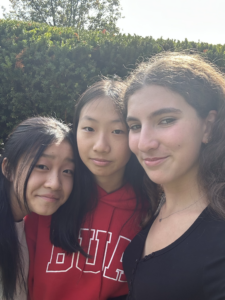
Eva Fridman and her SySTEM Playground co-founders, Chloe Jiang and Catherine Wang. Courtesy photo
Fridman said extracurricular classes helped shape her life, but that she understands many families can’t afford outside tutoring. Her hope is that SySTEM Playground will spark curiosity in STEM subjects from a young age and open doors that could lead to internships and other opportunities.
“The reason why it’s called SySTEM playground is because it’s a playground,” she said. “You can mess up, and I think that’s pretty inviting for kids who are afraid of getting the wrong answer.”
In an ideal world, these subjects would be taught in school from a younger age so that fewer kids graduate high school thinking that STEM is not for them, Fridman said. But for now, she finds outside learning to be the best option.
“I think reinforcing extracurricular programs is much more realistic and probably a better solution than just adding more blocks to school,” she said. “I think anyone can be interested (in STEM) if there’s the right teacher and the right subject taught.”
Share This Story On:
DONATE TO SUPPORT LOCAL NEWS
Your tax-deductible gift to the Newton Beacon keeps our community connected and its residents informed.
Get story alerts twice a week:
Related Posts




Upcoming Events