
CULTURAL NEWTON
Newton’s annual Open Studios, held last month, is one of the city’s cultural highlights. More than 100 artists shared their work with the public, inviting visitors going into studios, homes, schools, nonprofits, and community spaces to experience creativity up close.
For visitors, Open Studios can be an opportunity to step directly into the creative process. We are often welcomed into deeply personal spaces, sometimes one on one, to see not only finished pieces but also how some artists bring their works to life. Others exhibit collectively and connect with the wider community.
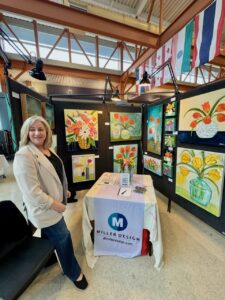
Newton artist Deborah Miller at Newton North High School. Photo by Gloria Gavris
What’s clear is that Newton residents value living in a creative community. We show up for it. We bring our children. We linger in studios and talk with artists. In a world convulsed by Covid and being reshaped by the rapid rise of artificial intelligence, Open Studios offers something increasingly rare: direct connection with people using their hands and minds to create.
But if Newtonians value creativity as part of community life, we also need to ask a hard question: Who will be able to afford to create in Newton in the future?
While it’s easy to view Open Studios primarily as a way for artists to sell work and for collectors to buy it, that’s only part of the story. Viewed through a broader lens, Open Studios tells us something important about the health of Newton’s cultural ecosystem.
At the Mayor’s Community Prayer Breakfast on May 27, Boston Pops conductor and Newton resident Keith Lockhart reflected on the difficulty of quantifying the impact of the arts.
While communities often look for metrics and economic data to justify cultural investment, some of the most important impacts, he noted, are qualitative. They’re human, emotional and harder to measure.

Exhibiting artists at the Villa in West Newton. Photo by Gloria Gavris
That observation stayed with me while thinking about Open Studios.
Like many communities in the Boston area, Newton faces extraordinary housing costs. For working artists—many of whom piece together income through freelance and project-based work—the barriers can be even greater. Long before the phrase “gig economy” was commonly used, artists were already living it.
Open Studios quietly reflects this reality. Because the event takes place largely in private homes or institutional spaces, it raises a larger question about who has access to the kind of physical space required not only to create work but to exhibit it.
Over time, the structure of Open Studios has shifted. Fewer artists appear to be opening private studios and homes, while more exhibit in schools, nonprofits and shared venues. That evolution may reflect changing economics, changing demographics, or changing needs—but it’s worth paying attention to.
Cultural ecosystems do not sustain themselves automatically.
Historically, artists have always relied on some form of support. During the Italian Renaissance, artists depended on patrons to provide financial backing and stability while they developed their craft. Today, artists still rely on scaffolding through grants, awards, affordable space and public policies that make creative life possible. Increasingly, municipalities across the country are recognizing this reality.
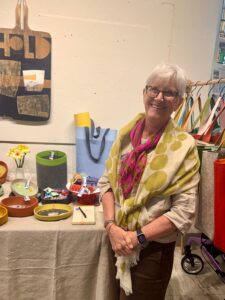
Newton artist Kim Spencer at the New Art Center. Photo by Gloria Gavris
Communities like Boston, Somerville, Cambridge and Providence have experimented with artist live/work housing, adaptive reuse projects, affordable studio initiatives, and zoning strategies designed to retain creative workers. These communities understand something important: supporting the arts means supporting artists themselves.
Housing, in other words, is cultural policy.
Newton has already experimented with this locally through the Claflin School Studios project in Newtonville, which transformed a former school building into artist-oriented live/work condominiums. It demonstrated that artist housing is not an abstract idea imported from elsewhere. It can work here in Newton.
But projects like Claflin remained isolated efforts rather than part of a larger municipal strategy to retain artists and support creative life across generations.
That distinction matters.
Communities that successfully sustain artists over time tend to treat creative space, affordability and cultural planning as interconnected issues rather than separate conversations. They recognize that cultural vitality depends not only on a city’s programs, but on whether creative people can realistically build lives there.
Newton has begun building stronger municipal infrastructure for arts and culture through the creation of the City’s Arts & Culture Department. But if we are serious about building a vibrant, innovative and inclusive cultural community, the conversation must expand beyond programming and events.
It must also include the conditions that allow artists—especially younger and emerging artists—to live here.
A cultural Newton cannot simply be a place where art is presented. It must also be a place where artists can afford to imagine a future.
Emily O’Neil is a Newton resident, former Executive Director of the New Art Center, and former Co-Chair of the Newton Cultural Council.
Share This Story On:
DONATE TO SUPPORT LOCAL NEWS
Your tax-deductible gift to the Newton Beacon keeps our community connected and its residents informed.
Get story alerts twice a week:
Related Posts




Upcoming Events