
slovakiacover
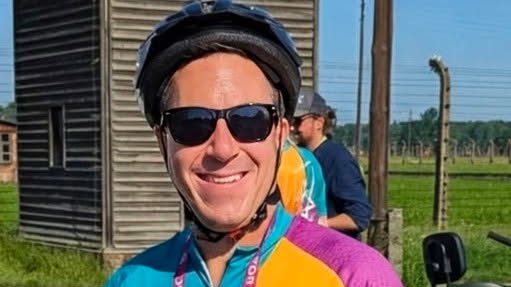
Matthew Fogelman visited Slovakia recently to trace his roots and his family's journey to freedom. Courtesy photo
Newton lawyer Matthew Fogelman had a very meaningful summer vacation: visiting the parts of Slovakia his grandparents left behind when they fled in the 1930s. He wanted to see the places where his family had lived—and died.
Fogelman’s grandmother Gertie was the youngest child of 11 in a small Jewish community in Slovakia. In the 1930s, Nazis were on the rise, and their desire to exterminate the Jewish people was obvious. A relative who lived in the United States could send money for just one ticket to America, and Gertie, who was 16 and had no spouse or children, was sent to the U.S. Her parents and all but one of her siblings would be killed in the Holocaust.
It was in the United States that she met her husband, a fellow Slovak Jew who was also a recent emigrant. His family, too, would be killed. They raised their two children in New York. They didn’t talk much about their homeland: it was too painful. But 30 years ago, Fogelman sat down with his grandmother and a tape recorder, hoping to hear the memories of the village she left behind. “I remember hearing that interview and thinking: I want to go there someday,” he said.
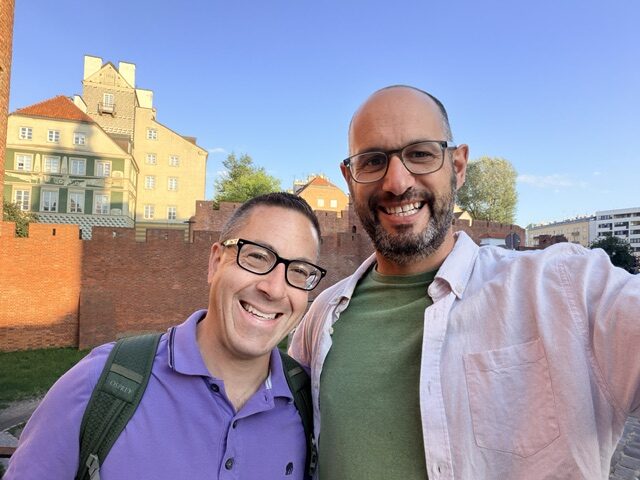
Matthew Fogelman, left, shown here with his friend, Jonah Sachs, visited Slovakia recently to trace his roots and his family’s journey. Courtesy photo
But it took him time to get there. He moved to Massachusetts to attend Boston College Law School. He focused on raising a family with his wife, Newton native Amy, and building up his employment and personal injury law practice. But then he saw the 2024 film “A Real Pain,” about two Jewish cousins doing a family heritage trip to Poland. He and his friend Jonah Sachs decided they wanted to do their own trip, visiting Poland for Sachs’ family and Slovakia for Fogelman’s.
He paid a local guide to help him find records for Cejkov, his grandmother’s tiny home village in eastern Slovakia about 10 miles from the Hungarian border. The village had a small Jewish section, with maybe 15 families. The buildings don’t remain, but Fogelman knew where the neighborhood was. “I just kept thinking about walking on the same ground they walked on,” he said. He also visited his grandfather’s home in the nearby city of Košice, which was particularly meaningful because the city’s synagogues are still there.
He also went to Auschwitz, where some of his relatives were killed. “Standing in the village was one thing, but standing in the concentration camp knowing they died there was another … it was hard to process,” he said.
At the end of his trip, Fogelman participated in the Ride For the Living, a charity bike ride that starts at Auschwitz and ends at the Jewish community center in Krakow, Poland.
“The Nazis wanted to kill all Jews, but they didn’t kill everyone. You go there and you’re proud to demonstrate—we’re still here,” he said. He was grateful for his fellow lawyers in donating and helping him raise $20,000 to support the small Jewish community in Krakow.
If he has any advice for Newtonians who might like to do their own family trip, it’s to make a plan. “Do as much work as you can beforehand,” he said. He’s also glad he and Sachs hired local guides for Poland and Slovakia, although he recommends leaving some time to explore on one’s own. On the other hand, don’t overschedule yourself, and allow for the possibility of something unexpected happening, like having a long conversation with someone in a village. “Leave room for the unknown,” he added.
Share This Story On:
BEACON SPONSOR

DONATE TO SUPPORT LOCAL NEWS
Your tax-deductible gift to the Newton Beacon keeps our community connected and its residents informed.
Get story alerts twice a week:
Related Posts





Upcoming Events