
TASTE OF NEWTON
The Newton Farmers’ Market, now in its 47th year, started in so much chaos that there was little clue it would one day become one of the longest-running farmers’ markets in Massachusetts.
Operated by the City of Newton, the first market set up outside of the War Memorial Auditorium at Newton City Hall. Judy Dore, who retired as market manager in 2020, remembered “maybe 10 trucks on opening day” in 1979.
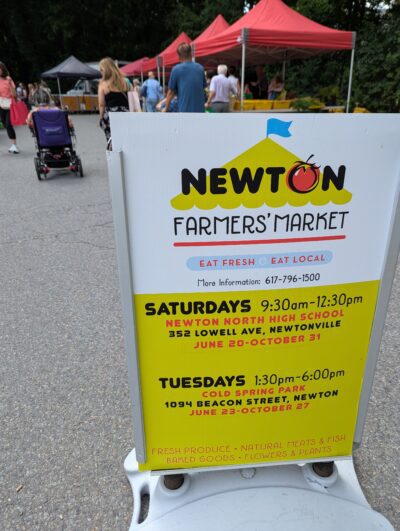
Newton Farmers’ Market is held at two locations. Photo by Clara Silverstein
That same day, Dore said, “The young man who was supposed to be the market manager said, ‘I hate this! I quit.’” Dore stepped in, even though, she said, “I didn’t know one darn thing about farmers. But I eat vegetables and I like people.”
She didn’t even have a sign for the market. The farmer from Wally’s Vegetables in Haverhill returned the following week with a farm scene painted on the side of his truck to help attract customers.
Steadily, Dore said, word spread and the Newton market became a success. Its growth paralleled the public’s renewed interest in locally grown produce and the farm-to-table movement.
The Massachusetts Department of Agriculture now lists more than 200 farmers’ markets in the state. At the time Newton’s market opened, Dore said, only Brookline and Boston hosted other farmers’ markets. (Haymarket, in downtown Boston, opened in 1820).
The Newton Farmers’ Market now operates in two locations (Tuesdays at Cold Spring Park and Saturdays at Newton North High School). Approximately 800 to 1,200 customers shop each Tuesday and another 400 to 600 each Saturday, said Nancy Scammon, one of the market managers.
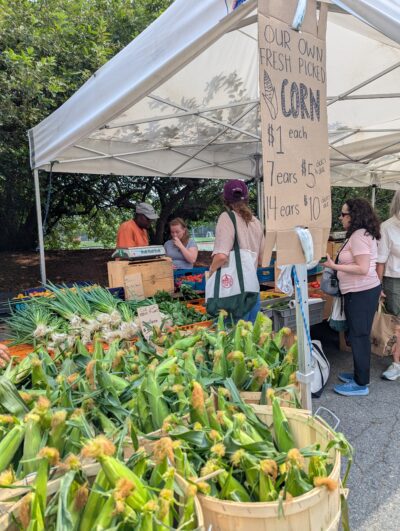
Corn sold at Farmers’ Market. Photo by Clara Silverstein
Products for sale now go far beyond fresh produce, among them flowers, baked goods, chocolate, fish, and prepared foods. Some vendors also accept HIP (Healthy Incentives Program), part of SNAP food assistance.
In late summer, farmers’ market vendors are likely to sell tomatoes, corn, zucchini, bell peppers, and early apples. The selection of produce changes during the June through October season.
Shoppers tend to have different habits at each market, Scammon said. The Cold Spring market is more well established. “Some of the shoppers are laser-focused, just going for a few things. Some people just walk in the circle [where the vendors are set up] all afternoon.” The Newton North market, for its part, tends to attract families doing their Saturday errands with young children.
The market had to move from its original location at Newton City Hall when construction for the Newton Free Library began in 1989. Dore helped scout the new location and told the farmers, “Get in your trucks. We’re all going to Cold Spring Park. They didn’t want to move but I told them, ‘We have no choice.’” The first day at the park, Dore recalled, “It was a madhouse with cars coming in and out. We had to hire two policemen to direct traffic.”
A second market was added on Saturdays to help meet public demand. Its location moved over the years, including stints at American Legion Nonantum Post 440, Newton South High School, and West Newton Square.
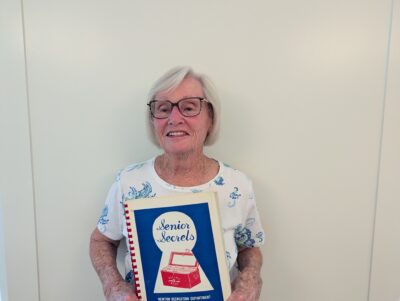
Judy Dore retired as market manager in 2020. Photo by Clara Silverstein
During her time as manager, Dore tried to raise awareness of the market by adding non-produce vendors and special activities, such as animal exhibits for children. She and her friends and family members even dressed up in fruit and vegetable costumes and marched in Newton’s Memorial Day parade. “I was a carrot,” she said. “We also had a strawberry, an eggplant, a pepper, and corn.”
Dore held other roles with the city’s Parks & Recreation Department and managed the market for more than 30 years. An annual Judy Dore Day, on August 4, was created in her honor in 2020.
Dore credits the Newton Farmers’ Market with improving her health. “The farmers got me eating fresh fruits and vegetables. I don’t cook but I like to eat. If I eat five fruits and vegetables a day, at the end of the night I’ve eaten a healthy diet.”
The market also contributes to the local economy. “A lot of vendors come in and out of the market,” Scammon said. “There are a lot of success stories from people who got a start there.”
RECIPE: In addition to managing the Newton Farmers’ Market for many years, Judy Dore directed a Senior Adult program with the Newton Parks & Recreation Department. In this role, she collected recipes from seniors in Newton and published several “Senior Secrets” spiral-bound cookbooks. One example: This recipe contributed by Faye Hays of the Parks & Recreation department in “Senior Secrets IV” (1987) takes advantage of fresh tomatoes likely to be found now at the Newton Farmers’ Market.
GLAZED BROILED TOMATOES
3 ripe tomatoes
3 tablespoons mayonnaise
1 teaspoon Dijon mustard
2 tablespoons finely chopped parsley
2 teaspoons finely chopped chives
¼ teaspoon salt
Pinch of pepper
3 tablespoons freshly-grated parmesan cheese
Heat the oven to 400 degrees. Cut tomatoes crosswise into ¾ inch thick slices. Place in single layer in baking dish. In a small bowl, combine mayonnaise, mustard, 1 tablespoon parsley, chives, salt, pepper, and 2 tablespoons parmesan. Spread mixture over each tomato slice, and sprinkle with remaining 1 tablespoon cheese. Bake until heated through, about 10 minutes, then immediately transfer to broiler and broil 6 inches from heat until topping is golden. Sprinkle with remaining 1 tablespoon parsley. Serve at once.
Clara Silverstein is a cookbook author with extensive knowledge of Newton history. She can be reached at clara@clarasilverstein.com.
Share This Story On:

DONATE TO SUPPORT LOCAL NEWS
Your tax-deductible gift to the Newton Beacon keeps our community connected and its residents informed.
Get story alerts twice a week:
Related Posts





Upcoming Events