
housingcover
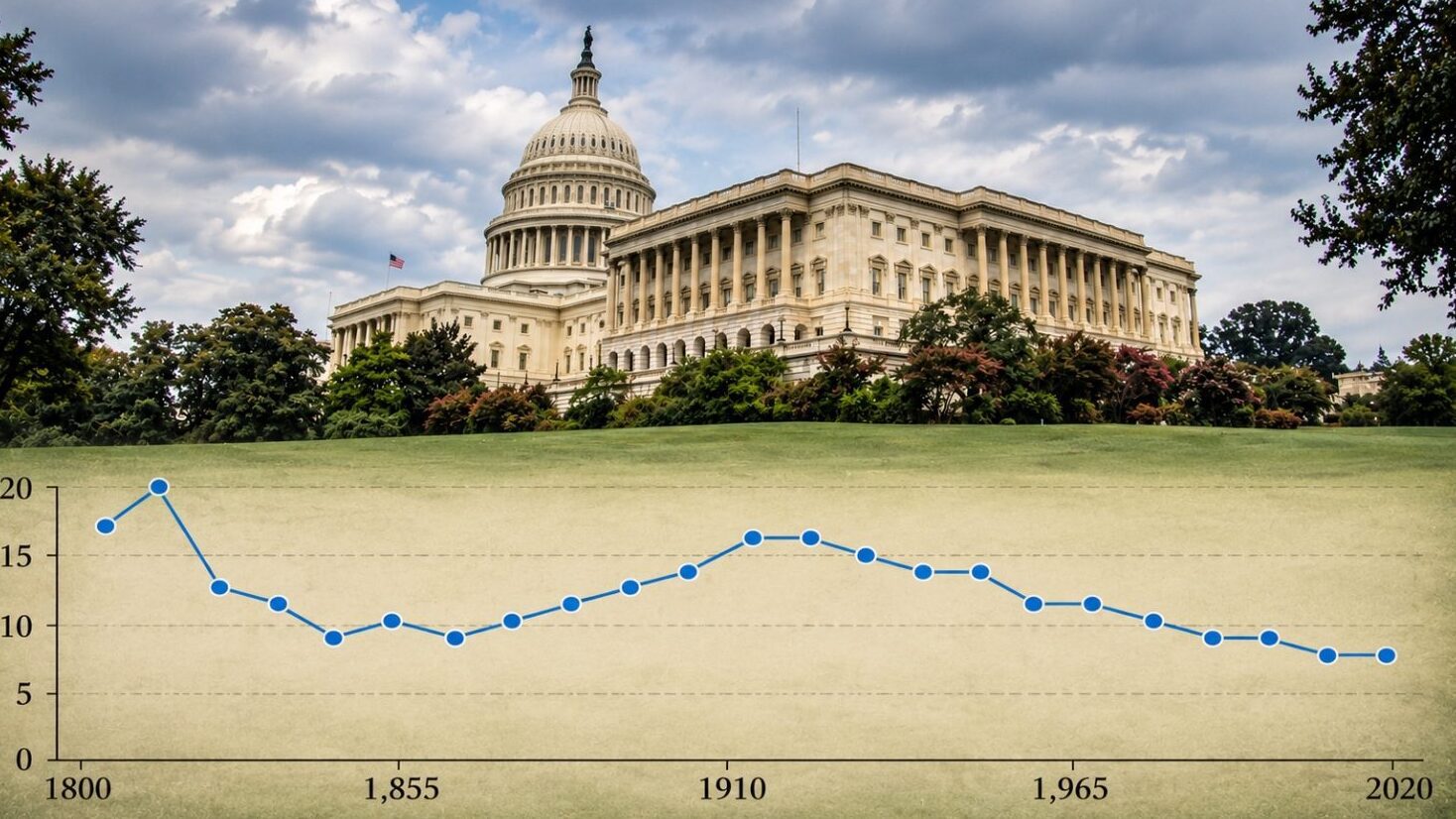
Massachusetts has seen its political power wane in recent decades as the state has lost congressional seats due to population disadvantages. Image created with Google Gemini AI
Housing advocates in Greater Boston have argued for a long time that adding more housing gives cities and towns more tax revenue, more diversity and a thriving community.
On Thursday, Newton for Everyone—a local nonprofit that promotes more housing diversity in the Garden City—hosted Boston University Political Science Professor Maxwell Palmer and U.S. Rep. Jake Auchincloss to talk about how housing stock correlates with political power in the federal government.
It’s actually simple. Every state gets two seats in the Senate and a certain number of seats in the House, and that number is based on the state’s population and a redistribution of the 435 seats in the House every 10 years. And the number of House seats a state has determines the number of Electoral College votes that state gets.
When a state has enough of a population boom, that state gets a new House seat. And when a state loses enough population, that state loses a House seat. The same 435 seats, newly apportioned according to where people are moving. And again, that House seat number determines the weight of that state’s presidential vote in the Electoral College.
Massachusetts has lost population in the past several decades, and that has resulted in the loss of three House seats since 1970. In the 2020 Census, Massachusetts was able to register just enough population growth to keep its remaining nine seats.
“Massachusetts has grown at half the rate of the rest of the country since 1990,” Palmer said.
Auchincloss has made the push for more housing a cornerstone of his tenure on Capitol Hill. In his six years so far in Congress, he’s watched the housing crisis balloon as what is known as a “K-shaped economy”—a phenomenon in which higher income earners thrive at the same time people on the lower end of incomes see stagnation or a financial decline—has widened a chasm between the wealthiest Americans and the working class in the wake of the COVID-19 pandemic.
“We’re 220,000 units of housing short in Massachusetts,” Auchincloss said. “It’s pricing out our middle class. We are right now seeing, as a state, domestic net outmigration of 20- to 45-year-olds. That’s the ideas. That’s the energy. That’s the new businesses. That’s the new jobs of our state, and you know it’s going to reduce our dynamism, both culturally and economically. It’s obviously cascading into our politics as well.”
The ups and downs
The period in which Massachusetts had the most seats in its history was between 1810 and 1830. After the 1810 Census, the U.S. House had 106 seats, and after the 1800 Census, Massachusetts had 20 of those seats, up from 17 before the reapportionment.
Then came waves of immigration, the Louisiana Purchase and American territorial expansion, and the total number of seats rose to 213 by 1830. After the 1830 Census, Massachusetts was down to 12 seats out of those 213.
The Permanent Apportionment Act of 1929 set the total number of House seats at 435. And the number of seats Massachusetts has held has fluctuated since, with a net decline of three seats since 1970.
In a polarized country with a deeply divided legislative branch, three seats can make all the difference. Currently, the Republican party holds a majority with 218 seats, while the Democrats have 214 seats, there’s one seat held by an independent member, and there are two vacancies.
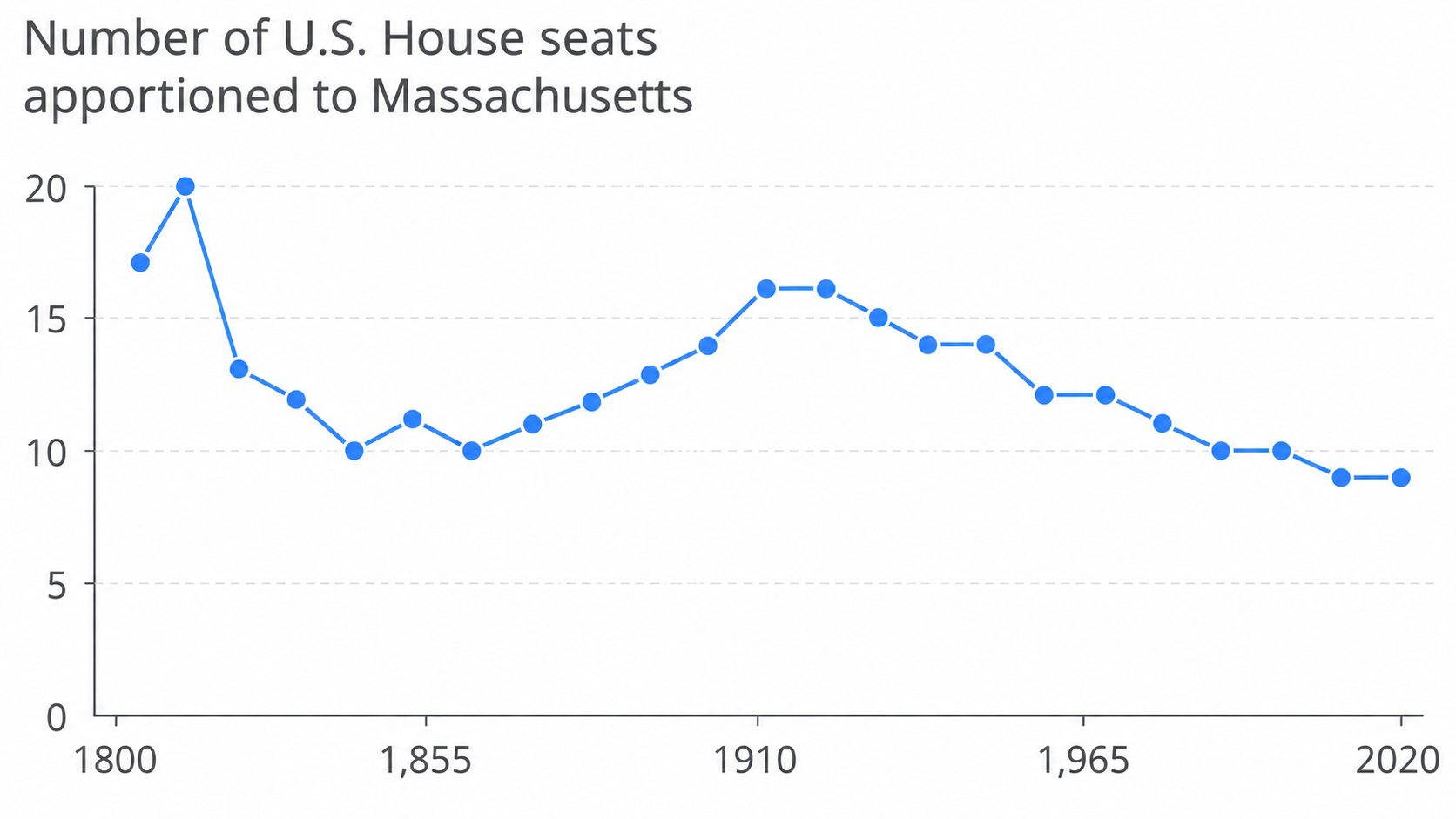
This chart shows the fluctuation of House districts in Massachusetts after redistricting, from 1800 to 2020. Image made with Census data and Google Gemini AI
The loss of political diversity
More House seats could also give more political diversity to Massachusetts’ congressional delegation.
Massachusetts is a Democratic-dominated state that hasn’t sent a Republican to the House since Republican Peter Torkildsen lost to Democrat John Tierney in 1996. And the continual loss in population relative to the rest of the nation has caused the state’s congressional districts to increase in area size, meaning the state’s conservative enclaves are absorbed into larger, more liberal swaths of the state to make congressional districts. And that means Republican areas of Massachusetts have no voice in Congress.
The South Coast area is a glaring example. Taunton, Fall River and New Bedford often have among the highest Republican vote counts in the state, and yet Taunton and Fall River are part of the 4th Congressional District, which includes Newton and Brookline, so the district consistently votes for a Democrat. And New Bedford is separated into the 9th Congressional District, represented by Democrat Bill Keating.
So, it’s arguable that having more congressional seats would allow greater political diversity in the state delegation, because progressive leftists, conservative Republicans and unenrolled independents would have a better shot against mainstream Democrats with more, smaller playing fields.
The exodus
Meanwhile, Palmer noted, states like Florida and Texas are gaining population and House seats. One of the fastest growing states in America is North Carolina, whose blossoming tech industry in the Charlotte area has lured New Englanders to warmer air and cheaper housing.
North Carolina is such a population poacher that Lt. Gov. Kim Driscoll mentions it when discussing the Healey administration’s ambitious housing agenda.
Massachusetts loses population to other states on net every single year. The tens of thousands of young adults who move to Massachusetts for college can’t plant their roots here after graduation because they can’t afford to stay. It’s an incessant bleed with serious social, economic and political ramifications for the commonwealth.
“And if we look further out, we can look at census projections going on to 2030, 2040,” Palmer continued. “There is no reason to believe this trend will change in any meaningful way, and actually, growth rates might continue to get worse.”
Massachusetts has been growing slightly, due to immigration. That part isn’t new: With every wave of immigration since the early 19th century, Massachusetts has seen population booms that have helped the commonwealth keep some political power as population dissipated across an expanding vastness that would become modern America. But now, Massachusetts is losing people to other states at a rate that can’t be offset by immigration for long.
“And if immigration declines, if we see decreases in this going forward, we’re going to see actual net population loss in the state,” Palmer warned. “Any bit of growth we have now is entirely because of new people coming in from outside of the country.”
It’s not just warmer southern states pulling people from Massachusetts. Some people are keeping their jobs in the Boston area and moving across state lines to New Hampshire and Rhode Island.
Consider this: Driving from southern New Hampshire or northern Rhode Island to Greater Boston takes around an hour, depending on the time of day.
“New Hampshire is a pretty small state, and we don’t often think of it as a big destination, but it’s actually one of the top destinations for people here in Massachusetts, because it’s affordable, relatively speaking, and often people can maintain their jobs and their commutes and stay roughly in their much greater community, moving say 50 miles instead of 500 miles,” Palmer explained. “Overall, neighboring states, especially New Hampshire as well as Connecticut and Rhode Island, make up 60 percent of our net population loss. These are people staying in New England, staying in the northeast, but who can’t afford to stay here.”
According to Zillow, the median sale price in Middlesex County is over $800,000 and Suffolk County hovers just above $750,000. Meanwhile, New Hampshire’s Rockingham County has a median sale price of slightly below $630,000, and Rhode Island’s Providence County has a median sale price lower than $455,000.
That’s a big savings on housing for the extra commute.
The trend, however, is destroying the Bay State’s power. Neither New Hampshire nor Rhode Island have gained any congressional seats from Massachusetts’ population loss. But as northeastern states shed population due to higher cost of living, southern states like Florida and Texas have added congressional seats and electoral college votes due to lower cost of living.
Projections for the 2030 Census show more potential congressional district losses for the northeast and midwest and the addition of more congressional districts in the south and southwest.
“So we’re going to see a continued shift away from the northeast, as well as from more liberal states to more conservative states, and this is going to be enough in 2030 to change the dynamics of presidential elections in some pretty meaningful ways,” Palmer said. “If you think about the key swing states of Wisconsin, Michigan and Pennsylvania, where that set was enough with the regular blue states for a Democrat to win, that’s not going to be the case in 2032 in that first presidential election.”

Max Palmer, associate professor of political science at Boston University, speaks about the relationship between housing and political power on Sept. 24, 2026. Photo by Bryan McGonigle
The state-local tug-of-war
If the problem is a shortage of housing inventory to meet demand, a logical fix would be more housing production across Massachusetts. People want to live near the jobs and the colleges and the culture. And developers have not kept up with the rising demand, making demand even stronger now as inventory is so low.
But in a state with relatively small land size and a hot demand for housing, politics can get messy.
“Housing politics is fundamentally local politics,” Palmer said. “It’s the politics of our communities. It’s fought on the ground in each city and town here. We’re permitting far fewer homes than we did even 20, 25 years ago. We are building more multifamily when we do build, which is a good thing, but one that we need to rapidly accelerate and increase.”
Massachusetts also has a local government system that produces hurdles for development. In other parts of the country, there are areas run by county government, not local government, allowing for much quicker development. Massachusetts has 351 municipalities, each with their own zoning ordinances, bylaws, and planning authorities.
“And in particular, every municipality has its own chart,” Palmer added. “You might know the rules for Newton perfectly, but the next town over, a few towns over, might have somewhat different rules.”
That variation was seen with the MBTA Communities Act. After years of debate, some communities only zoned for the exact number of units the new law required.
“So there’s just a huge amount of variation here that makes solving the problem at the state level really hard,” he said.
The people who show up to local government meetings related to zoning and planning tend to be homeowners and they tend to be older than average residents. Palmer suggested housing advocates attend these meetings to offset that imbalance.
And even local elections themselves serve as barriers, since most cities and towns have their local elections in odd years (as opposed to even years when state and federal elections bring more participation) or in the spring, making for low turnout. Low turnout local elections are dominated by older homeowners, too.
“And statewide, if you look at all the local elections, older homeowners are about 14 percent of registered voters, but 27 percent of those who turn out to vote in these off-cycle elections that don’t match up to any other election cycle, and these are also people electing representatives to Town Meeting,” Palmer said. “These are not the people looking to build a lot of housing in their communities, and they have a lot of voice in shaping what town meeting is going to be and how they go.”
The solution, it seems, may be state overhaul of local control over housing development.
Palmer pointed to a development in Wellesley in 2018. That year, the town spent about $3.5 million and a chunk of Community Preservation Act money not to build affordable housing (as the CPA is meant for) but to buy the land beneath a planned 40B development to prevent that housing from being built at all.
“The larger point is that whenever we look at a new approach to build affordable housing or market rate housing or any kind of housing, towns are always finding creative ways to stop it,” he said. “That’s one of the big challenges with state laws that leave things up to the town, like the MBTA Communities Act. When you let towns implement regulations, they will find ways to do the bare minimum. They’ll find ways to get around things, and they’re willing to spend real money and resources to do it.”
The ‘righteous political movement’
Auchincloss cautioned against putting too much emphasis on congressional seats and Electoral College votes when talking about the housing shortage, as most people are experiencing it at a personal level financially, not as a political argument.
“Yes, it could be a congressional seat for Massachusetts, which obviously is personal to me. But more immediately, and probably profoundly, too, it’s no secret that the Democratic Party right now is riven with some pretty deep divides and divides that really are generational in nature,” Auchincloss said.
He pointed to this year’s Democratic primary races across America in which challengers have run an insurgency from the left with a platform of fighting for affordability.
“And I get asked all the time, ‘Jake, what’s going on with the DSA? What’s going on? Why is the party shifting left or whatever?’” he said. “I’m not that interested in labels. I just think if the average age of buying your first home is 42 years old in America, it’s not unreasonable to look around and be like, ‘Whatever you call this system, if you’re calling it capitalism or democratic, I don’t like it very much because I can’t buy a home.’” And if we want people vested in a market-oriented economy, it probably helps if they can afford to have a mortgage and feel like they actually have some equity in that economy.”
Making homeownership attainable for the middle class again, Auchincloss emphasized, is what will benefit Massachusetts politically and culturally.
Auchincloss—a proud founder of the pro-housing “YIMBY Caucus” in the House—concurred that getting enough housing means going around local zoning control with state laws like the MBTA Communities Act, federal legislation like the 21st Century ROAD to Housing Act, and ballot initiatives like Question 7 this year, which is aimed at decreasing minimum lot sizes for single-family homes.
“So the YIMBY movement has basically, I think, politically been operating on this idea of zoning at the local level (with) some inherently exclusionary aspects to it,” he said. “It under-develops what the land can bear, and so with state and federal, or even by the ballot, we’re going to up-zone, and that’s a righteous political movement.”

U.S. Rep. Jake Auchincloss talks about housing policy at a Newton for Everyone event on Sept. 24, 2026. Photo by Bryan McGonigle
The soft gentrification?
When it comes to local zoning changes, Auchincloss recommended cities and towns try street-by-street upzoning, an “ultra-local” approach known as a “street votes” system that allows a very targeted approach.
“Street vote’ is when literally a street, like between two intersections, can decide—based on a menu of options given to them by the city council—with a 60 percent or 70 percent supermajority vote of all registered voters who are resident on that street, to upzone,” he explained. “So maybe they up-zone. We’re going to allow everybody on the street to have an ADU, or we’re going to allow everybody on the street to turn their single-family home into a duplex or a triplex, or we’re going to reduce the setbacks, or we’re going to allow lot division. Basically, it’s gentle gentrification, but on a street-by-street basis.”
This approach would be more appealing to residents and business owners in a community, because it “makes property rights arguable.”
Auchincloss believes voters will pass Question 7, which promotes the construction of more starter homes. But he doesn’t believe it would pass locally. A push for starter homes statewide feels abstract, he said, while a similar policy in local zoning would make people panic because it’s more real and more immediate. It’s what Auchincloss calls a “reverse Goldilocks” situation.
“It feels real, and yet the benefits don’t feel concentrated enough,” Auchincloss explained. “Where at the street level, you actually make those property rights negotiable. If you choose to upzone, Newton’s a great example because the land values are very high here, and it’s a very developable town. At the street level, 15 residents on that one street can go to upzone. Their property values are going to go way up. Like you will meaningfully see that increase in your property values if you go from single family to duplex zoning.
London incorporated such a strategy with its planning overhaul in 2021.
“I represent 35 cities and towns,” Auchincloss continued. “In most parts of the country, they would just be counties, right? When I talk to my colleagues from Indiana or Kansas, they’re like, ‘Wait, what? Like, you have 35 select boards? We just have a county commissioner.’ I’m like, ‘No, no, no, no, no. Mendon and Millville feel very, very differently about things, despite having 2,000 people in each town.’ So I think Massachusetts is actually very civically equipped to do this kind of hyperlocal governance in a way that I think can organically densify street by street.”
Housing advocates are going full-throttle against local housing development hurdles. Newton for Everyone, the group that hosted the event, is even gathering signatures for a citizen petition to force a public hearing and a City Council vote on zoning changes that would allow more density by-right.
Share This Story On:

DONATE TO SUPPORT LOCAL NEWS
Your tax-deductible gift to the Newton Beacon keeps our community connected and its residents informed.
Get story alerts twice a week:
Related Posts







Upcoming Events