
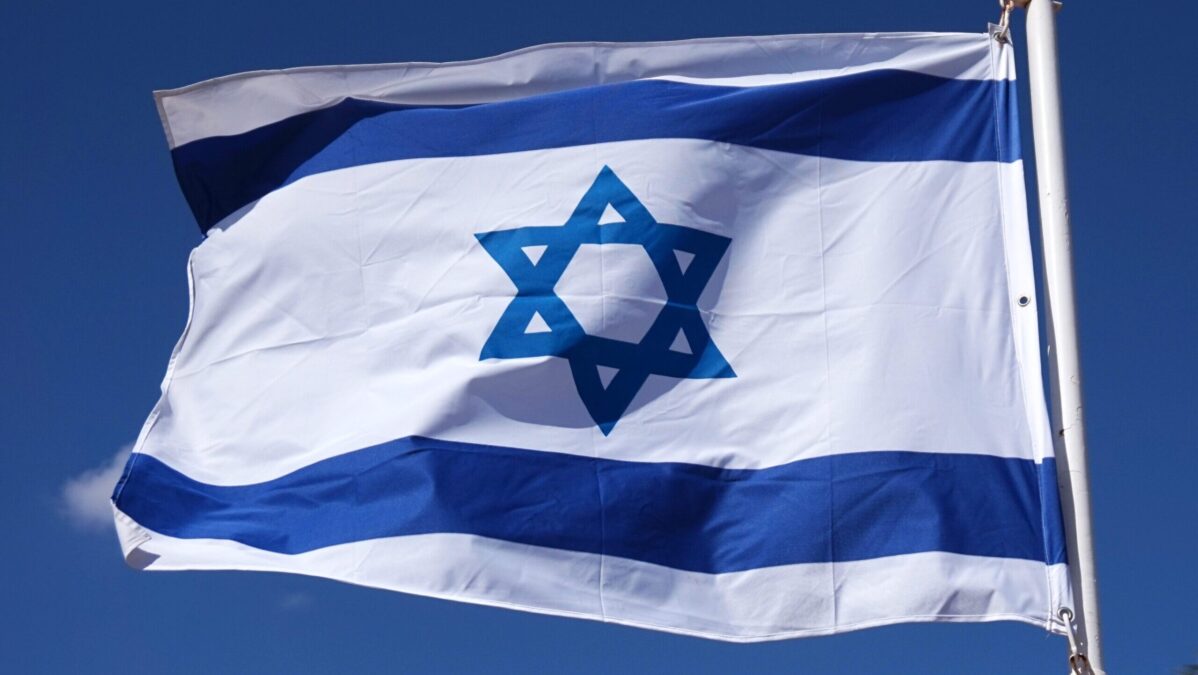
israeliflag
Israeli flag. Wikimedia Commons
The following was first published on Brookline.news, a nonprofit local news outlet that serves the town of Brookline.
****
Amir Grinstein has lived in the United States for 13 years. Come Oct. 27, the marketing professor will be in a voting booth in Israel, far from his Brookline home, hoping the ballot he casts will help oust Prime Minister Benjamin Netanyahu.
The “soul of the country,” he said, is at stake.
“It’s such a crucial moment,” Grinstein said. “It feels like in a soccer game, where they play 90 minutes, like it’s the 88th minute, where you can still steer the country in a good direction.”
Grinstein is among an estimate 50,000 expatriate Israelis that the New York Times reports are returning to vote in a “dead-heat” election that pits Netanyahu’s far-right government against an opposition led by centrist Gadi Eisenkot, a former military chief of staff who lost a son and two nephews in Gaza. Unlike many democratic countries, Israel largely does not permit absentee voting from abroad.
The election is Israel’s first since the Hamas attack of Oct. 7, 2023 that killed around 1,200 Israelis and saw 251 hostages taken to Gaza. It comes after a devastating war in Gaza that has killed tens of thousands of Palestinians, which the United Nations and others have called a genocide, a characterization that Israel rejects. The election comes, too, amid Israeli settler violence in the West Bank and a global increase in antisemitism.
Like Grinstein, most of the returning Israelis are expected to vote for political parties aligned with the opposition, according to the Times. In interviews with Brookline.News, six Israelis living in Brookline and Newton, home to some of the largest Israeli populations in the state, fit that mold.
“A decision about what kind of country Israel will be”
For the third time since they moved to the United States four decades ago, Kobi and Nurit Gilon, who live in Newton, are traveling to vote.
“I think this government lost touch,” Nurit said. “The only thing we can do as dual citizens, American and Israeli, is to use our vote.”
Yossi Landesman, a biotech scientist who lives in Brookline, moved to the United States in 1993. This is only the second time since then that he is voting in an Israeli election.
“This time I’m dedicating my time and my expenses to go and vote,” Landesman said. “I think the current government cannot stay there. Those who were in the role on Oct. 7, they cannot stay there.”
Landesman worries about increased threats to Israel from terrorists and about rising antisemitism around the world.
“During the pandemic I was in Israel, and I listened to my 96-year-old aunt describe to me when she was 12 in Germany, the rise of Nazism,” he said. “Some of those memories that she was telling me back then are resonating now.”
Eitan Berechman, 22, a self-described peace activist, is traveling from Newton to vote in Israel for the first time. Born in the U.S. to an Israeli father, he calls this election the most consequential in Israel’s history.
“It’s a decision about what kind of country Israel will be,” he said.
Tomer Cohen moved to the Boston area in 2022 and settled in Brookline the next year. He works in the tech industry and helped found a nonprofit organization that connects Israeli and Palestinian entrepreneurs. He describes a collective understanding that goes beyond the statistical insignificance of his individual vote.
“Everybody wants to take part in it, to make sure it’s a place where we are feeling comfortable with, and a place that represents good things like tikkun olam [repairing the world], and the innovation that comes out of Israel, all the things that make us proud to be Israelis.”
Travel brings challenges, opportunities
The Gilons drove to New York, where flights were less expensive than those from Boston. They are staying in a hotel, which they have been warned does not have a safe room. If air raid sirens blare, they will have 10 minutes to run to the underground parking garage from their room on the 22nd floor.
Visiting Israel for the first time in more than two years will also give them the chance to catch up with friends and family, as well as get their fill of their home country’s food and culture.
Grinstein plans to present at an academic conference while in Israel. The conference is one of many, Israeli news outlets have noted, that were apparently timed to coincide with the election.
“People are extremely motivated. The fact that people are flying from the U.S. is just one example of this,” Grinstein said.
Berechman, the peace activist from Newton, plans to take part in Protect the Harvest , which organizes volunteers to protect and accompany Palestinian farmers picking olives in the West Bank amid escalating violence by Israeli settlers.
Cohen, meanwhile, worries that the Netanyahu government may seek to restrict flights around the election. The Israeli newspaper Haaretz has reported, for example, that officials were discussing informal ways to prevent or significantly limit charter flights before the election.
“Even if my flight got canceled last minute, I’m going to still find a way to make it to Israel,” Cohen said. “If not by the air, maybe taking a boat from somewhere close in Europe.”
Election Day, Oct. 27, is just around the corner.
“10 p.m. Israeli time,” Grinstein said, “will be the moment of truth, when we know if we can breathe again.”
Share This Story On:
BEACON SPONSOR

DONATE TO SUPPORT LOCAL NEWS
Your tax-deductible gift to the Newton Beacon keeps our community connected and its residents informed.
Get story alerts twice a week:
Related Posts




Upcoming Events